Considered one of the most biologically important and endangered ecosystems in the world, the Upper Paraná Atlantic Forest encompasses portions of Brazil, Argentina and Paraguay and hosts multitudes of species, including some found nowhere else in the world. In addition, more Indigenous communities reportedly live in Paraguay’s portion of the Paraná than anywhere else in the country.
But this area of Paraguay is also home to relative newcomers. Between the 1920s and the 1950s, Mennonite communities immigrated to the region from Russia, Poland and other European countries, fleeing economic hardship and war.
Located in the department of Caaguazú, the Sommerfeld colony was founded in 1948 and has around 900 producers that are part of a cooperative that operates in different agricultural sectors including dairy, alcohol and flour production.
The cooperative produces some 10% of the country’s wheat flour and 5% of its pasta, according to the Millers Chamber of Paraguay. In addition, it’s the main milk provider for Lactolanda, a major dairy brand whose products are distributed across the nation.
Collectively, Sommerfeld producers operate on around 22,000 hectares (54,300 acres) of farmland. But in the 1940s, this farmland was forest where Mbya Indigenous communities lived.
 Recently cleared land in an Indigenous reserve in the department of Caaguazú. Image by Mario Silvero.
Mbya means “belonging to the forest,” but currently there are only a few forest patches left in the region’s scattered Indigenous territories. One of these is the reserve inhabited by the Pindo’i community.
Mongabay Latam reporters who visited the Pindo’i Indigenous Territory in October 2022 were greeted by large swaths of bare land and fragmented forest. Members of the Pindo’i community interviewed by Mongabay Latam — and who preferred to remain anonymous for safety reasons — said that the Sommerfeld Mennonite colony was responsible for clearing these large areas of cropland from the forest.
In April 2021, a Caaguazú member reportedly filed an official complaint against the colony after heavy machines cleared three hectares (7.4 acres) of forest and destroyed a body of water in the Pindo’i territory.
Deforestation of Indigenous territories has been banned by law in Paraguay since 2004, suggesting any deforestation that occurred in 2021 was done illegally.
The April 2021 incident was not have been the area’s only deforestation event in recent years. In May 2020, police from the town of Juan Eulogio Estigarribia, also in Caaguazú, sent a document to prosecutor Marta Leiva alleging forest was cleared on a Mennonite property near the Pindo’i community.
Oscar Rivas, former minister of the environment, told Mongabay Latam that during his tenure between 2009 and 2012, the ministry took actions to stop the expansion of Mennonite agriculture that was coming at the expense of Indigenous groups.
“We worked for the defense of three Indigenous communities for five years, and against the spread of plantations in their territory by the Sommerfeld Cooperative,” Rivas said.
 Local sources told Mongabay that forest is cleared by burning it, which invigorates the soil. Image by Mario Silvero.
A report sent by prosecutor Leiva to the Indigenous Institute (INDI), an organization that develops public policies concerning Indigenous Peoples in Paraguay, pointed to Indigenous leaders as responsible for the deforestation.
However, local journalist and community worker Ovidio González disputed this, asserting that individuals from the Sommerfeld colony were behind the clearing.
“Here Indigenous people don’t even have machetes,” he told Mongabay Latam. “All that deforestation has been the work of Mennonites for years, but no one is investigating [it].”
David Friesen, a representative of Sommerfeld, said the colony is not responsible for the deforestation.
“First, we don’t agree with those [clearings] and secondly I doubt a Sommerfeld settler is responsible,” he said. “And if that’s the case, then he isn’t collaborating with us. I can speak for Sommerfeld and I don’t think it’s one of our settlers.”
Alba Guillén, leader of Environmental Management at INDI, said the laws are clear. She said that the area’s Indigenous leaders, Mennonites, and non-Indigenous, small-scale farmers called campesinos all know that clearing forest in Indigenous territories is illegal.
An Indigenous resident who spoke to Mongabay Latam on the condition of anonymity said that the loss of forests is destroying the Mbya way of life.
“The Mbya live from what the forest gives us, but here there’s almost nothing left,” the resident said. He added that with a lack of alternatives, many locals are forced to work on Mennonite plantations.
An officer with the prosecutor’s office told Mongabay Latam that Mennonite colonists are responsible for the clearings “as they are the only ones with the capacity to own machinery for this activity.”
“The problem these communities have is a lack of support,” said journalist Ovidio González.
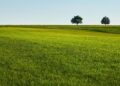
 Lone trees stand, relics amidst an expanse of farmland in the Parguayan department of Caaguazú. Image by Mario Silvero.
Paraguay is the world’s fourth largest exporter of soybeans, netting the country $2.15 billion in 2020 alone, according to analysis from the Observatory of Economic Complexity. While the farms of Caaguazú are responsible for a large portion of this output, it’s not the only Paraguayan department where crop fields are expanding at the expense of fragile ecosystems.
To the west of the Upper Parana Atlantic Forest lies the Paraguayan Chaco. Encompassing portions of Argentina, Brazil and Bolivia, in addition to western Paraguay, the Gran Chaco is a vast expanse of dry forest and savannas — or at least it used to be. As available arable land ran out in other areas — such as the Atlantic Forest — farmers and commodity companies turned their sights to the Chaco, transforming it into South America’s last agricultural frontier.
According to data from Global Forest Watch, the Chaco region lost 5 million hectares (12.3 million acres) of forest cover — an area larger than Switzerland — in the two decades between 2001 and 2021.
Despite being arid and semi-arid, Paraguay’s Chaco boasts high biodiversity, hosting nearly half the country’s plant species, according to Paraguayan botanist Fátima Morales.
Loma Plata and Filadelfia, two of the most major cities in the central Chaco region of Paraguay, are separated by 25 kilometers (15.5 miles) and were founded by Mennonite colonies in the first half of the 20th century.
“Everything that you see used to be pure forest and our ancestors lived here but now nothing belongs to us,” said an Indigenous resident of the Enhlet Norte group who lives in what is now Loma Plata and who requested anonymity.
 Satellite imagery captured February 2023 by Planet Labs shows most of the land around Loma Plata has been converted for large-scale agriculture.
One of the Chaco communities that have reported invasion of their territory is the Manjui Wonta – Santa Rosa community of the Manjui Indigenous group.
In 1998, INDI bought the land with the objective of making it available to the Manjui. However, the transfer of the land to the community was not legally binding. This opened it up to outsiders, such as Mennonite colonies, to settle and clear the land for agriculture.
Burkhard Richard Schwarz, a German geographer, historian and researcher with Tierra Libre – Instituto Social Ambiental and who is working with the Manjui Wonta – Santa Rosa community, said they have called upon government institutions to help the Manjui gain legal rights to their territory, but help has not been forthcoming.
Even protected areas in the Paraguayan Chaco are at risk, with satellite data and imagery from Global Forest Watch showing ongoing expansion of large-scale crop fields around and within El Chaco Biosphere Reserve, and very close to Defensores del Chaco National Park.
Schwarz said the bulk of deforestation in the Paraguayan Chaco stems from the massive economic and territorial expansion of Mennonite colonies across the region.
“The Mennonite system responds to a pattern that stems from the belief that the forest is unproductive land, that is, wasted land,” Schwarz said.
This is a translated and updated version of a story that was first reported by Mongabay’s Latam team and published here on our Latam site on Oct. 19, 2022.
Banner image: Deforestation in the Pindo’i Indigenous Territory. Image by Mario Silvero.
Feedback: Use this form to send a message to the editor of this post. If you want to post a public comment, you can do that at the bottom of the page.
Agriculture, Atlantic Forest, Biodiversity, Cattle, Cattle Ranching, Colonialism, Dry Forests, Environment, Featured, Fires, Forest Loss, Forests, Green, Habitat Destruction, Indigenous Communities, Indigenous Reserves, Indigenous Rights, Industrial Agriculture, Land Rights, Mata Atlantica, Mongabay Data Studio, Plantations, Soy, Tropical Forests
Latin America, Paraguay, South America
Source link : https://news.mongabay.com/2023/03/mennonite-colonies-linked-to-deforestation-of-indigenous-territories-and-protected-areas-in-paraguay/
Author :
Publish date : 2023-03-24 03:00:00
Copyright for syndicated content belongs to the linked Source.