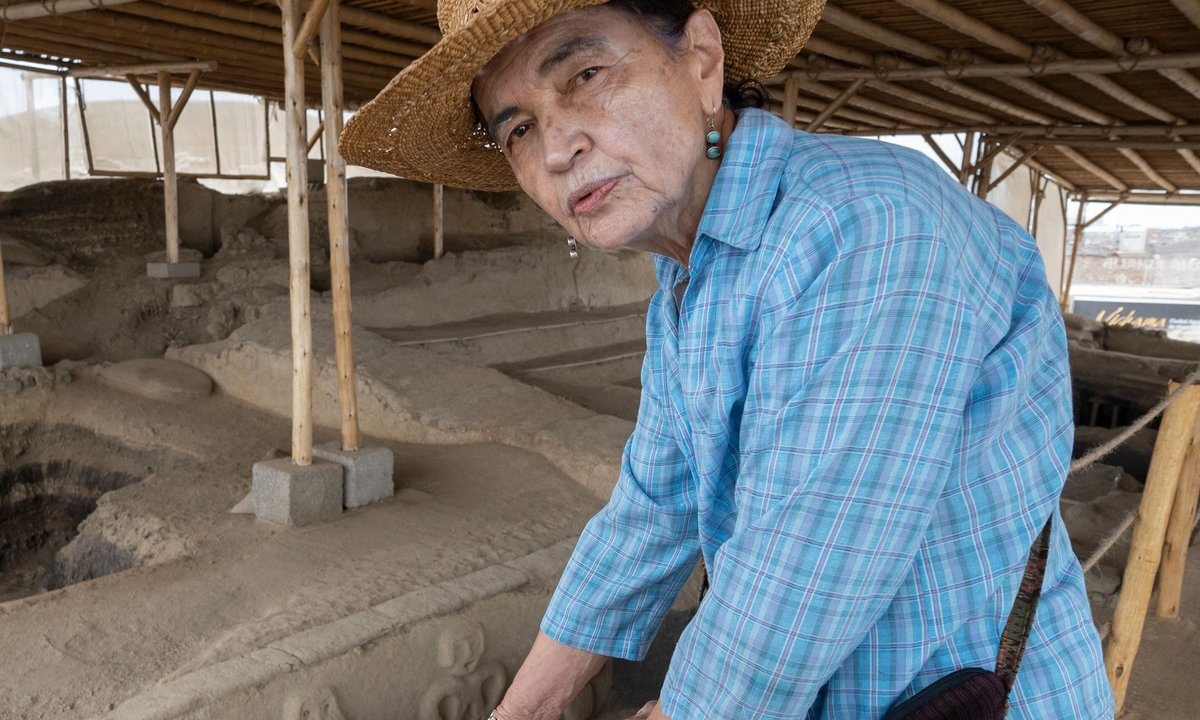
In 1994 on the north-central coast of Peru, 125 miles from Lima, a new wrinkle in the history of humankind was revealed by a pyramid once thought to be just a hill. An advanced and previously unknown ancient civilisation was discovered—a contemporary of the Sumerians, the Ancient Egyptians and the earliest Chinese societies. The Sacred City of Caral-Supe was declared a Unesco World Heritage site in 2009. Yet this past October, as the Caral archaeological site celebrated its 30th anniversary, its researchers were receiving death threats from local land traffickers eager to illegally get their hands on the surrounding territory, and perhaps some valuable artefacts.
The Caral civilisation, the oldest known society in the Americas, settled in the area nearly 5,000 years ago. Springing up in a narrow valley between the Pacific Ocean and the central Andes, it is considered the “mother culture” of Andean civilisation. A research team lead by Ruth Shady, Caral’s chief archaeologist, located 12 settlements belonging to the civilisation, where everything now associated with the Incas is believed to have originated: language, crop irrigation, the quipu knot system of record-keeping, temple architecture and art.
In the middle of Caral were six pyramids arranged around a central square. Alongside them, an amphitheatre and a temple. Between them, a bonfire contained a flame that would burn for eternity. The wind carried the flames through underground conduits to places where enormous permanent fires crackled on altars. (This required a knowledge of turbines—a technology undiscovered in Europe until thousands of years later.)
Around the amphitheatre, archaeologists found finely wrought musical instruments—cornets and flutes made from the bones of condors, llamas and deer. They also identified fragments of annatto, still used today by Amazonian cultures to paint their faces, season their food and as an aphrodisiac.
In the remains of the city of Caral-Supe, a Unesco World Heritage site, archaeologists have found evidence of a highly developed ancient society Mark Green/Alamy Stock Photo
Findings pointed to an extensive trading network, as many of their materials were not native to Caral’s territory but came from the high Andes and the jungle, more than 180 miles away. Analysing the food eaten by Caral’s inhabitants, Shady and her team found remains of fish that could only have come from the coast, more than 15 miles away. They also found an abundance of cotton, pointing to an extensive trade network between farmers and fishers, who used the material to make their nets.
Rich archaeology in a poor country
Over the years, Shady has navigated multiple adversities at Caral, often without any support from the Peruvian government. Since the mid-2000s, her research team has been under attack by land traffickers, who have at times received the support of corrupt local officials. In 2003, she almost died in an armed robbery as she arrived at the site with cash to pay her workers. More recently, one of her colleagues was attacked by traffickers. Several Caral researchers have resigned due to safety concerns.
The Caral archaeological site has also been affected by budget cuts in the past few years. In a recent interview, Shady said the budget allocated to research at Caral in 2024 had been slashed by nearly 50%, forcing her to lay off 80 local workers.
Pedro Novoa, the deputy director of research and conservation at Caral, has been working with Shady for 17 years, and he has seen just how little support Caral has received from the Peruvian government. “Peru is a privileged country in archaeological heritage—comparable to Egypt, Pakistan, China, Mesopotamia and Mesoamerica,” he tells The Art Newspaper. “There should be a policy regarding this cultural heritage with dedicated institutions and a special budget. But that budget will always be scarce in a country with deficiencies in education, health and basic services.”
Novoa adds that Shady “has a great interest in the connection of society to heritage—that a place of great value like Caral serves to reinforce the identity, improve the self-esteem and the quality of life of its neighbours.” He says that when the project started 30 years ago, “there was no road, no electricity, no water, no drainage. There were only farmers in poverty.” The site is important not just for its scientific research, but also as a creator of jobs in the community—the ones that were cut along with the budget.
The Caral prophesy
In November, Peru’s state news agency released a 20-minute documentary marking the Caral archaeological site’s 30th anniversary. Shady features prominently in the film, La Profecía de Caral: el Cambio Climático (the Caral prophecy: climate change), in which she draws a connection between Caral and climate change—but not in a way one might expect.
After almost 1,000 years of prestige, the Caral civilisation had to face very intense climate change
Ruth Shady, archaeologist
“After almost 1,000 years of prestige, the Caral civilisation had to face very intense climate change,” she says in the film, noting the extreme drought suffered there thousands of years ago. She sees the droughts around the world today (and their counterpart, flooding) and forest fires in the Amazon as indications that we are facing a phenomenon with similar characteristics—albeit much more industrial in nature. Shady also notes that “almost at the same time” that people from Caral were forced to abandon urban centres due to a drastically changed climate, the same thing happened in Northern Mesopotamia, Egypt, India and China.
“The collapse of this civilisation coincides with a global event called 4.2,” Novoa tells The Art Newspaper, citing a theory dubbed the 4.2-kiloyear event, a time of a severely changed climate throughout the world that took place 4,200 years ago.
In the film, Shady says that Caral is significant because of the “meaning and symbolism” its inhabitants left behind. She points to the friezes in the Caral city of Vichama, where archaeologists have found reliefs depicting squalid individuals with empty stomachs. Nearby, there is a frieze of a toad emerging from the earth. In Andean ideology, the toad symbolises fertility, water and moisture—a sign of hope.
Source link : http://www.bing.com/news/apiclick.aspx?ref=FexRss&aid=&tid=67850bcc2d96484f9ad4968062616555&url=https%3A%2F%2Fwww.theartnewspaper.com%2F2025%2F01%2F13%2Ffacing-multiple-threats-peruvian-archaeologists-remain-determined-to-research-the-americas-oldest-known-civilisation&c=11465077053541904335&mkt=en-us
Author :
Publish date : 2025-01-12 23:17:00
Copyright for syndicated content belongs to the linked Source.