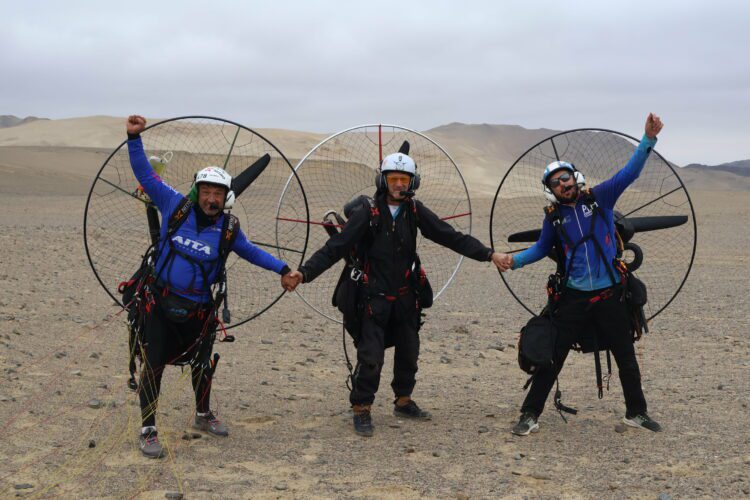
Paramotorist Marcio Aita Junior soaring over the Peruvian desert during the seven day expedition in 2022. Credit: Marcio Aita Junior
The expedition expenditure could only extend to seven intensive days in November 2022, with the scientists covering approximately 300 miles by land and air. The team surveyed huge areas of over 15,000 ha, but with limited time focused their efforts on the locally named “Tillandsiales” habitat, which is dominated by Tillandsia species (in the Bromeliaceae plant family, which includes other “air plants” and pineapples).
These species cover large swathes of Peru’s hyperarid desert, and they are poorly researched and mapped as their unique leaf surfaces act like an invisibility cloak; diffracting light in a way that makes them hard to track using satellite sensors.
Mike Campbell-Jones, Forest Air president and co-founder, says, “It was simply wonderful to bring the scientists and the pilots together, to put theory into practice and finally (after many FA COVID cancellations), have the chance to prove the combination for what it truly is—a valuable new tool for science and the many important tasks ahead.
“As a pilot, with many years’ experience, flying and directing competitions around the world, I must say, I have never been so motivated on a mission task or learned as much about our planet as seeing one of its most fragile ecosystems through the eyes of a scientist. The flights we made on this expedition as the Forest Air team were the most memorable of my long and colorful life.”
A faster, eco-friendly way to collect plants
The scientists were keen to see how paramotoring would compare to the ground team’s work across a typical range of plant survey activities. Their objectives included: measuring the respective damage to desert surface ecology, reconnaissance flights to identify plant populations, monitoring for threats and clandestine human activity, surveying the landscape through aerial photography, as well as collecting plant specimens.
In the latter case, the paramotorists flew two missions at distances of up to 28 km, with the longest mission lasting just over two hours. On average, they completed their missions 4.5 times faster than the ground crews and for longer missions it was estimated it would be up to 10 times faster. Moreover, paramotorists were able to survey huge areas, targeting and imaging specific regions not distinguished by drones or UAVs.
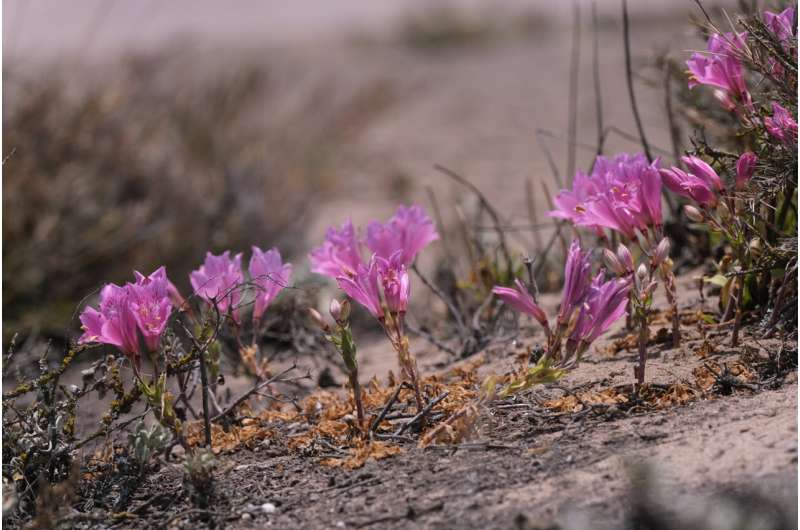
Plants in the lomas have adapted to the harsh desert conditions by drawing in moisture from fog sweeping in from the Pacific. Botanists trained the paramotorists in how to collect plant samples for DNA sampling, as well as specimens for herbarium vouchers, which were then taken back to the Royal Botanical Gardens, Kew in London, UK. Credit: Oliver Whaley
Another important measure of success was looking at the greenhouse emissions of both the paramotorists and the ground teams. On shorter ventures into the desert, the CO2 emissions were roughly equivalent, but in the longer missions, the ground team produced three times more CO2 than the flying teams.
The paramotorists excelled in terms of their negligible impact on the fragile desert surface, causing minimal damage by leaving only a few footprints on landing and take-off. Conversely, the authors demonstrate that 4×4 vehicles damage an area equivalent to a football pitch for every five kilometers driven and in fragile conditions for every one kilometer driven. The paper highlights that track compounded off-road vehicle tire damage is far-reaching, even able to cause dust storms, damage archaeology and destroy ecosystems and biodiversity.
Dr. Justin Moat, senior research leader at RBG Kew and National Geographic Explorer, says, “This study was a unique and exciting experience for everyone involved; for many years we have attempted to reach some suspected large areas of endemic vegetation in the Peruvian desert but found it very difficult to access without major damage to the desert surface using 4x4s, due to the harsh desert conditions and soft shifting sands.
“To overcome this challenge, we would have had to mount a major expedition, probably lasting weeks. Meanwhile, the paramotorists had flown great distances and returned with plant specimens and aerial photographic evidence of the vegetation within the space of two hours.”
Now, the study’s authors are hopeful their findings will help other scientists conduct fieldwork in environments that are too remote to access by normal means or otherwise extremely sensitive to human activities such as off-road driving. They also believe this novel approach to fieldwork will help inspire an interest in botanical science among a new generation.
Oliver Whaley, Honorary Research Associate at RBG Kew, says, “Plants are often ignored or outright taken for granted when we think about wildlife conservation, which is unfortunate as every single aspect of our lives depends on them. The planet is in serious trouble and with botanical sciences facing a precipitous decline just when we need it most, we have to think of new ways in which we can inspire people to take action.
“Our study shows that through an exciting and multidisciplinary collaboration, today’s extreme sports enthusiasts can work alongside scientists to help monitor ecosystems, and with some basic training, gather crucial environmental data, protect species and aid conservation efforts. By engaging local and international adventurers in our scientific work, we’re not only empowering them to take nature-positive action, but helping to safeguard our amazing planet—our Pachamama!”
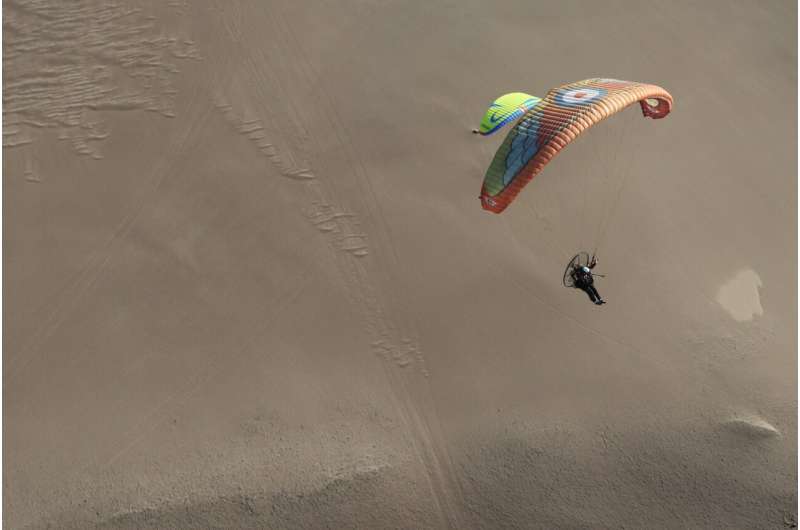
Paramotorists Márcio Aita Júnior and Senderson Laurido midair. The study found paramotorists can emit fewer greenhouses gases than 4×4 vehicles and cause less damage to the desert surface when taking off and landing. Credit: Mike Campbell-Jones
A conservation success
Finally, 20 years of hard work in Peru has paid off, as earlier this year through the joint efforts of RBG Kew, and Huarango Nature (with support of The Darwin Initiative, Sainsbury’s, Kew staff, legacy donors and others) a large area of lomas (surveyed by the work above) was declared as a reserve for conservation and known as the Lomas y Tillandsiales de Amara y Ullujaya.
Conservation of this globally unique fog oasis site, followed multiple rounds of intense negotiations and research with Peruvian authorities on both regional and national levels, and was protected as a concession for conservation by the Peruvian Government over an area of 15,689-acre (6,349 ha) to ensure preservation of its endemic biodiversity on the coast of Peru.
The reserve, which is home to many rare and threatened native species, has been mostly untouched by human activity, but recent years have seen the encroachment of urban development, off-road driving, windfarms and mining. It is now protected by an official Concession for Conservation. Even so, only 4% of the lomas across Peru and Chile are presently under protection.
More information:
Plants, People, Planet (2024). doi.org/10.1002/ppp3.10571
Provided by
Royal Botanic Gardens, Kew
Citation:
Extreme botany: Paramotorists soar across remote Peru desert to collect threatened plants (2024, September 24)
retrieved 24 September 2024
from https://phys.org/news/2024-09-extreme-botany-paramotorists-soar-remote.html
This document is subject to copyright. Apart from any fair dealing for the purpose of private study or research, no
part may be reproduced without the written permission. The content is provided for information purposes only.
Source link : http://www.bing.com/news/apiclick.aspx?ref=FexRss&aid=&tid=66f353265a9f40ceb138974d3c8da235&url=https%3A%2F%2Fphys.org%2Fnews%2F2024-09-extreme-botany-paramotorists-soar-remote.html&c=16292569218915495748&mkt=en-us
Author :
Publish date : 2024-09-24 12:00:00
Copyright for syndicated content belongs to the linked Source.