Miners began to return to “areas controlled by the police, then into other areas,” Silman added, as enforcement dwindled during the pandemic because officers were deployed to enforce a strict lockdown.
“Conservationists sometimes focus too little on enforcement, but without enforcement, there’s no sustainability,” he said.
While Operation Mercury raids went on into late 2020, from the onset of the pandemic in March 2020 there was a reduction in military and police presence at the bases, and deep budgetary cuts.
“The pandemic started and that was the turning point,” said Martín Arana, a consultant for the Foundation for Conservation and Sustainable Development in Peru, who has researched illegal mining in the country. The pandemic was a “substantial setback” for financing Operation Mercury, as funds from all ministries were redirected to deal with the public health emergency.
The government of then interim president Francisco Sagasti tried to refloat the antimining initiative with “Plan Restoration.” But the multiple ministerial changes that came with the new government of Pedro Castillo, in office from July 2021 until he was impeached in December 2022, made maintaining a consistent policy near impossible. In 2019, funding for the “reduction of illegal mining” in Madre de Dios and other regions in the country amounted to 33 million soles ($9.9 million at the time); this year, it’s down to 8.4 million soles ($2.2 million), according to government figures.
“All the political instability which continues to this day means everything that had been achieved is lost,” Arana said.
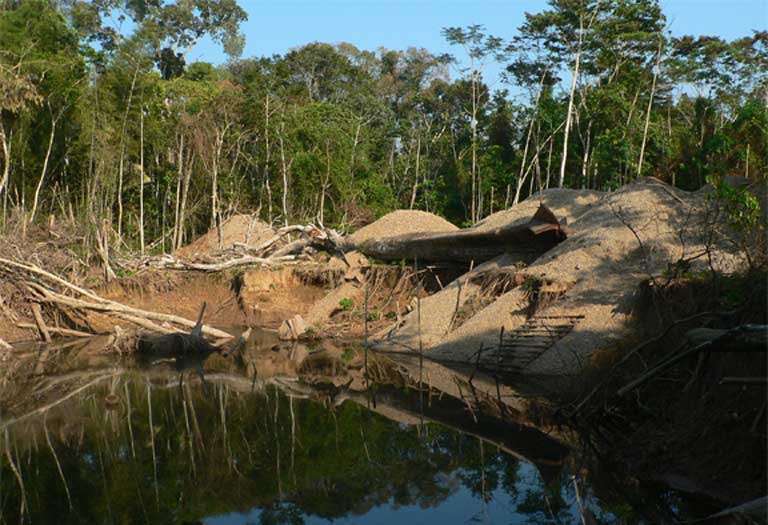 A flooded gold mine in Madre de Dios, Peru. Photo by Claire Salisbury.
Following Operation Mercury, mining decreased by 70-90%, the study found, and for the next two years, the miners had virtually abandoned almost all the areas targeted. The number of excavated mining pits or ponds in illegal mining areas decreased by up to 5% per year, compared to increases of 33-90% per year before the intervention.
Deforested areas experienced revegetation at a rate of 100-300 hectares (250-740 acres) per year. Most of the revegetation occurred on the edges of deforested areas, with the highest revegetation in southern La Pampa. However, this progress was more than offset by increases in deforestation in legal mining areas north of the Interoceanic Highway. Here, forest was lost at rates of 300-500 hectares (740-1,240 acres) per year, and mining pond areas also increased by 42-83%.
Satellite monitoring
In order to assess Operation Mercury’s impact on mining activity, the research team drew on satellite data from 2016 to 2021.
Using radar and multispectral data, they were able to quantify changes in water, water quality, mining pond areas, and deforestation in La Pampa from before, during, and after the intervention.
Mining ponds typically show up as yellow to brown; this color is associated with high levels of suspended sediment in the water — a marker for gold mining activity, Fernández said.
“We use the color changes in the mining ponds as a proxy for [mining] activity,” he told Mongabay. As mining ceases and ponds are abandoned, the sediment settles, and the degree of yellowness diminishes — a pattern the researchers found in the raided areas following Operation Mercury.
“Conversely, when it turns back to a cappuccino color, we know it’s being mined again,” Fernández added.
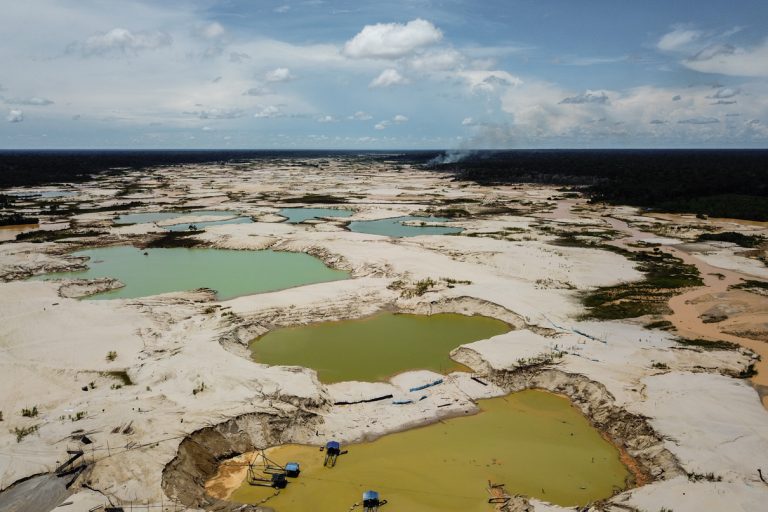 Mining ponds in the La Pampa area near Puerto Maldonado, Peru. Image courtesy Jason Houston/Upper Amazon Conservancy.
Recent MAAP satellite images show that mining infrastructure has returned, increasing by 400% in La Pampa compared to 2020. But unlike before, current mining takes place mostly in waste pits and lagoons because much of the forest cover has gone.
The return of illegal mining has brought with it the return of crime and violence, in many cases associated with transnational organized crime gangs. The vast majority of the mining activity is illegal or unauthorized, paying no tax and attracting crime groups involved in human trafficking, the sexual exploitation of underage girls, and modern-day slavery, Arana said.
“There are now bigger fish on the scene which are eating the previous ones,” he said, referring to the presence of new, more powerful organized crime groups.
Meanwhile, scientists continue to study the toxic impacts of residual mercury used in illegal gold mining. As wildlife returns to abandoned mining ponds, scientists are also studying the fallout, with results expected to be published soon.
“The worry is that you’re going to get the methylation of mercury as you start to build up organic matter, so you’re going to get a lot of mercury cycling,” Silman said.
As illegal gold mining continues to proliferate in the Amazon, Madre de Dios serves as an example that the state’s presence is key to controlling its spread, Silman said.
Citation:
Dethier, E. N., Silman, M. R., Fernandez, L. E., Espejo, J. C., Alqahtani, S., Pauca, P., & Lutz, D. A. (2023). Operation Mercury: Impacts of national‐level armed forces intervention and anticorruption strategy on artisanal gold mining and water quality in the Peruvian Amazon. Conservation Letters, 16(5). doi:10.1111/conl.12978
Banner image: Gold mining in the Peruvian Amazon. Photo by Rhett A. Butler.
Related reading
Qualified success: What’s next for Peru’s Operation Mercury?
FEEDBACK: Use this form to send a message to the author of this post. If you want to post a public comment, you can do that at the bottom of the page.
Amazon Destruction, Amazon Mining, Amazon Rainforest, COVID-19, Deforestation, Drivers Of Deforestation, Gold Mining, Illegal Mining, Law Enforcement, Mining, Tropical Deforestation, Tropical Forests
Latin America, Peru, South America
Source link : https://news.mongabay.com/2023/12/perus-crackdown-on-illegal-gold-mining-a-success-but-only-briefly-study-shows/
Author :
Publish date : 2023-12-05 03:00:00
Copyright for syndicated content belongs to the linked Source.