State absence
Megan Montoya, a student at the University of Richmond and co-author of the report, told Mongabay that environmental defenders in the Peruvian Amazon lack protection because of the country’s “flawed system” for punishing those guilty of killing environmental defenders. It has been 10 years since the murder of the four Indigenous Asháninka environmental defenders and yet the case is still ongoing.
Despite having several agencies and regulations to protect environmental defenders, such as the Intersectoral Mechanism for the Protection of Human Rights Defenders and Bill 2069/2021-PE, which is meant to protect and assist communal and Indigenous or Native leaders at risk, they continue to face criminalization, legal harassment and threats of violence and murder, according to the MAAP report.
The wife of one of the Indigenous leaders killed in 2014 told Mongabay the state has done nothing to help her community. “When you file a complaint in Peru, they don’t pay attention to you,” she said.
Peru’s Environmental Investigation Agency (EIA), Ministry of Justice and Human Rights and Ministry of the Environment did not respond to Mongabay’s requests for comment before publication.
David Salisbury, chair and associate professor of the Department of Geography, Environment and Sustainability at the University of Richmond, who was not involved in the report, told Mongabay that the Peruvian state has been largely absent from these remote regions. “Development interests and the invasion of the same remote areas by drug traffickers appear to complicate the state’s ability to defend its most marginalized rural populations from the incursions of outsiders,” he said.
Many of the 29 deaths that were reported between 2010 and 2020 remain unsolved, such as the killing of Juan Julio Fernández Hanco near the edge of the Tambopata buffer zone in 2022. During 2021 and 2023, nearly 24,000 hectares (59,000 acres) were deforested in this area as a result of gold mining, an earlier MAAP report found.
“Peru is bound by international treaties, but unfortunately it does not comply with that,” Odicio said. “They are destroying our territories more and more, and that’s why we raise our voices. Then we are the ones who are threatened and murdered.”
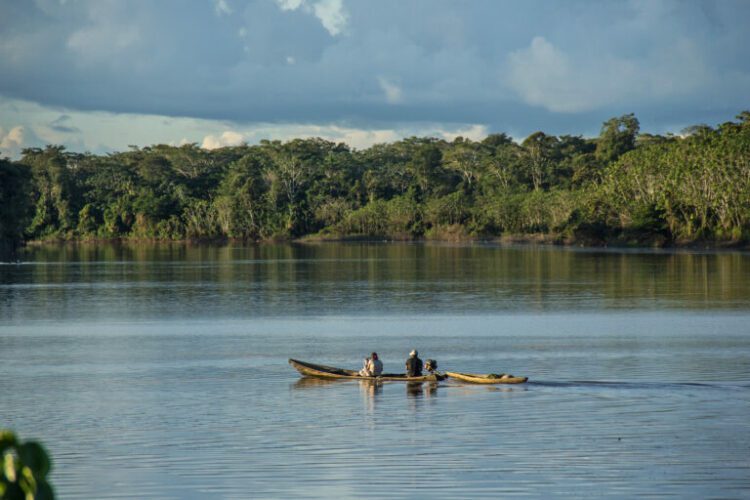
Banner image: An Indigenous group in a boat in the Ucayali River. Image by Juan Carlos Huayllapuma/CIFOR via Flickr (CC BY-NC-ND 2.0).
Safety of Peru’s land defenders in question after killing of Indigenous leader in the Amazon
Citations:
Finer M, Mamani N, Ariñez A (2023) Gold Mining Deforestation in the Southern Peruvian Amazon, 2021-2023. MAAP: 195. Recovered from: https://www.maaproject.org/2023/mining-deforest-peru/
Montoya M, Bonilla A, Novoa S, Tipula P, Salisbury D, Quispe M, Finer M, Folhadella A, Cohen M. (2024). Killing of Environmental Defenders in the Peruvian Amazon. MAAP:218. Recovered from: https://www.maaproject.org/2024/killing-enviro-defenders-peru/
FEEDBACK: Use this form to send a message to the author of this post. If you want to post a public comment, you can do that at the bottom of the page.

Source link : http://www.bing.com/news/apiclick.aspx?ref=FexRss&aid=&tid=66e3b1deda714fa2a93f459dd51ddc0b&url=https%3A%2F%2Fnews.mongabay.com%2F2024%2F09%2Freport-links-killings-to-environmental-crimes-in-perus-amazon%2F&c=13422382992857534976&mkt=en-us
Author :
Publish date : 2024-09-12 03:08:00
Copyright for syndicated content belongs to the linked Source.