The woman depicted on the walls and pillars of the throne room, as well as on the throne itself, is associated with symbols of the crescent moon, the sea and its creatures, and the arts of spinning and weaving. In the recently discovered murals, a unique scene of a women’s workshop dedicated to weaving and spinning has been found, along with a procession of men carrying fabrics and the crown of the female leader, adorned with braids. Pañamarca continues to challenge our expectations, says Lisa Trever, professor of Art History at Columbia University, not only because of the boundless creativity of its painters, but because its depictions are transforming our understanding of gender roles in Moche culture.
The debate among scholars now revolves around the identity of this powerful woman: Was she a human figure, a priestess, a goddess, or a queen? Despite these discussions, physical evidence from the throne, such as the erosion of its backrest, the presence of green stone beads, fine threads, and even human hair, suggests it was occupied by a real person, likely a female leader from the 7th century in Pañamarca.
In another part of the project, excavations in the plaza revealed a previously unknown monumental structure: the “Hall of Braided Serpents.” This hall, built on square pillars in the southern corner of the large plaza, stands out for its murals depicting a figure whose body is composed of intertwined serpents with human legs, a unique motif in Moche art.
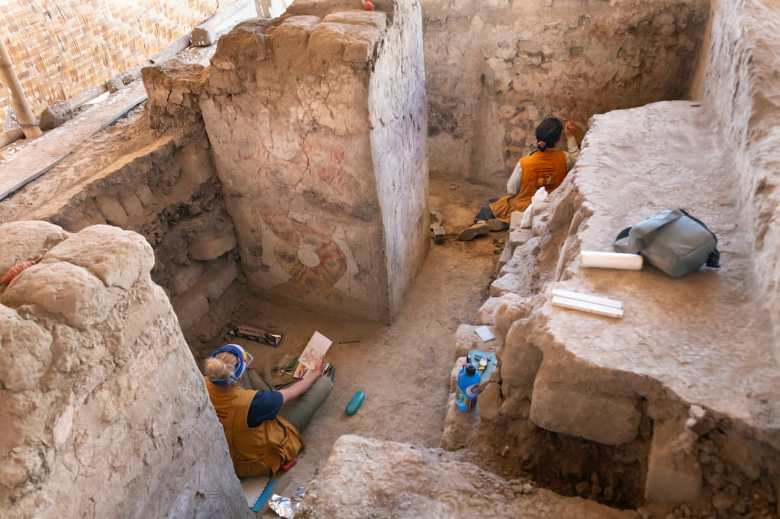 Archaeologists Michele Koons and Lisa Trever study the painted architecture of the Hall of the Braided Serpents. Credit: Rick Wicker / Pañamarca Digital / Denver Museum of Nature & Science
Additionally, there are representations of warriors, anthropomorphized weapons, and a scene of a monster chasing a man. The hall underwent multiple renovations over time, including the placement of material offerings, ritual burnings, and the resurfacing of floors and walls. According to Michele L. Koons, archaeologist at the Denver Museum of Nature and Science, this hall offered a prominent view, almost like a gallery from which to observe events in the plaza, while also providing private spaces for its occupants.
In terms of conservation, the archaeological work in Pañamarca is carried out alongside a meticulous preservation effort. Every structure and mural is stabilized, documented, and studied by a team of specialists, who use both traditional drawing techniques and advanced 3D scanning technology to record every detail. Due to the fragility of the murals, they are currently not accessible to tourists. Leaving them exposed without a conservation program would lead to immediate deterioration, as happened with the murals discovered in the 1950s, says José Antonio Ochatoma Cabrera, the project’s archaeologist.
For this reason, the team follows the recommendations of the Peruvian Ministry of Culture, covering the excavations at the end of each season to ensure their long-term preservation. In addition, roofs and windbreaks are being constructed to protect the painted structures, all with the aim of safeguarding this valuable cultural heritage.
Discover more from LBV Magazine English Edition
Subscribe to get the latest posts sent to your email.
But as soon as the first light of day appeared, the gleaming chainmail, girded with steel bands, and the shining breastplates, seen from afar, showed that the king’s forces were…
The Portara is one of the most iconic monuments on the Greek island of Naxos, located in the Cyclades. This gigantic marble gateway, which stands on a small peninsula facing…
When we think about European battles of World War II, we typically imagine Germans or Italians fighting against the British, Americans, or Russians, and we might also extend that to…
During the Roman era, the southern promontory of the Gulf of Baia (in Latin Baiae) was the perfect location for constructing villae maritimae for the Roman elite, who chose to…
Almost everyone has at least heard of Daniel Defoe, or at the very least, his most famous work: The Life and Surprising Adventures of Robinson Crusoe, a Sailor of York.…
The 1983 Pet of the Year award in Great Britain went to a dog that entered the Guinness Book of World Records, whose popularity led to the commercialization of stuffed…
In a surprising twist from the natural world, queen ants are taking extreme measures to protect their colonies from disease by eating their own infected offspring. According to a new…
Most historical civilizations, such as the Sumerians, Egyptians, Chinese, Babylonians, Greeks, Mayans… used natural measures of time. These include the day, the solar year, or the phases of the moon.…
A recent study carried out by a multidisciplinary team from the University of Granada has revealed a surprising discovery in the megalithic necropolis of Panoría, located in Darro (Granada, Spain).…
During the winter of 2023-2024, a team of archaeologists conducted an excavation in the basement of a house in the Montconseil neighborhood of Corbeil-Essonnes (Île-de-France). This operation was prescribed by…
An international team of researchers has successfully germinated and analyzed an ancient seed, uncovering secrets that may shed light on a plant species mentioned in ancient texts like the Bible,…
The analysis of Bronze Age arrowheads found in the Tollense Valley, in the German state of Mecklenburg-Western Pomerania, has revealed that some of them were not produced locally. This finding…
Load more articles
Something went wrong. Please refresh the page and/or try again.
Source link : http://www.bing.com/news/apiclick.aspx?ref=FexRss&aid=&tid=66f52ea4c682497dae76bdc8460c132d&url=https%3A%2F%2Fwww.labrujulaverde.com%2Fen%2F2024%2F09%2Fthe-throne-room-of-a-queen-from-the-moche-culture-associated-with-the-moon-goddess-and-marine-creatures-found-in-peru%2F&c=6634373792002410813&mkt=en-us
Author :
Publish date : 2024-09-25 13:01:00
Copyright for syndicated content belongs to the linked Source.