
Collaborating with partners — and across borders
Collaboration seems to have come relatively easily to Latin America – where it has been used as a tool to broaden investigations, build connections, and tackle issues like corruption that are not restricted to any one country. Huge investigative collaborations into cases like Lava Jato, or Operation Car Wash — which explored a sprawling web of corruption centered on Brazilian companies — crossed several borders. Last year, one of the biggest cross-border collaborative projects was NarcoFiles.
“We realized that transnational issues could not be covered by solo reporters or by national media outlets, so alliances were a natural response to enhance our scope,” says CLIP’s Jose Luis Peñarredonda.
Xanic says reporters in the region know how to collaborate: “The lack of resources has made it happen very naturally, especially among local media, nonprofit organizations, and small independent digital media.”
In Brazil, an international collaborative investigation involving more than 50 journalists from 10 countries was convened to investigate the relationships between local government and the individuals suspected of murdering British journalist Dom Phillips and the Indigenous activist Bruno Pereira in the Amazon region in 2022. “We reported in the Amazon, at the crime scene, and brought the voices of Indigenous people who have been suffering the oppression that Dom and Bruno would denounce,” says Tatiana Farah, the communications manager of Brazil’s Abraji.
At Mexico’s Periodistas de a Pie, the team is grateful for the “legacy of outstanding journalists who knew how to build collaborative knowledge.” In Peru, Adriana León, from Instituto Prensa y Sociedad (IPYS), credits international meet-ups like COLPIN, the investigative journalism conference for reporters in Latin America, with fueling collaborative work between journalists from different countries.
“At conferences, webinars, and small gatherings, journalists in the region have pointed to the importance of collaboration that crosses borders and oceans,” concurs Mioli. “Big investigative topics in Latin America – government corruption, financial crimes, environmental destruction – are not relegated to a single country or region.”
Key concerns: Legal attacks, security, and financial woes
The challenges facing outlets in the region are numerous, but many of our members sounded the alarm about the same risks: several mentioned financial sustainability and judicial harassment.
At Colombia’s Consejo de Redacción, the team also pointed to the general threats and violence that many reporters of the region must regularly confront when going about their work. Colleagues in Mexico point to the threat from the expansion of organized crime.
“Investigative journalism in Latin America is risky,” says León from IPYS. “Attacks against journalists — threats, murders, judicial harassment, among others — are one of the main problems faced by the press in the region.”
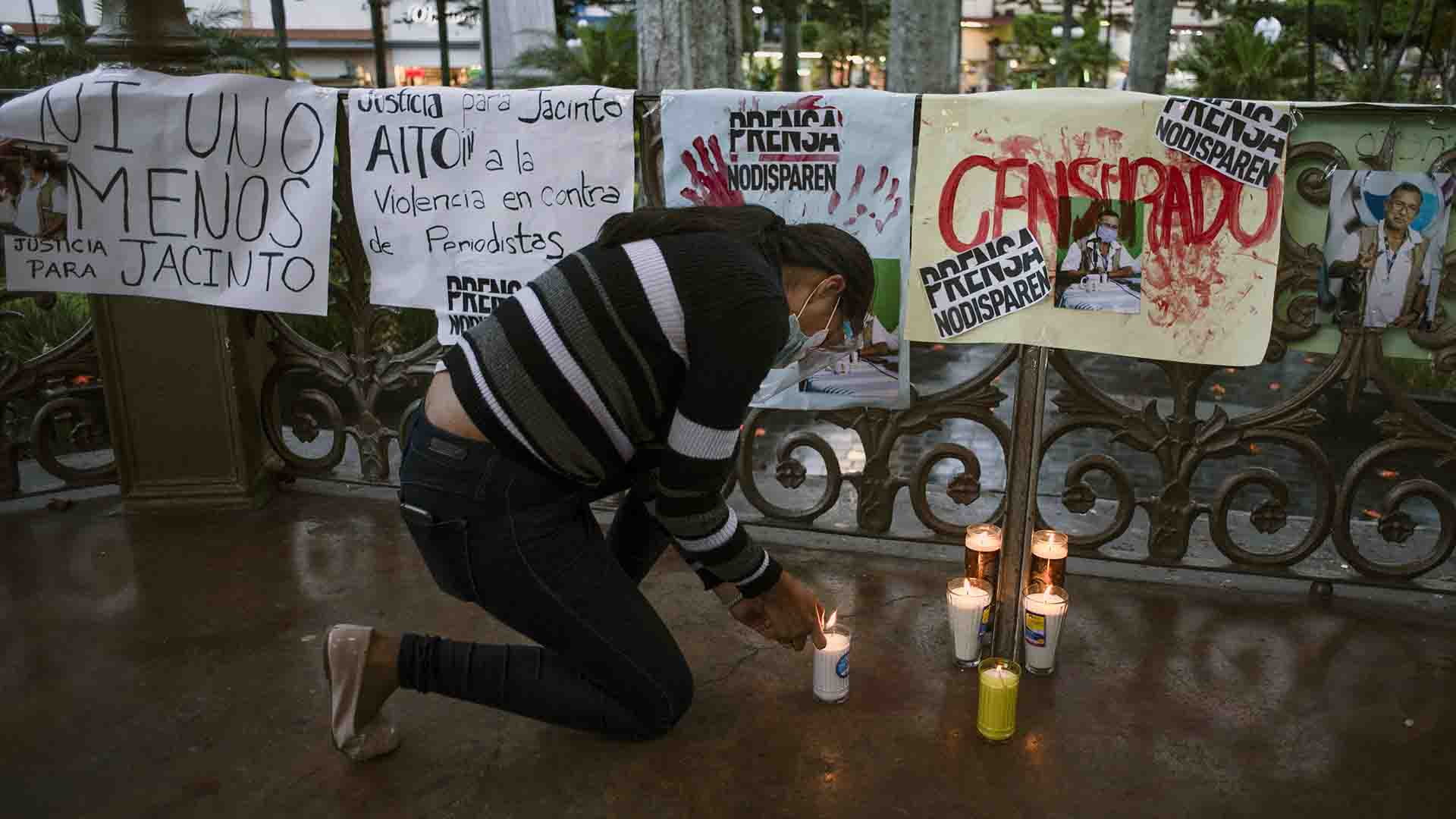
A woman lights a candle during a protest in demand of justice for the murder of Mexican journalist Jacinto Romero Flores, in Orizaba, state of Veracruz, Mexico on August 19, 2021. It was the latest such murder in one of the world’s deadliest countries for reporters. Image: Victoria Razo/AFP via Getty Images
Legal cases brought by those in power remain a looming problem.
“Investigative journalism requires time, resources, and backing from media leaders for it to fully develop. If any of these things are scarce, reporters cannot do their job well,” says El Surtidor’s Acuña. “The second challenge is the instrumentalization of justice and the law to persecute and silence journalists, what is known as ‘lawfare’ in English. Those in power who are the subject of scrutiny by journalists mount cases for defamation, slander, and other legal cases without solid foundations, brought with the aim of censoring and punishing.”
Lastly, the teams at CLIP and Connectas point to a theme that comes out in one of our stories this week – a regression in terms of reporters’ ability to access information in many countries. “Another challenge that investigative reporters face is how to overcome opacity in the majority of Latin American countries,” says Carlos Huertas, the director of Connectas. “We see a general pattern of access to sources of information being shut down, especially official sources, which makes it very difficult to find stories that reveal structural problems.
Where will investigative reporting in the region go next?
According to organizations in the region, the future will bring more transnational investigative projects. This response is natural in a region where government corruption, financial crimes, and environmental destruction transcend borders and require a collective effort.
Scharfenberg from Armando.info envisions “a more profound and regular collaboration in transnational investigative projects,” while Mioli at LatAm Journalism Review sees a path in which there is even “more collaboration among colleagues in the Americas, but also with colleagues from Asia, Europe, Africa.”
At Periodistas de a Pie, the team see a future where local stories have significant regional impact – and where intense audience engagement and collaboration allow publications to have a more “intense connection” with audiences.
Others also expect investigative journalism in Latin America to continue to innovate by using new platforms and narratives to better connect with audiences, to engage more effectively with readers, and foster a deeper connection with the public.
“We think that investigative journalism has to find its place in the new media environment,” says Amaya at the Consejo de Redacción. “It also has to find ways to engage in more collaborative transnational enterprises when looming dangers threaten the whole region in terms of the environment, international dubious flows of money, and the spread of disinformation and misinformation.”
On technology and training, León from IPYS expects to see a greater professionalization that will allow reporters to continue investigating what the major powers want to hide. CLIP’s Peñarredonda foresees technology and AI tools marking a new era of tech-savvy investigative journalism that will help journalists hold powerful entities accountable.
“Investigative journalists are increasingly using and developing technology and AI tools to improve our productivity, take advantage of new sources of information, and to do our work in a secure way,” he explains. “As technology becomes an increasingly influential force in our societies, we will evolve our understanding of how it works, how it interplays with other powers, and what we can — and should — do to keep its creators, sellers, and peddlers accountable.”
A number are hopeful that the best is yet to come. Mexico’s Xanic says that reporters in the region “still have a lot to investigate together. We are just warming up our engines.” El Surtidor’s Acuña agrees: “I don’t know where it will go, but I can’t wait to see what it will bring us.”
Source link : http://www.bing.com/news/apiclick.aspx?ref=FexRss&aid=&tid=66baee74db274fba9a81b247db1a8676&url=https%3A%2F%2Fwww.icij.org%2Finside-icij%2F2024%2F08%2Fwe-are-just-warming-up-our-engines-whats-next-for-investigative-journalism-in-latin-america%2F&c=907273145748712084&mkt=en-us
Author :
Publish date : 2024-08-12 15:37:00
Copyright for syndicated content belongs to the linked Source.