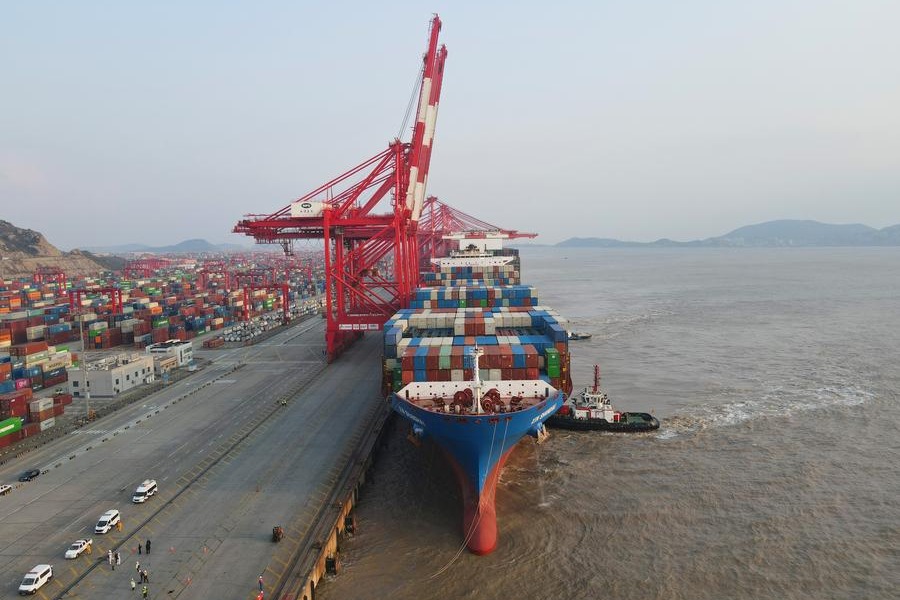
An aerial drone photo shows the “Xin Shanghai,” a vessel operated by China COSCO Shipping Corporation Limited, approaching Yangshan Port, East China’s Shanghai, Dec 18, 2024. [Photo/Xinhua]
CLOSER TRADE LINKS
The Chancay Port project is not only an infrastructural feat but also a symbol of the deepening trade relations between China and Peru. Over the past decade, trade between the two countries has grown rapidly, driven by China’s increasing demand for Peru’s agricultural and mineral products such as fruits and seafood.
China has been Peru’s largest trading partner and largest export market for 10 consecutive years. From 2016 to 2023, bilateral trade grew at an average annual rate of 14.6 percent, reaching $37.69 billion last year. This mirrors the increasingly closer economic links between the two nations.
The completion of Chancay Port will bolster these trade links by reducing the time and cost of transporting goods, said Santa Gadea.
The facility is expected to handle millions of tons of goods annually, providing a faster and more efficient route for Peruvian exports to reach China’s ports. At the same time, China will benefit from the improved access to South America’s growing consumer base.
In addition to fostering trade, the Chancay Port project is likely to stimulate new business ventures and joint investments between Chinese and Peruvian companies. The port’s modern infrastructure is expected to attract global companies seeking to expand their operations in South America, creating new opportunities for collaboration and economic growth.
The port’s capacity to handle large volumes of cargo will also facilitate the growth of trans-shipment operations, making it what Santa Gadea called a regional trade hub for South America.
Felipe Ribadeneira, president of the board of directors of the Ecuadorian Federation of Exporters, told Xinhua that shorter transportation time is great as bananas, shrimp, cocoa and other agricultural products from Ecuador can reach the Chinese market more quickly through this new channel.
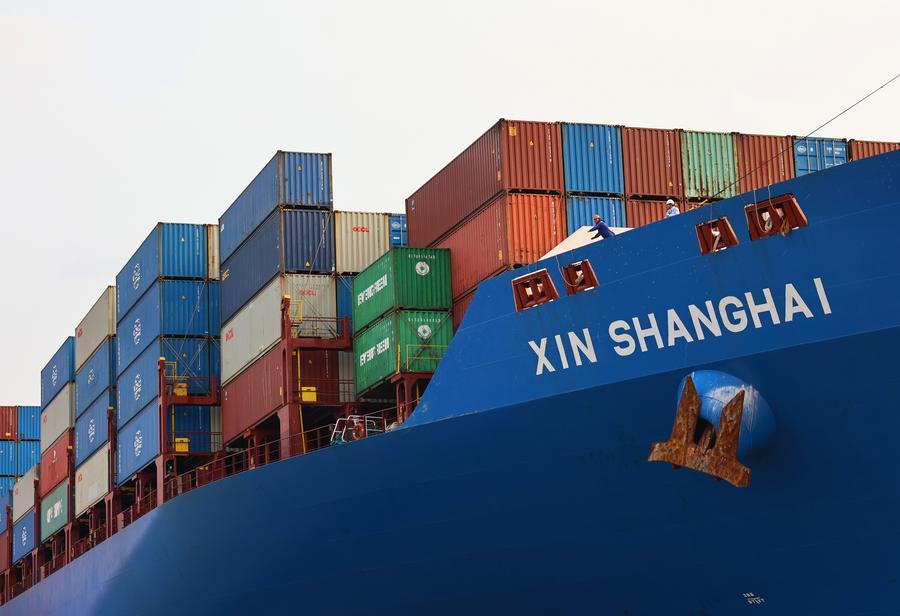
A sailor aboard the “Xin Shanghai,” a vessel operated by China COSCO Shipping Corporation Limited, throws cable to the dock at Yangshan Port, East China’s Shanghai, Dec 18, 2024. [Photo/Xinhua]
BLUEPRINT FOR COMMON DEVELOPMENT
Also at the port’s inauguration ceremony, Xi said the corridor, to connect the Inca Trail with the 21st Century Maritime Silk Road, will open up a road of common prosperity and happiness for Peru and other Latin American and Caribbean countries.
As analysts pointed out, the port represents more than just a logistics hub — it is a concrete manifestation of the broader vision for common development that underpins the Belt and Road Initiative (BRI). The initiative, proposed by Xi, emphasizes mutual benefit, win-win cooperation, and shared prosperity among participating countries.
Addressing the fourth symposium on Belt and Road construction work in Beijing earlier this month, Xi stressed the importance of comprehensively advancing high-quality cooperation under the BRI.
Since the initiative was put forth in 2013, major achievements have been made in Belt and Road cooperation, enhancing China’s friendship with participating countries and promoting their economic and social development, he said.
Jorge Chain, general manager of the Peru-China Chamber of Commerce, described the Chancay Port project as a prime example of “beneficial and mutually advantageous cooperation.”
Over the past decade, China and Latin America have become partners under the BRI. So far, 22 countries in the region have signed BRI cooperation documents with China. A host of projects jointly built under the BRI, including the Belo Monte Hydropower Plant ultra-high-voltage transmission line in Brazil, Argentina’s Belgrano Cargas railway and the Jamaica North-South Highway, have borne fruit.
For Peru, Chancay Port offers an opportunity to enhance its role in the global supply chain. As one of the leading economies in Latin America, Peru has long been recognized for its abundant natural resources. With global demand for these resources constantly evolving, Peru will have more opportunities to diversify its economy and develop new sectors.
“The BRI brings more connectivity and is contributing to the development of this agriculture sector. But this is just the first step; the second step is to develop more manufacturing products, export of manufacturing products,” said Santa Gadea.
Source link : http://www.bing.com/news/apiclick.aspx?ref=FexRss&aid=&tid=6767dabe83b543dfbf7f78dc6b9c2298&url=https%3A%2F%2Fwww.chinadaily.com.cn%2Fa%2F202412%2F20%2FWS6764e049a310f1265a1d40a1.html&c=2351365135257421332&mkt=en-us
Author :
Publish date : 2024-12-19 14:11:00
Copyright for syndicated content belongs to the linked Source.