The first work visitors encounter is a multisensory installation by Puerto Rican-born, Berlin-based artist Chaveli Sifre, who greets them with the tropical scent of “Caribbean Colada” from “Little Trees” car fresheners. Drawing from her upbringing in Puerto Rico and tapping into its ancestral knowledge, Sifre critiques the stereotypes of the Caribbean as a “paradise” for exploitation without truly valuing its native culture. A neon sculpture depicting intertwined profiles with conjoined respiratory tracts bathes viewers in light as they navigate the space, echoing the action of inhaling and exhaling, subtly implicating them in the exploitation process. In the show’s final room, this critique of tourist economies is echoed in Anina Major’s installation, which combines palm leaves, video, woven ceramics and a biting neon sign quoting poet Patricia Glinton-Meicholas: “No Vacancy in Paradise.” The piece urges responsibility in tourism, emphasizing the importance of respectful cultural exchanges. Central to Major’s installation is the video Saturday Afternoon (2018), which references 1950s Bahamian destination advertising and, drawing on her grandmother’s craft market work, addresses how commodifying Bahamian landscapes and traditions dehumanizes locals, reducing them to mere attractions for visitors.
Notably, “Flow States” unfolds in a neighborhood shaped by migration, and many artists in the show share their personal migration experiences, reflecting on both the positive and negative aspects of these journeys. One example is Rutas [Journeys] (2023), an ongoing project by Studio Lenca, the artistic name of José Campos, who left El Salvador as an undocumented child migrant. In this project, Campos conducts workshops with individuals who share similar narratives, helping them process and emotionally translate their journeys onto canvas. The resulting works are aerial depictions of cities like New York, Phoenix, Philadelphia, Dallas, Chicago and his hometown of Los Angeles, mapping the Latinx presence and creating a vibrant record of the global Latinx diaspora.
Other artists explore their identities by reconnecting with their homeland traditions. Sarita Westrup, for example, creates installations using traditional basketry techniques. Her works challenge the association between basketry and Mexican crafts, transforming functional baskets into symbolic vessels that evoke agency, acts of care and community. Meanwhile, Koyoltzintli’s work, rooted in her Indigenous heritage, uses documentary filmmaking and photography to explore spiritual questions about nature, ancestral technologies and Indigenous knowledge. Her video installation, Objetos del futuro [Objects of the Future], captures members of her community playing instruments she crafted for them, creating a sacred chorus that evokes notions of grief, intimacy and healing.
Another standout piece comes from Alberta Whittle, whose film What is a better life (exorcised in the middle), part of Hindsight is a Luxury you cannot afford (2021–2022), uses strategic montage techniques and her own Barbadian and Scottish ancestry to draw parallels between past and present, exposing the enduring legacies of imperialism and colonization. As curator Susanna Temkin notes, the piece fits within the theme of “Memorialized Bodies,” inviting viewers to confront history’s ongoing impact on contemporary life.
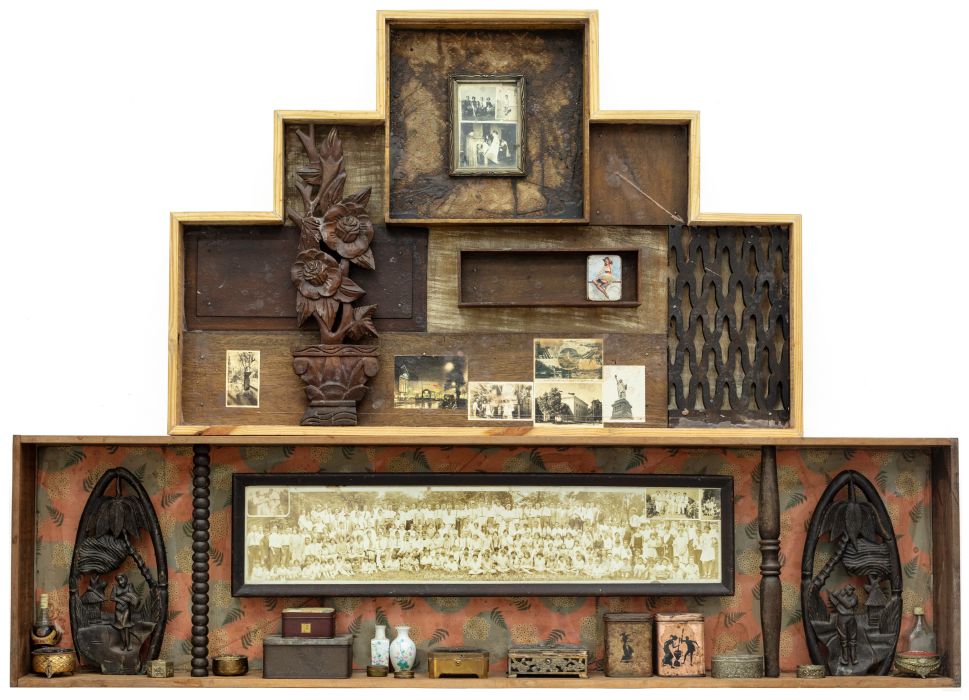 Norberto Roldan, 100 Altars for Roberto Chabet / NO. 23, 2014-2023; Assemblage with personal effects and architectural debris from demolished old houses, decorative wooden carvings, latticework, old photographs from a family album (c. 1950), group picture from America, postcards, imported perfume bottles, cookie tin boxes, metal jewelry receptacles, and second-hand fabrics. Courtesy of the artist
One of the most compelling aspects of this Triennial is how its global approach to the Latinx diaspora extends beyond the Americas and Caribbean, recognizing the shared legacies of colonial histories. A standout example is the work of Norberto Roland, one of the most renowned Filipino artists, who presents a series from his ongoing project 100 Altars for Roberto Chabet (2014–2023). These wood-made altars, reliquaries, and archives incorporate various objects from the daily lives and cultural traditions of anonymous mid-century Filipinos, revealing stories of migration and trade routes that have long connected the Philippines with the Americas. Through the complex interplay of artistic, anthropological and political narratives, Roland’s works highlight the potential for expanding the notion of Latino culture to include global connections and evolutions.
Other artists in “Flow States” embrace the condition of constant change, viewing it not only as a hallmark of the migrant experience but also as a source of endless transformation, cultural exchange, hybridization and adaptability—qualities that resonate with today’s global multicultural landscape. A vivid example is the large-scale, colorful textile installation by Maria A. Guzmán Capron, which playfully blends personal narratives with broader universal dynamics. Born in Italy and raised there before moving twice as a teenager with her Colombian and Peruvian parents (first to Colombia, then to Texas), Guzmán Capron’s work reflects the complexity of belonging in multiplicity and contradiction—an experience shared by many in the diaspora and reflective of our global culture. Rejecting the idea of a fixed self, she combines diverse cultural and aesthetic references in her vibrant fabric works, embodying the potential within diversity. As she explains in the catalog, “By merging figuration with abstraction, [my] works explore cultural hybridity, pride, and the competing desires to assimilate and to be seen.” Deeply informed by Chicanx fabric-based visual traditions, Latin American arpilleras (sewn pieces by politically driven collectives of self-taught women artists), Indigenous textiles from Peru and canonical art movements like Impressionism and Surrealism, Guzmán Capron’s approach underscores the fertile creative possibilities within transcultural identity.
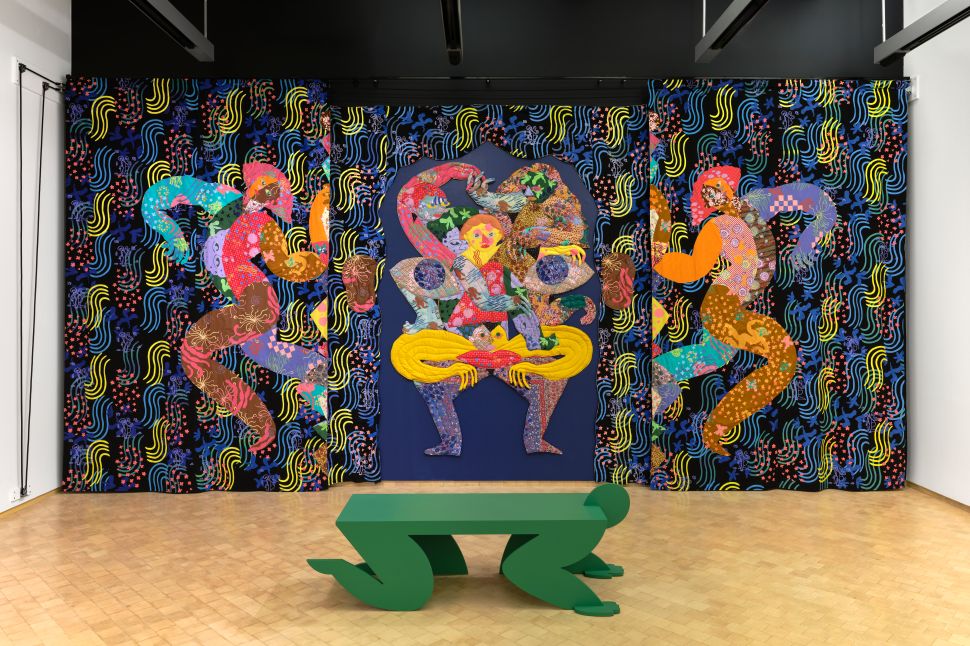
Maria A. Guzman Caprón‘s En Tu Mirada [In Your Eyes], Las Curlies, and Aquí Para Ti [Here for you], 2024. Matthew Sherman
In the show, diasporic bodies subject to a pervasive global culture are depicted as both malleable and fragile in their fluid state, a concept explored through an immersive installation by internationally renowned artist Ser Serpas. In this newly commissioned work, Serpas delves into the malleability of identity with a series of paintings based on images generated through endless modifications via A.I. software, which are then meticulously hand-transferred onto canvas. This process reflects the shifting, fluid nature of identity in a rapidly evolving technological and cultural landscape.
The complexities of hybridity are further examined in the paradoxical assemblages by Ruben Ulises Rodriguez Montoya. Using discarded materials, Montoya creates monstrous figures that embody both the pain and transformative potential of the tensions between land, humans and animals. For the artist, these grotesque creatures serve as tools to test the limits of bodily contamination while also evoking the liberatory potential of what he calls an “abject queer fecundity.” These unsettling forms push the boundaries of identity and offer a space for imagining new possibilities for bodies in flux.
Cosmo Whyte’s Persona Non-Grata (2024) addresses similar themes, connecting materials from Black archives with lived experiences to challenge the notions of foreignness and nationhood. Using documentary photographs and archival images from the 1968 Rodney riots in Kingston, Whyte’s work highlights how societal unrest, fueled by nationalism and other polarizing ideologies, reverberates through time, linking past events to present and future global dynamics.
SEE ALSO: Jean-Marie Appriou’s Perrotin Show Celebrates the Perpetual Promise of Life in the Cosmos
This sense of precarity between floating lands and fluid identities is also present in Karyn Oliver’s work. Oliver incorporates salvaged asphalt and urban imagery into her pieces, transforming them into “urban fossils” that explore the concept of traces—examining the multivalence of site, material and the histories embedded within them.
As curator Susanna V. Temkin notes in her essay, exploring one’s relational position to bodily presence or absence is central to the diasporic framework. The conceptual and physical impact of distance is also addressed in Tony Cruz Pabón’s San Juan (Puerto Rico) / New York (2024), part of his ongoing series Dibujos de distancia [Distance Drawings] (2003–present). By translating the metric distance between his current location and his hometown onto paper, Pabón stages a meaningful act of site-making and marking, using his body as a point of connection to the landscape and exploring the interplay between physical presence and geographical displacement.
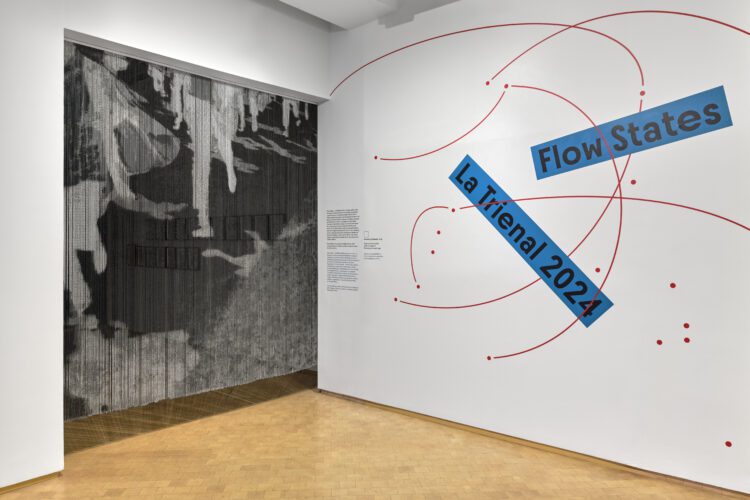
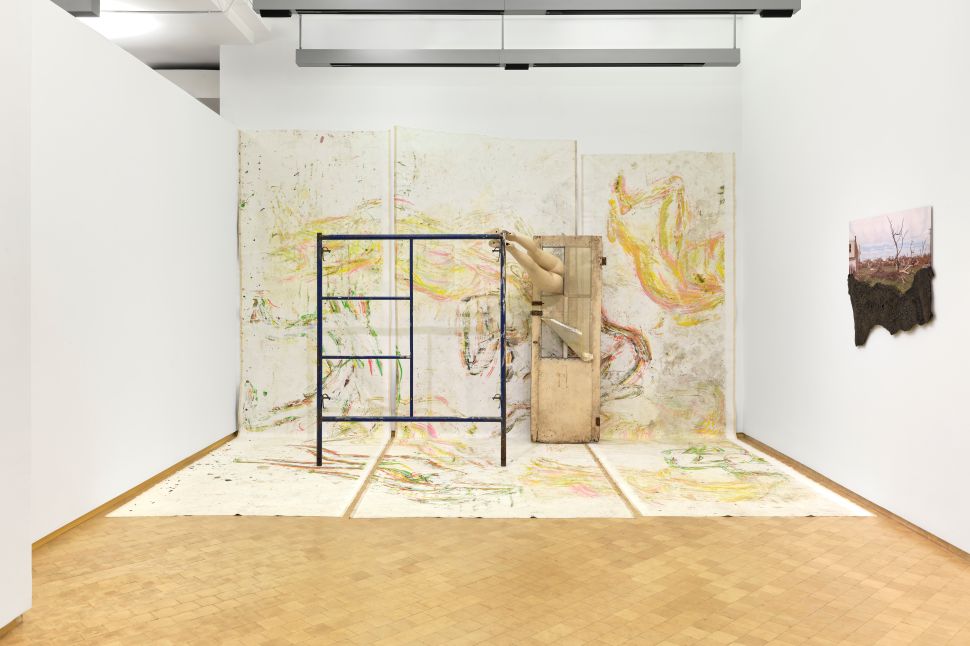 Another view of “Flow States – LA TRIENAL 2024” at El Museo del Barrio, New York, with the work by Ser Serpas. Matthew Sherman
Other artists in the show explore intimate dimensions of personal trauma, revealing how individual experiences are often communal in underserved communities. A powerful example is Alina Perez, one of the youngest participants, whose shocking work portrays a rape scene with disarming realism. By depicting a disturbing mix of abusive adults, condescending children and vulnerable young women, Perez opens up difficult questions about the body, family, and the community environments that can shape and alter it. Her work delves into the unwilling transformations of the psyche driven by trauma, offering a stark examination of how such events impact both individuals and their surroundings.
Fully embodying the notion of fluid identity between body and psyche is the process-oriented work of Mexican artist Carmen Argote. Her deeply material, even sensual, mixed-media compositions explore the concept of perpetual transformation. The thick, visceral presence of her paint reflects the psychological intensity of her work. As Argote explains in an insightful note in the catalog, “I often think of my body akin to a sponge, trusting in human processing of my surroundings. This process of digesting builds my understanding of the relationships between personal history, memory, cultural systems, and the collective energy in society.”
This statement seems to encapsulate the core message of the Triennial, which deconstructs notions of nationhood to highlight the fluidity and hybridity inherent in diasporic culture and identity. The exhibition presents this perpetual state of transition, acknowledging the traumas that often accompany it, while also positioning fluidity as a model for adapting to the continuous, dynamic nature of reality.
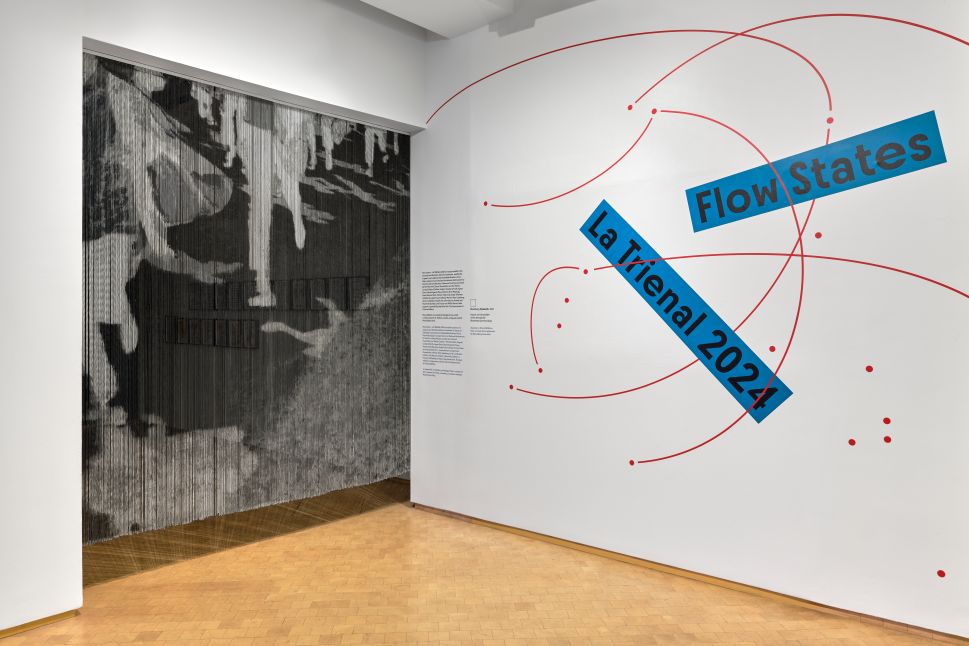
“Flow States – La Trienal 2024” will remain on view at El Museo Del Barrio through February 9, 2025.
Source link : http://www.bing.com/news/apiclick.aspx?ref=FexRss&aid=&tid=67181166fb024d629847798939a11f1a&url=https%3A%2F%2Fobserver.com%2F2024%2F10%2F2024-el-museo-del-barrio-triennial-flow-states-review%2F&c=9605532090518186070&mkt=en-us
Author :
Publish date : 2024-10-22 09:17:00
Copyright for syndicated content belongs to the linked Source.