The boat owners of La Familia Grady-White Puerto Rico raised money for Fe Que Transforma (Faith that Transforms), a group that prepares food for those in need. It also reportedly generated some $100,000 for the local economy, which is in some need.
Courtesy Grady-White
La Familia
Luis Rivera has been attending the raft-up since the beginning. A doctor from the main island, he was excited to hear about the mammography machine that will aid the locals, considering the alarmingly high rates of cancer on the island, compared to the mainland. He was called by the mission, but what keeps him coming back is the overall atmosphere. He contributed to it, after all, seeing that I decided to talk to him after devouring the crab salad he came and offered me.
“What keeps me coming back is that the people are respectful, and we donate to help poorer people in the community. My family enjoys it very much.”
The music was a good mix of Top 40 and local sounds. Clean lyrics of course. On Friday, the crowd is light, but Saturday, the surf is comfortably crowded with children on paddleboards and kayaks, snorkeling, and flipping into the water. Rivera’s brood of six jumped in line to snack on pernil and arroz con gandules when they weren’t floating along or dancing to the sounds of the live band. At 70, Rivera wasn’t the oldest participant, and even tiny babies were held in waist-deep water sporting their floats.
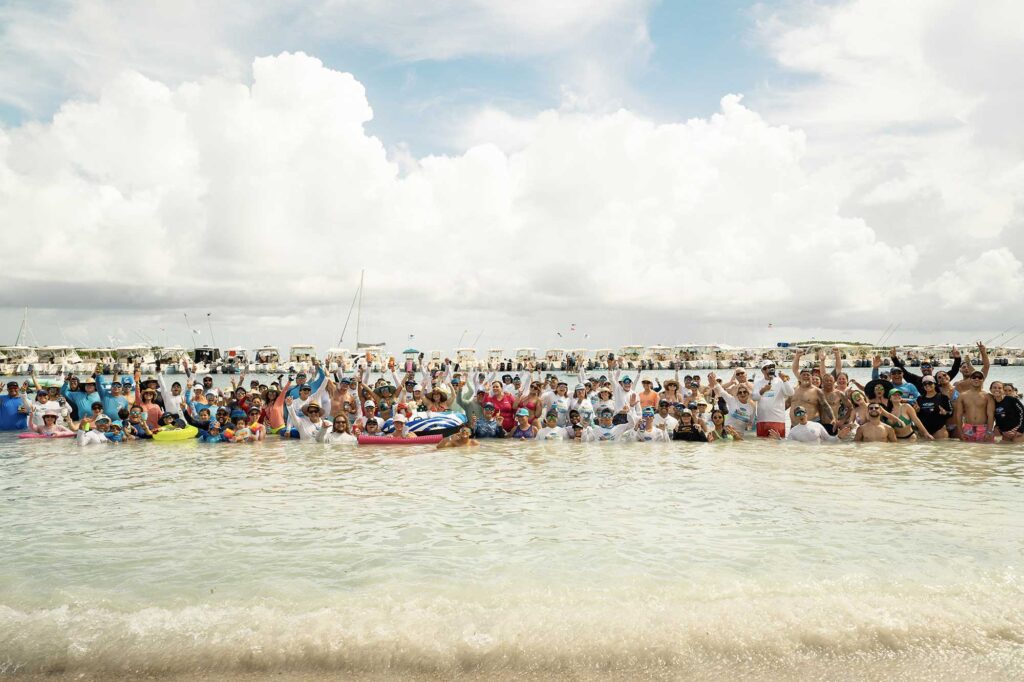
It all comes down to people having fun and helping others. Good job, Grady-White owners of La Familia Grady-White Puerto Rico.
Courtesy Grady-White
Day of Strategies
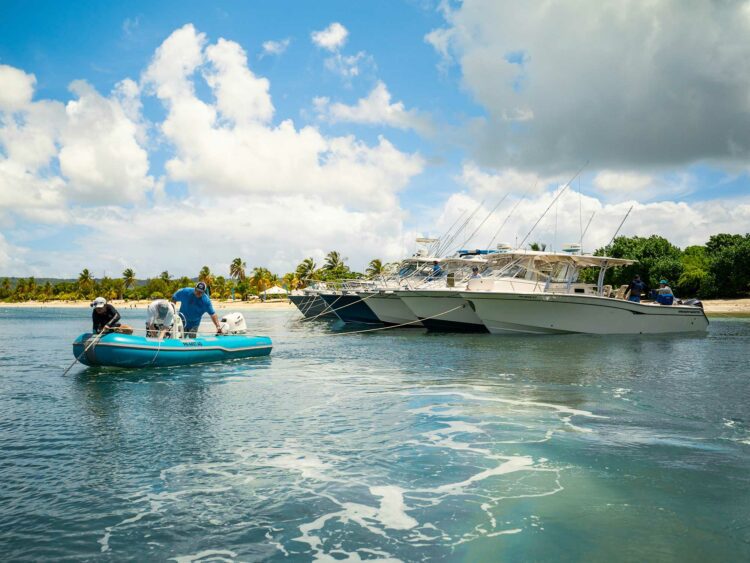
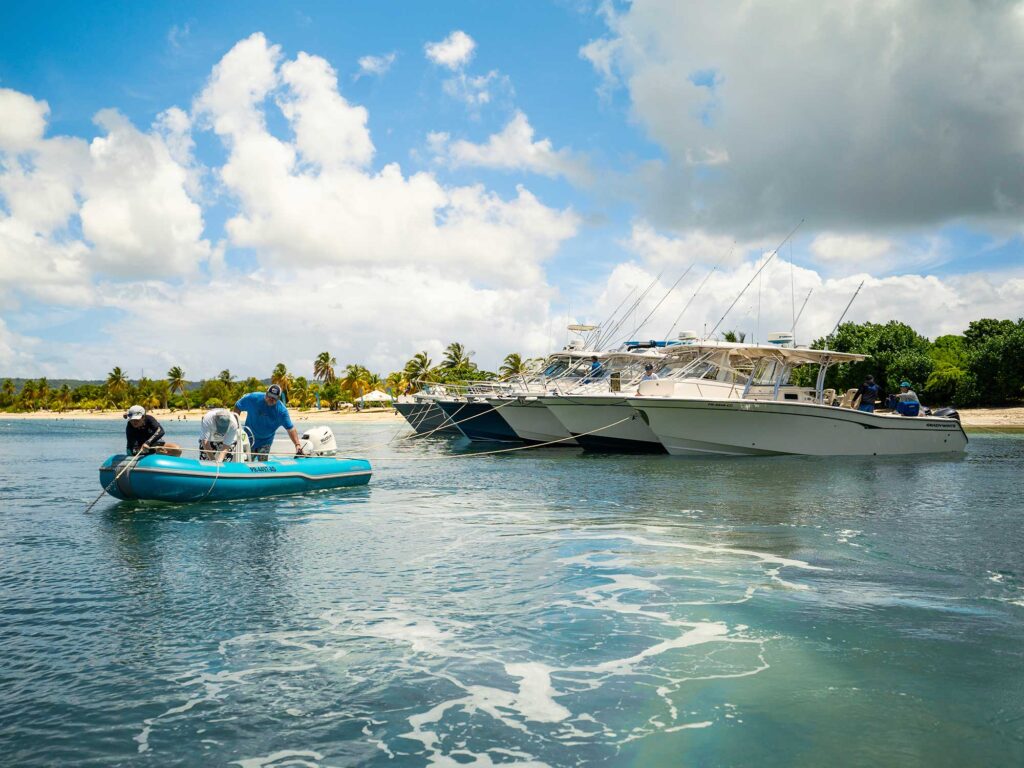
On the first day of the Rendezvous, I noticed Camillo running around with a hand-held VHF radio. No water-based event can work without them, and certainly not without dinghies (how do you think I got to Burleson’s beautiful boat with my recorder—swimming?) Future raft-up organizers take note.
The event has never run into a significant problem, and that is probably because they keep safety at the forefront. This is another important consideration for those planning a raft-up.
According to Burleson, “We don’t allow people to walk from boat to boat. If you want to see a friend down the way, you take a dinghy or paddleboard, or you swim.” At the minimum, breaking an ankle would dampen the vibe, but boating accidents can be deadly, even when everyone is sober.
Safety is also why this year’s line-up was also broken up, with some boats anchored together separately, off to the side. While it may not be as aesthetically pleasing, it is safer than forcing boats out into a rougher part of the bay. Besides, locals also need access, and a big chain of boats can block them.
Again, work with the community in which you are planning your raft up.
Besides, how else would the local fisherman come to the shore with their freshly caught lobster?
Common courtesy is enforced, and each participant gets a list of rules.
Burleson says, “We give everyone a list of requirements, including regarding your holding tanks. You’re not going to flush them here.”
That list includes how to interact with the turtles, informing everyone of the legality.
Use these tips to organize your next raft-up and help ensure its success. BONUS TIP: A dinghy can help if one is available.
Courtesy Grady-White
Familiarize Yourself With Rafting Up
For an event like the Rendezvous, boaters received plenty of help, but it was beneficial for all of the boats to know how to raft up prior to the event. Dinghies also directed oncoming boats to exactly where they’d tie up. Consider stationing people in dinghies to direct and help people at your raft-up.
If you’re new to tying up, start by having three fenders and two mooring lines per side, and tie the fenders up higher than usual to prevent any impact. It is also good to have two to four spring lines on hand. The larger boat will serve as the “anchor,” and other boats should be facing the same way when approaching.
Camillo warns that you could injure yourself or others if someone is in the water, or if you aren’t watching your hands closely. Make sure all passengers keep their hands and feet in the boat while rafting up, so they don’t get pinched.
Bottom Line
The Grady-White Owners of Puerto Rico, put on one of the most successful and largest raft-ups in the world. It is a testament to good planning, the fellowship between boaters and to top it off, it helps those in need. To the Grady-White Family of Puerto Rico, we say, ¡Buen trabajo!
9 Tips for Rafting Up
The largest, heaviest boat should drop its anchor first, and smaller boats can tie up on either side.
Approaching boats should slow down to avoid any potentially damaging collisions. Think twice about cutting your engine—you may need to guide your boat against the current.
Remember to deploy your fenders before approaching another boat to raft up.
Come in facing the same direction as the larger boat, then throw your bow line over to the larger boat.
Try to align the boats’ transoms. Exchange lines, and make sure they’re firm before tying up.
Tie the bowline first, then the stern line.
Always secure boats to one another using the cleats—not rail stations, handrails, or other accessories.
Keep the lines tied between boats as tight as possible to minimize motion between the boats.
Try your best to raft together with boats that are a similar size next to each other, or in size order.
Source link : http://www.bing.com/news/apiclick.aspx?ref=FexRss&aid=&tid=66cf3fb9a0cd4dd59c0e2cef3b8f39b3&url=https%3A%2F%2Fwww.boatingmag.com%2Fhow-to%2Fgrady-white-pulls-off-its-largest-raft-up-ever-in-vieques-puerto-rico%2F&c=17440997088009539803&mkt=en-us
Author :
Publish date : 2024-08-25 12:59:00
Copyright for syndicated content belongs to the linked Source.