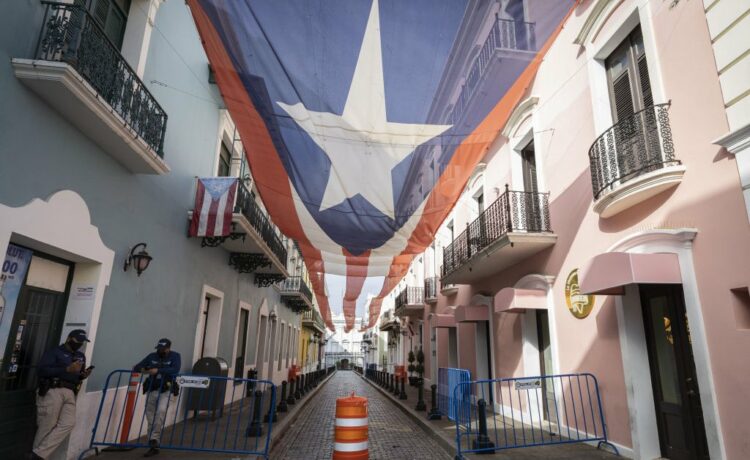
This November, the U.S. citizens of Puerto Rico will go to the polls, just like their fellow U.S. citizens. But unlike their fellow citizens, they will not be able to vote for Senators or Representatives or the President. A U.S. territory since 1898, Puerto Rico has its own constitution and government, but it has no representation in the federal government except for one non-voting “Resident Commissioner” in the U.S. House. Euphemisms aside, Puerto Rico is a colony of the United States.
In the coming election, the island’s voters will have a chance to express their desire for decolonization. In a non-binding plebiscite, they will choose among three options that would result in a new, non-colonial status for Puerto Rico: statehood, independence, or free association under international law (a status in which a former colony achieves the separate sovereignty of independence while entering into a revocable power-sharing arrangement with a larger nation). But Congress, and only Congress, has the power to make their choice a reality.
Puerto Rico cannot become a state of the Union unless Congress admits it. It cannot become independent unless Congress agrees to it. It cannot enter into a free association arrangement unless Congress provides for it.
In other words, for Puerto Rico to cease being a colony, Congress must do its part.
Read More: Puerto Rico Is Voting for Its Future
Puerto Ricans have been demanding decolonization for a very long time. Before the United States annexed Puerto Rico in 1898 at the end of the Spanish-American War, the island was a colony of Spain. During the final century of Spanish sovereignty, Puerto Rican political leaders debated whether the island should become an equal province of Spain or instead achieve a constitutional status they called “autonomy.” A small minority called for independence.
The Spanish government stonewalled until the eve of the U.S. invasion of the island, when Spain belatedly granted Puerto Rico a “Charter of Autonomy.” It had barely gone into effect when a defeated Spain ceded temporary control over Cuba and full sovereignty over Puerto Rico, the Philippines, and Guam to the United States.
U.S. General Nelson Miles, who had led the troops who landed on Puerto Rico’s southern shore, grandiosely pronounced that the United States would bring islanders the “blessings of enlightened civilization.” But those blessings turned out to be decidedly mixed. U.S. sovereignty brought both welcome and unwelcome developments, but on the question of Puerto Rico’s relationship to the United States, it brought confusion and delay.
At first, Puerto Rican political leaders coalesced around the goal of statehood, with the two major political parties on the island adopting pro-statehood platforms. They knew that ever since the days of the Northwest Ordinance of 1787, which had promised statehood to the territories that became Indiana, Illinois, Michigan, Ohio, Wisconsin, and part of Minnesota, every territory annexed by the U.S. had been on the path to statehood. And they saw in statehood a version of the autonomy they had sought from Spain. As one of the leading politicians on the island, Luis Muñoz Rivera, stated in a public hearing held in late 1898, Puerto Ricans “aspire[d] to maintain the individuality of the country within the Union of states.”
But the United States quickly betrayed their expectations, refusing even to grant them U.S. citizenship and denying them certain constitutional rights.
When the U.S. Supreme Court weighed in, it compounded the betrayal. Beginning in 1901, in a series of decisions known as the Insular Cases, the court confirmed that Puerto Rico, the Philippines, and Guam were different from other U.S. territories—and lesser. Unlike prior territories, they “belong[ed] to,” but were not “a part of,” the United States. They were, instead, “foreign to the United States in a domestic sense.” As a result, they lacked the implicit promise of statehood that other territories had enjoyed. They might be admitted as states. Or they might become independent, as the Philippines did in 1946. Or they might just remain territories indefinitely. It was up to Congress, and Congress alone, to decide.
Read More: House Passes Bill That Would Allow Puerto Rico to Vote on Its Statehood or Independence
Thrust yet again into a wrenching debate about their future, Puerto Ricans split into factions that mirrored their factions under Spain. Some favored statehood and others autonomy, while a small minority called for independence. Meanwhile, Congress stonewalled, gradually increasing the island’s self-government but withholding a permanent, non-colonial status.
In 1917, Congress granted U.S. citizenship to Puerto Ricans. In 1950-52, Congress authorized Puerto Rico to adopt its own constitution and gave it the official title “Commonwealth of Puerto Rico.” But even in the wake of these momentous developments, Puerto Rico’s constitutional relationship to the United States remained unchanged. It remained a U.S. territory, still deprived of federal representation, and still subject to Congress’s power to govern it under the Territory Clause of the Constitution. Known as “plenary power,” it includes the power to modify or withdraw Puerto Rico’s self-government. The Commonwealth of Puerto Rico was still a colony, albeit one with a fancy name.
Over the past 50 years, Puerto Ricans have held six votes on status. The first, in 1967, yielded a victory for an “enhanced” version of the commonwealth arrangement that would have stripped Congress of its plenary power. It was an illusory promise, because Congress does not have the power to relinquish its plenary power except by admitting a territory into statehood or granting it independence (with or without free association).
The second, in 1993, did not produce a majority: persisting in their quixotic quest for the constitutionally impossible “enhanced” commonwealth, its supporters took 48% to statehood’s 46%. Meanwhile, independence trailed and free association did not make it onto the ballot.
The third vote, in 1998, produced a victory for “none of the above.” The fourth and fifth saw statehood prevail, but opponents questioned their validity based on what they considered a problematic process (a two-step ballot in 2012) and a deficient turnout (27% in 2017). The sixth, in November 2020, was a Yes/No referendum on statehood, which statehood won with 52.5% of the vote and a solid turnout of 55%.
Some argue that a status vote is a waste of time because Congress will never act. But their argument begs the question: a status vote is a demand for congressional action. Some propose that Puerto Rico should decide its own future in a constitutional convention. But a convention would not solve the problem that Congress, too, must act.
Worse, by ignoring that fact and creating the false impression that Puerto Rico can decolonize itself, a convention would amount to an exercise in self-deception.
Observers unfamiliar with the debate wonder why Congress should do anything at all if so many Puerto Ricans favor the status quo. And yet, assuming the majority favors the status quo would be a mistake. Almost no one in Puerto Rico favors the status quo—which is why even commonwealth supporters have sought to “enhance” it.
Meanwhile, congressional efforts have yet to produce results. Since the 1930s, bills have been introduced and bills have been tabled, or passed in one chamber and died in the other. Time and again, they have failed because Puerto Rico has never been a congressional priority. It is difficult enough to get legislation enacted under ordinary circumstances, but without representation, it is next to impossible.
Read More: ‘We Want to Become a State.’ Puerto Rico’s Sole Representative in Congress Speaks Out
This is the colonial catch-22: Puerto Rico remains a colony because it has no leverage in Congress, and it has no leverage in Congress because it remains a colony.
But today, there is a glimmer of hope, in the form of the Puerto Rico Status Act (PRSA). The PRSA is a federal bill that would finally offer Puerto Ricans a choice among their non-colonial options—statehood, independence, and free association under international law—and provide for a transition to the one that wins.
The PRSA passed in the House of Representatives in December 2022 with bipartisan support—but without enough time to be considered in the Senate before the end of the session. It was reintroduced in the current session in both House and Senate, again with bipartisan support. It now has 97 co-sponsors in the House and 26 in the Senate, along with the support of Senate Majority Leader Charles Schumer (D-NY). This is the largest number of Senate co-sponsors ever for a bill addressing Puerto Rico’s status, and the first time in history that a Senate Majority Leader has co-sponsored such a bill.
It is the prospect that the PRSA will falter before the finish line that drove the government of Puerto Rico to schedule the island’s seventh status vote this November. The message to Congress will be loud and clear: this is what it looks like to do your part.
Christina D. Ponsa-Kraus is the George Welwood Murray Professor of Legal History at Columbia Law School.
Made by History takes readers beyond the headlines with articles written and edited by professional historians. Learn more about Made by History at TIME here. Opinions expressed do not necessarily reflect the views of TIME editors.
Source link : http://www.bing.com/news/apiclick.aspx?ref=FexRss&aid=&tid=6709658eb3e84b02b282136afd1ec7c4&url=https%3A%2F%2Ftime.com%2F7024574%2Fpuerto-rico-status-vote%2F&c=7055579496798109965&mkt=en-us
Author :
Publish date : 2024-10-11 06:23:00
Copyright for syndicated content belongs to the linked Source.