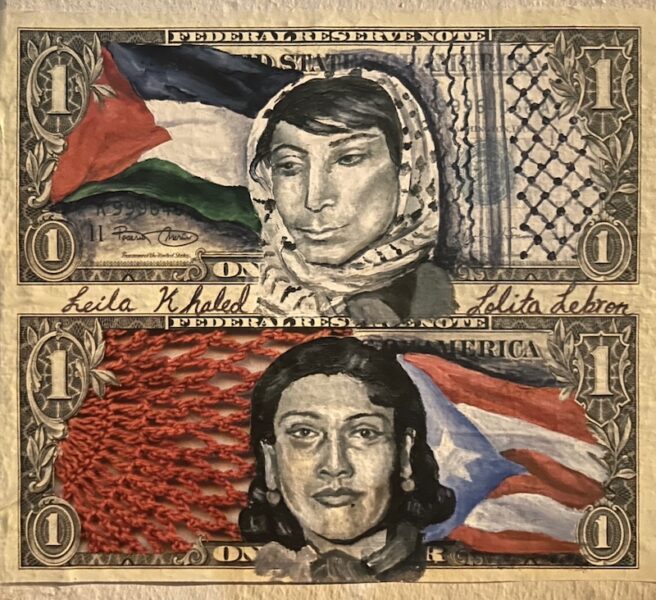
Born from the legacies of these Palestinian and Puerto Rican warrior women are Leila Khaled and Lolita Lebrón, two nationalist freedom fighters determined to continue the fight to free their people from the oppressive grip of Israeli and U.S. colonial power.
While Khaled and Lebrón represented a previous era of armed struggle, much remains unchanged. Today, we are witnessing the same abuses that existed in the 1950s and 60s—continued usurpation of lands, displacement of populations, and aggression and criminalization of resistors. We need only turn to Gaza, where unprecedented atrocities against the Palestinian people—including 15,000 children killed—are being committed with impunity.
The Face of Palestinian Militancy
Known as the “poster girl of Palestinian militancy,” Leila Khaled learned at the tender age of four what it means to be born among a subjugated people. Fleeing their hometown of Haifa after the Zionist forces’ reign of terror in the 1948 Nakba, or “Catastrophe,” as the event is known to Palestinians, her family was among over 700,000 Palestinians who became dispossessed and displaced refugees.
Putting the catastrophe into perspective, Khaled shared an early childhood memory with Break Through News in a 2022 interview:
After the massacre of Deir Yassin, my mother took us to her uncle’s house in Tyre, southern Lebanon. Arriving, we saw oranges on the trees very near to the house entrance—we wanted to cut the oranges. My mother screamed at us, ‘These are not your oranges, you’re not allowed to take them. Your oranges are in Haifa.’ Since that moment, I hated oranges.
The pain in Khaled’s voice is palpable. Her words recal Owda’s search for fruit in a war-torn landscape late last year, linking Owda to Khaled’s earlier raison d’être—the struggle for her people’s land and their Right of Return.
Khaled’s involvement in the 1969 and 1970 TWA hijackings— in which the Popular Front for the Liberation of Palestine (PFLP) demanded the release of Palestinian political prisoners—seared her name on the world’s psyche. In the first sequester of TWA flight 840 en route from Rome to Tel Aviv, Khaled is said to have demanded the pilot fly over her hometown of Haifa because the Israeli government did not allow the Palestinian refugees to return. After landing at Damascus, the PFLP evacuated the aircraft and “blew up the nose section of the plane.” No passengers were injured in the incident. During the hijacking, Khaled delivered a speech to the passengers, saying her intention was “to tell the world about the crimes the Israelis inflict upon our people… for their own propaganda objectives they repeatedly say we attack their ‘innocent’ women and children. I want you to know that we love children, too, and we certainly do not aim our guns at them.”
“Our dream was to go back to Palestine,” Khaled told journalist Marta Vidal in a 2023 New Internationalist interview. She keeps that dream alive today via guest lectures, interviews, and advocating for the rights of women.
Imprisoned 25 Years for Anti-Colonial Struggle
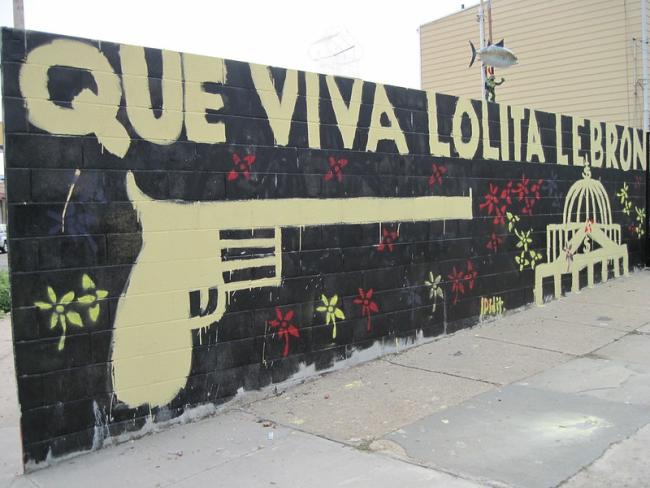
On the Caribbean archipelago of Borikén, Dolores “Lolita” Lebrón Sotomayor was born in the central-western town of Lares. Due to economic uncertainty, she left her native Borikén in 1940 to work as a seamstress in New York City’s Garment District. The exploitation and racial discrimination she faced as a Puerto Rican—which was widespread against Latinxs at that time— created an awareness in the young Lebrón. It was there that she became politically involved with the Puerto Rican Nationalist Party. As a socialist feminist member of the party, she participated in a series of revolutionary actions, including the 1950 Jayuya Uprising. Less than four years later, on March 1, 1954, she led a small group of nationalists in an attack on the United States House of Representatives to draw attention to Puerto Rico’s continued colonial status as a U.S. territory.
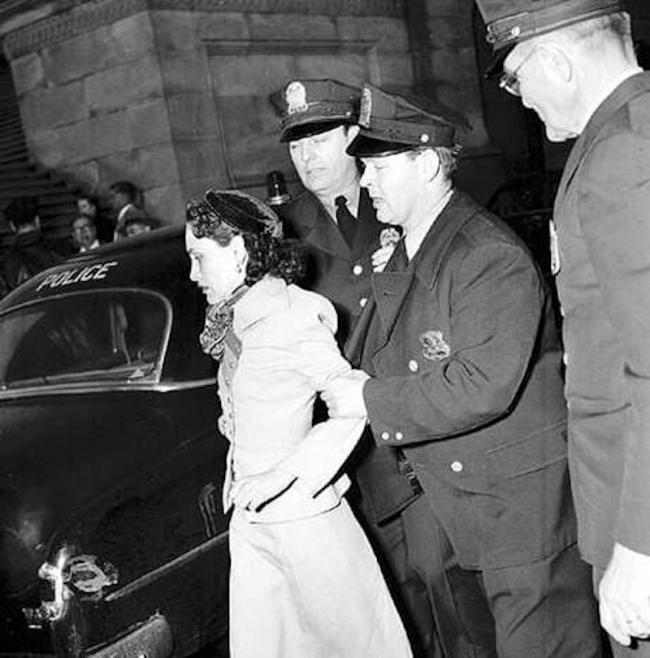
Lebrón and three other Nacionalistas—Irving Flores, Rafael Cancel Miranda, and Andrés Figueroa Cordero—stormed the House chambers with pistols. As they shot, Lebrón unfurled the Puerto Rican flag, shouting “Viva Puerto Rico libre!” Five members of Congress were wounded. Lebrón was convicted of aggravated assault and served 24 years of a 56-year prison sentence; in 1979 she was released after being granted clemency by President Jimmy Carter. Upon being arrested, Lebrón yelled, “I did not come to kill anyone, I came to die for Puerto Rico!”
Lebrón remained a staunch supporter of her country’s independence until her last breath, on August 1, 2010, at the age of 90.
Feminist Collectives Building Bridges of Change
The model set by these two revolutionary women serves as a compass for present-day Puerto Rican political movements like the Black Feminist Project, La Colectiva Feminista en Construcción (La Cole), the Palestinian Feminist Collective (PFC), and the work of Palestinian activist and freedom writer Noora Kassem. These collectives and activists are working to change the narratives around the plight of our peoples and bring about real change in our communities.
In mid-May, I interviewed Shariana Ferrer Nuñez, a prominent leader, spokesperson, and militant with La Cole, a “political organization that stems from the legacy of Black and decolonial feminism, founded in 2014.” We discussed women in the movement, the links between Leila and Lolita, and the definition of violence, which in mainstream media often depicts freedom fighters as senseless perpetrators. A 15-year veteran of political militancy with various independentista and socialist organizations in Puerto Rico, Ferrer Nuñez noted that “women have always been present in social struggles, and the bridge [between Lebrón and Khaled] is that they both participated as [freedom] fighters, so that beyond their identity as women, what unites them is their identity as combatants for the liberation of their nations—occupied and colonized territories.”
Recently, La Cole was involved in the University of Puerto Rico’s Río Piedras campus pro-Palestine encampment, called the Vigil for the Martyrs. Held on May 9th, it was a way for students, community members, and social justice organizations to come together to honor the lives of those murdered by the Israeli military, express solidarity with our Palestinian sisters and brothers, and share in their pain and rage in the face of the ongoing genocide. It was also an opportunity to reaffirm the commitment to end the imperial war machine being aided and abetted by our second colonizers, the U.S. government.
Ending colonization and occupation are just two items on the Palestinian Feminist Collective’s (PFC) agenda. The PFC is “an intergenerational collective of activists, organizers, practitioners, creators, thinkers, artists, scholars, healers… committed to achieving Palestinian social and political liberation by confronting systemic gendered, sexual, and colonial violence, oppression, and dispossession.” The Palestinian and Arab feminists are centering the urgency of the Palestinian struggle and building awareness through events like their moderated panel discussion Land, Life, Love, and Liberation in March 2022. Intentionally held during International Women’s Month, the webinar event commemorated Palestinian Land Day and the first anniversary of the “Pledge that Palestine is a Feminist Issue.” Written by PFC members, the pledge was inspired by “the legacies of solidarity between Palestinian, Black, Indigenous, Third World feminist, working class, and queer communities who have struggled side-by-side within larger anti-colonial, anti-capitalist, and anti-racist movements in the U.S. and globally,” said a PFC spokesperson.
The organization also served as a co-convener for the May 24-26 People’s Conference for Palestine held in Detroit in which artists, activists, community leaders, and organizations came together to “reflect, exchange, and strengthen themselves and each other in the fight for a free Palestine.”
Palestinian activist and freedom fighter Noora Kassem has been part of the struggle for 20 years through her writings and community farming with vulnerable populations in Jordan. “Palestinian women have always been equal partners with our male counterparts in our struggle, centering the liberation and decolonization of our people as a collective,” she recently shared via email. Kassem hails from a long lineage of freedom fighters; her mother, Hala Hijazi, was active with the PFLP during college, and her great grandfathers, Asad Hijazi and Abdel Mohsin Hijazi, were revolutionaries who fought the Zionists during the 1948 Nakba. In her work to end colonialism, especially settler colonialism, Kassem calls on the Palestinian people to “formulate a way and language of resistance that is entirely true to our native voices, essence, heritage, spirit, and evolution.”
As Leila Khaled reminded us during an October 2023 interview with People’s Dispatch: “Where there is repression, there is resistance. People will not live under occupation and repression. History taught us that when people resist, they can keep their dignity and their land.” Indeed, for freedom fighters across the globe, hers are words we live by.
At the time of writing, Gaza has been under bombardment for 307 days. Eight months after Bisan Owda’s post about finding citrus fruit, the people of Gaza are facing famine. Living up to her legacy, Owda continues to post relentlessly about the everyday struggles of her people to survive. Despite her admonishments of global silence, we bear witness to her efforts. She is not alone: From every river to every sea, Palestine, Borikén, and all oppressed peoples will be free!
Lola Rosario is a New York City-raised Afro Boricua cultural storyteller and spoken word poet. Her work focuses on feminism, cultural identity, and social justice issues impacting her ancestral homeland of Borikén.
Source link : http://www.bing.com/news/apiclick.aspx?ref=FexRss&aid=&tid=66b68d96e4904f2e9b13166b9fae8375&url=https%3A%2F%2Fnacla.org%2Ffaces-feminist-resistance-palestine-puerto-rico&c=10668477840678049858&mkt=en-us
Author :
Publish date : 2024-08-09 10:16:00
Copyright for syndicated content belongs to the linked Source.