NEW YORK — Our children are told when they’re little: Play nicely. Work together. Don’t hit. Use your words. Multiply that by nearly 200 countries, leaders of varied backgrounds and a preposterously complex set of 21st-century priorities and goals, and you come up with what exists in the world today: the United Nations.
There, the word for “play nicely” and “work together” is a complex one — “multilateralism” — and its goals often get lost in its syllables. But the principle remains the same: Unite to get more done, unite to offset bullies, unite to find outcomes that all can endorse and that benefit as many of the planet’s human beings as possible — and can be the foundation for an eventual lasting world peace.
At the U.N. General Assembly this week, it’s a principle that leaders — and, not surprisingly, leaders of smaller nations most of all — mention constantly. That’s not just because the U.N. has stood for multilateralism since it rose from the dictator-inflicted rubble of World War II. It is because today, in an interconnected era where human fates lie more than ever in what other humans do in other places, cooperation isn’t just an ideal but a necessary reality, whether anyone wants it or not.
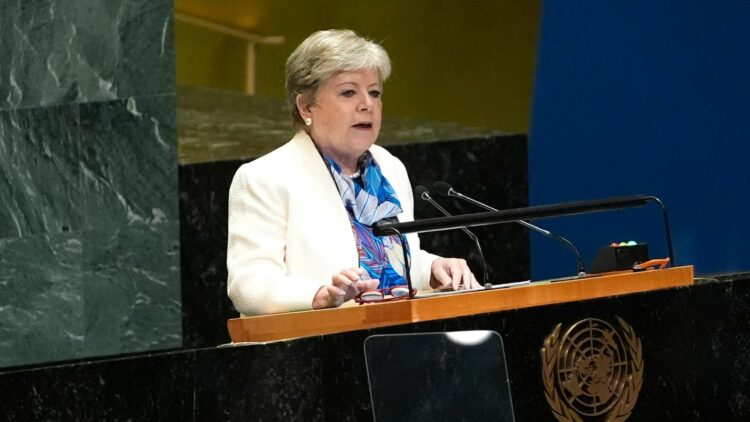
But the problem, many leaders say, is that despite that hope that the U.N. still offers, the aging model of multilateralism — “a mirror that obstinately reflects the values of 1945,” according to Mexican Foreign Minister Alicia Bárcena — hasn’t been retooled to be effective in an era it quite possibly never envisioned.
“We cannot ignore that our common multilateral progress is failing us in the hour of greatest need,” said Hilda Heine, president of the Marshall Islands.
“This old political shell of the post-1945 political order can barely contain the contradictions,” said Ralph Gonsalves, the prime minister of Saint Vincent and the Grenadines. “We cannot continue to rule in the old way, but the new is yet to be born.”
Both of those nations are small ones, and that’s no coincidence. Though many larger nations embraced multilateralism and still do — to a point, depending on their own strategic priorities — it is smaller states that embrace it most fervently. After all, they stand to benefit most from a united front in everything from military operations to development. “For small states, multilateralism in international law is not an option. It is in fact an existential necessity,” Singapore’s foreign minister, Vivian Balakrishnan, said Saturday.
Four generations after World War II ended, the challenges of the 21st century and — of late — the rising tide of populism have led many to conclude that old models of multilateralism aren’t working. But even leaders who still believe that working together and equally is ultimately the most effective and most secure way to do things lamented, one after another, that they are still waiting for the emergence of such a fresh approach.
António Guterres, head of the United Nations for the past seven years, has spent most of that time preaching passionately about the virtues of multilateralism — first patiently, then less so, then more urgently, now increasingly desperately. He knows things aren’t working. He believes they still can — not in spite of an increasingly complex world but precisely because of its realities.
“I have no illusions about the obstacles to reform of the multilateral system,” Guterres told leaders this week. “Those with political and economic power – and those who believe they have power – are always reluctant to change. But the status quo is already draining their power. Without reform, fragmentation is inevitable, and global institutions will become less legitimate, less credible and less effective.”
Fragmentation. That’s a key word here. The rise of the internet and the global economy and the subsequent repercussions stitched things together in some ways but tore them into a million pieces in others. Long-prevailing narratives are crumbling — for good and for ill. Putting the pieces back into a recognizable and productive mosaic — the very job of the United Nations — is a Sisyphean task.
This is where most conversations about multilateralism tend to end up. The very things that make it strong — many voices, many backgrounds, many diverse priorities — also make it, and the United Nations itself, almost impossible to wrangle.
That has a particularly strong impact on those smaller states, which need that collaboration desperately in the face of larger, more muscular ones.
Increasingly beleaguered Tuvalu can’t solve the encroaching waters of climate change on its own. Saint Kitts and Nevis isn’t going to figure out all the impact of AI alone. Without a thriving international economy, there are a lot more problems that descend upon everywhere from Kazakhstan to Suriname to Eswatini. African nations in particular have been seeking a permanent seat on the powerful U.N. Security Council so they can have a strong bloc of cooperation — and power — within the larger one.
“Multilateral institutions, including the Security Council, do not represent African needs and aspirations,” said Nangolo Mbumba, Namibia’s president.
Because of the wide perception that multilateralism is at a breaking point, Guterres this year convened a summit that produced a “Pact for the Future,” a wide-ranging plan that the secretary-general said was “designed to bring multilateralism back from the brink.”
He said that, unlike many other U.N. initiatives, this one must be more than talk and documents but produce tangible, collaborative results in coming years. Essentially, it resembles a soft reboot of the United Nations itself to make it more relevant in an age of globalization, interconnectivity, fragmentation and artificial intelligence.
Many speakers this week have seized upon precisely that kind of modernization across the board — what Mohamed Irfaan Ali, the president of Guyana, called “enlightened multilateralism.” To nations like his, that notion would represent a more substantive inclusion, a world in which they are not simply partners but equal partners — not just being a member of the club of nations, but helping to run the clubhouse.
Could the “great powers” ever accept this? Could a reset, even a limited one, of the only truly global body of nations push the United Nations back on the path it has long envisioned? Everyone, including Guterres, insists that it’s possible — but that time for a new and reinvigorated multilateralism is running out.
“The world stands fractious, polarized and frustrated. Conversations have become difficult; agreements even more so,” said Indian Foreign Minister Subrahmanyam Jaishankar. “Conversations have become difficult, agreements even more so. This is surely not what the founders of the U.N. would have wanted of us.”
The founders recognized that people wouldn’t always play nicely — but that they had to work together. And, ideally, not hit each other. And using their words? Even in a forum committed to dialogue and understanding (not to mention long equipped with real-time translation), that is becoming a taller order with each passing year. “If we carry on like this,” Jaishankar said Saturday, “the state of the world is only going to get worse.”
___
Ted Anthony, director of new storytelling and newsroom innovation for The Associated Press, has been writing about international affairs since 1995. Follow him at http://x.com/anthonyted
Source link : http://www.bing.com/news/apiclick.aspx?ref=FexRss&aid=&tid=66f89661f1e74a12b70d27dab318e5d1&url=https%3A%2F%2Fabcnews.go.com%2FUS%2FwireStory%2Fchildren-learn-cooperate-early-world-leaders-struggle-114320601&c=10690628067856163340&mkt=en-us
Author :
Publish date : 2024-09-28 12:24:00
Copyright for syndicated content belongs to the linked Source.