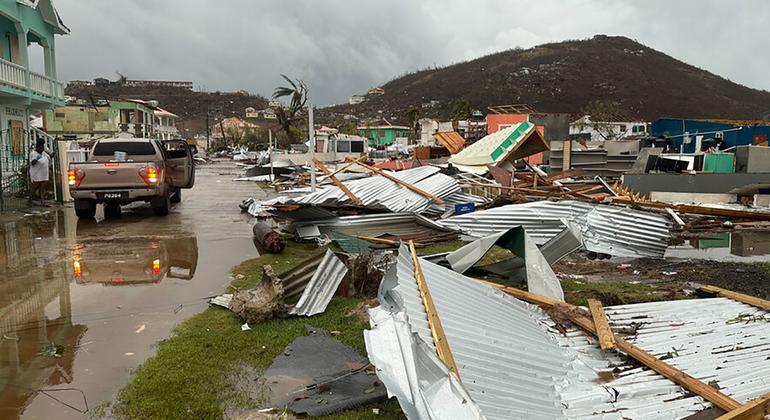
A family stands outside their home destroyed by Hurricane Beryl in Grenada.
‘Pledge to be there for children’
According to the UN Children’s Fund (UNICEF), over 650,000 people – including 150,000 children – in Barbados, Grenada, Saint Lucia, Saint Vincent and the Grenadines, and Tobago were in the path of Hurricane Beryl.
Many have lost homes and are being housed in temporary shelters.
The UN agency for its part had pre-positioned life-saving supplies before the storm and is mobilizing supplies and funds for the response.
“[We are] deeply concerned at the plight of those affected by Hurricane Beryl, especially the most vulnerable – children and women … we pledge to be there for children of the affected countries,” said Pieter Bult, UNICEF Representative for the Eastern Caribbean Area.
Similarly, the UN World Food Programme (WFP) has also deployed teams to the affected islands, supporting authorities with assessments and early response.
In Saint Vincent and the Grenadines, the agency has been asked to provide emergency telecommunications and logistics support, while in Barbados it is assisting with emergency food kits that will be shipped and distributed to people in the affected islands.
‘Very intense’ hurricane season looms
Earlier in the day in Geneva, Vanessa Huguenin, a spokesperson for the UN Office for the Coordination of Humanitarian Affairs (OCHA), said that while humanitarians have been preparing for this hurricane season, “such a strong storm this early is extremely rare.”
“It is also a warning for the anticipated very intense hurricane season that is coming,” she said at the regular media briefing at the UN Office at Geneva (UNOG).
The Atlantic storm season runs from June through the end of November, with 17 to 25 named storms expected. The average is 14 storms a year.
Of those, the UN World Meteorological Organization (WMO) said that eight to 13 are forecast to become hurricanes – above the average of seven – including four to seven major hurricanes.
A major hurricane is category three, four or five on the Saffir Simpson scale, with winds of 110 mph winds (177 km/h), or higher.
“This new reality of unprecedented hurricanes is becoming an annual and ever-present reality for the Caribbean countries while facing the brunt of climate change,” said Rhea Pierre, Disaster Manager at the International Federation of Red Cross and Red Crescent Societies (IFRC).
“The severity of damages in the aftermath of Hurricane Beryl are tangible and devastating.”
Source link : https://news.un.org/en/story/2024/07/1151811
Author :
Publish date : 2024-07-05 16:23:58
Copyright for syndicated content belongs to the linked Source.