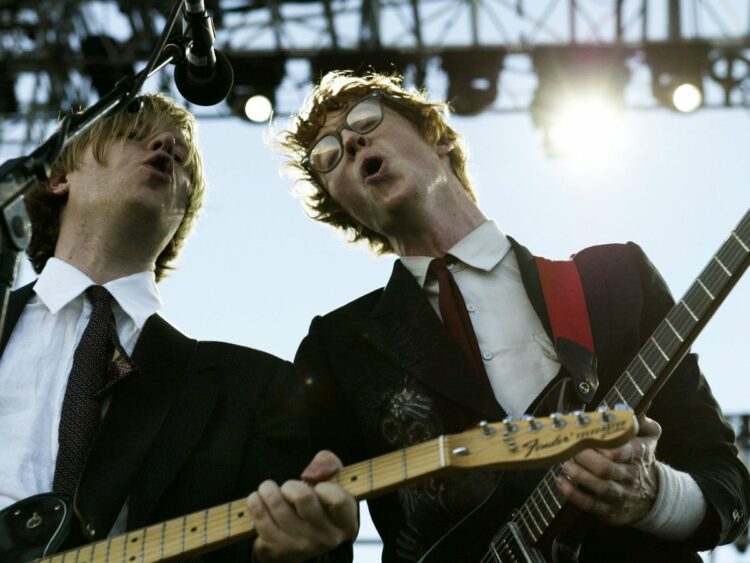
Funeral was very much a living, tempestuous daguerreotype of its environment: Montreal’s sharp, enclosing winters and the wild creative maelstrom broiling within (Getty)
“We were in a small community of active artists and musicians, everyone doing their thing all at the same time in an ugly, chaotic fashion,” says Parry of the early Noughties Montreal scene. “It was very normal to play music with your friends in all their different bands,” adds Sarah Neufeld, Arcade Fire violinist. “It felt like ‘you want a horn player? My roommate is amazing’. It was everyone joining in with everything and if it works, great. If it doesn’t, great.”
Amid this churning thrash of music, Parry and Neufeld began working together in Bell Orchestre, and with Neufeld’s cellist Rebecca Foon on a rich instrumental album First Sounds, which they finally recorded 20 years later during the pandemic and will release in November. And Arcade Fire morphed, writhed and contorted into being, gradually mustering the scene’s currents into an unstoppable tornado. In 1999, Texan native and classic indie rock fanatic Butler quit his fine art course in New York and followed his best friend Josh Deu to Montreal to study religion and Russian literature at McGill University and concentrate on songwriting together.
At a local jazz club, Butler saw medieval student and daughter of Haitian refugees Chassagne sing and, bewitched, set about wooing her as both creative and romantic partner. “The first time we played together, she came up with this great part to the song ‘Headlights Look Like Diamonds’,” Butler told Uncut in 2005. “It was immediately just really, really easy creatively.”
There was a previous version of Arcade Fire that was kind of more acoustic and punk
Richard Reed Parry
Founded in 2001, Arcade Fire went through several incarnations en route to Funeral. “There was a previous version of Arcade Fire that was kind of more acoustic and punk,” says Reed, whose band with fellow future AF members Tim Kingsbury and Jeremy Gara, The New International Standards, would often support Win and Regine’s troupe. “We played a few shows out of town where we’d swap band members and jump in with each other in this kind of chaotic fashion that has informed the DNA of what that band became.”
Reed owned a tape recorder so was asked to help produce the band’s self-titled debut EP at Butler’s family farm in Maine in the summer of 2002. In subsequent jam sessions with the band, he recalls suggesting the vocal line for the upbeat coda to “Wake Up” and jamming out the drum and piano parts for “Neighborhood #1 (Tunnels)” when it was a formative synth soundscape. “[Win] and Regine were jamming it on guitar and this medieval reed instrument and it was just a bonkers thing.” Before long he found he’d kind of fallen into the band.
“That version of [Arcade Fire] imploded and our band dissolved unofficially,” he says. “Then the two things drifted into being together…We overlapped and found each other. It was never like ‘hey, do you want to join our band?’” Neufeld remembers the vocal harmonies of Reed’s band becoming a key element of the cohering Arcade Fire sound. Once Reed had brought her on board, her own classical elegance became pivotal too, even when played in the most inelegant of situations. “You remember The Cave?” she asks Parry. “We were all packed into a little space. I fully played the whole show standing on a chair.”
“Some nights you’re kind of threatening the audience,” Butler said at the time. “You want peoples’ hearts to beat a little faster.” And having only previously toured with a puppet show, Neufeld confesses to some “instrument fear” during wilder early Arcade Fire shows. “I wasn’t a fancy, classical person with a classical job but I was worried about my instrument getting broken, which had happened to other people.”
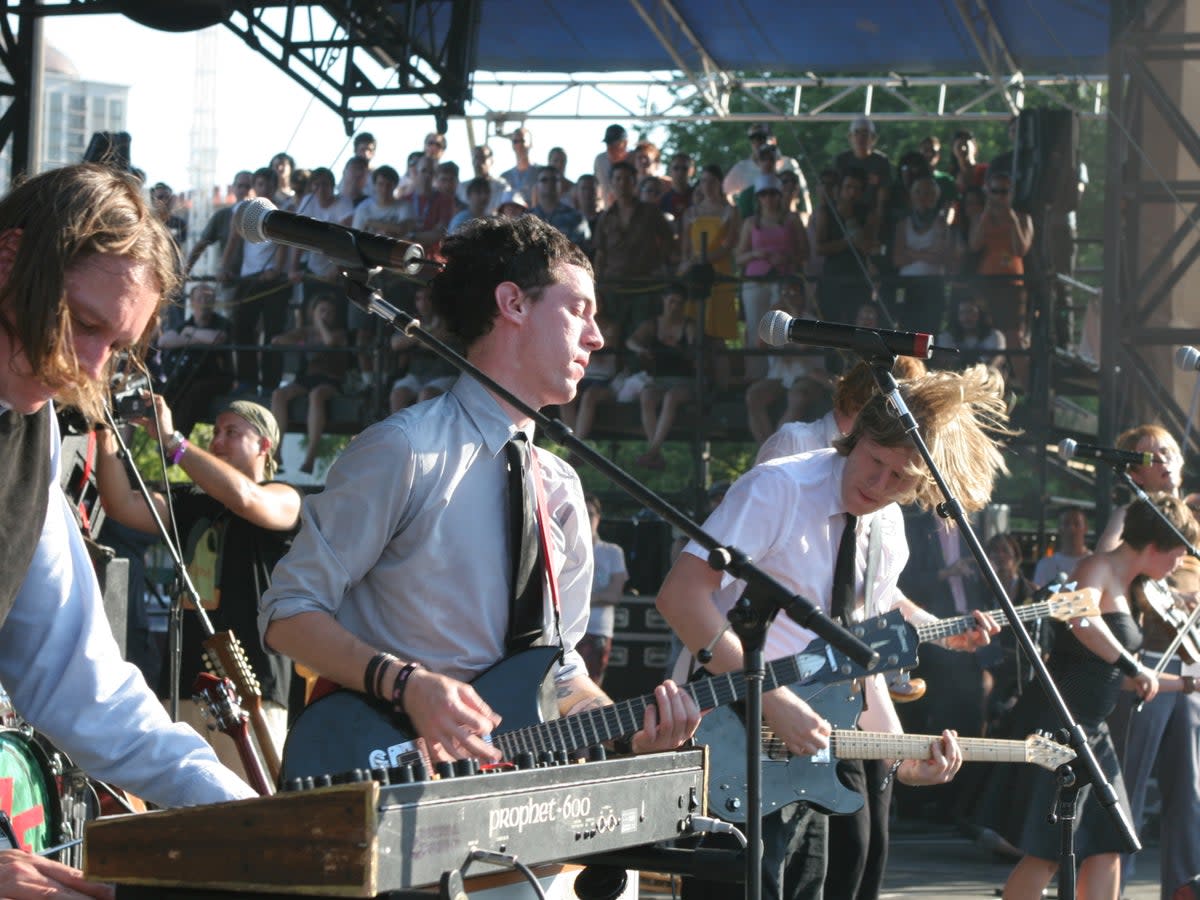
Arcade Fire performing at Lollapalooza in 2005, the year after ‘Funeral’ was released (Getty Images)
The road remained rock-strewn. Reed once quit the band onstage after a row with Butler (only to rejoin later), and drummers came and went with a Spinal Tap-esque abruptness. It was what Reed calls a “very loose and un-boundaried” band, then, which began recording Funeral in August 2003; at local post-rock giants Godspeed You! Black Emperor’s loft studio Hotel2tango (the “epicentre” of the scene, Neufeld says) when they could afford it, and at Butler and Chassagne’s own loft and rehearsal space when they couldn’t. “We didn’t have a lot of money,” Reed says. “So we ended up going back and forth quite a lot with a tape machine in the back of Win’s pick-up truck.”
Over a year of sporadic sessions, this million-dollar edifice of unhinged grace and grandeur was – inconceivably – completed for a total of $10,000. Its frugality might well have been the making of its legend. Howard Bilerman, owner of Hotel2tango and soon to become one of Arcade Fire’s revolving cast of drummers, co-produced the record alongside Reed and the band, and would sometimes leave them the keys for the studio when it wasn’t being used. “We’d end up using it wrong,” Reed laughs. “He’d come back and be like ‘this is insane but it sounds good’. It was me just trying stuff as best I knew how. Anything distorted or explosive sounding would make me excited so I’d gravitate towards those things, Howard would push back and somehow it got to where it was.”
Such unpractised enthusiasm was the bedrock of Funeral’s rebel-rabble righteousness. Reed enthuses about the freedom of sessions spent in the Arcade Fire loft, creating and improvising the string quartet parts: “There were four of us on our feet coming up with arrangements as an ensemble and everyone figuring out how their part would work. It was so creative.” Neufeld hails the enduring sound they created there. “Whenever we play together,” she smiles, “it’s still pretty magical.”
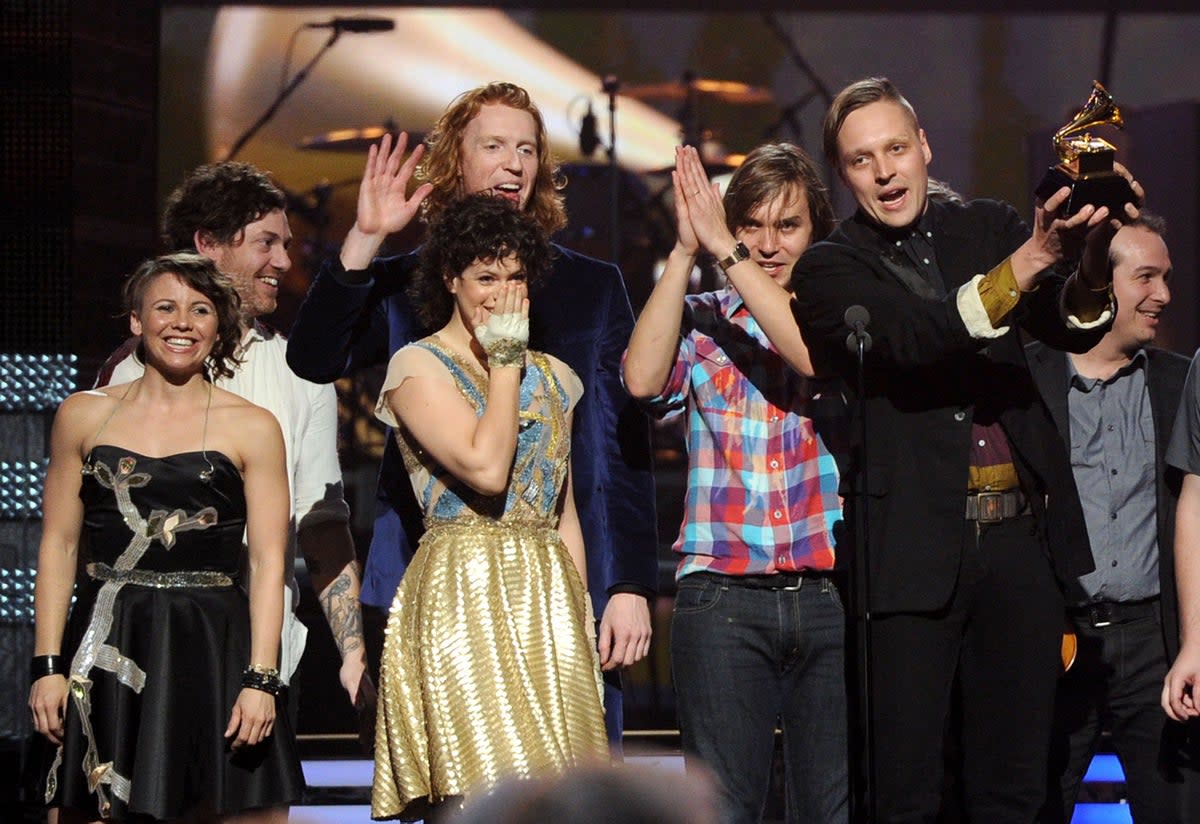
Arcade Fire’s Sarah Neufeld: ‘Whenever we play together, it’s pretty magical’ (Getty)
Particularly when teasing out the otherworldly textures of Funeral’s songs; songs of corroding youth, anguished adulthood, escape and defiance, set in a wintry landscape somewhere between dream and waking. Many of the songs concern childhood hope and naivety colliding with the realities of adulthood. Both “Neighborhood #1 (Tunnels)” – based on a Beethoven melody Butler had heard in A Clockwork Orange – and “Neighborhood #3 (Power Out)” were inspired by the idea of children running amok during a real-life week-long Montreal blackout in the harsh winter of 1998.
“There was an ice storm, and the power lines were all crooked,” Chassagne told Spin in 2006. “It was so crazy and I got lost in my own city.” In the former, the children dig tunnels through the snow to run away from their troubled homes and start new lives as ice-dwelling primitives. In the latter, they swing from power lines, pick fights and die out in the snow while their parents lie frozen in their beds. A vivid scene of desolation, anger and release, it’s a purposefully ambiguous metaphor.
“There are always two sides to a coin,” Win told the National Post. “You can hear a song like ‘…Power Out’, and the line, ‘There’s something wrong in the heart of man/ Take it from your heart and put it in your hand,’ and interpret that as uplifting. I see it as, if there’s something f***ed up in your heart, you’re going to put it in your hand as a sword.”
If there’s something f***ed up in your heart, you’re going to put it in your hand as a sword
Win Butler
A similar dichotomy plays out throughout the album. The frantic “Rebellion (Lies)” is told from the perspective of a child fighting back against early bedtime, shot through with a message to live every hour, day or night. And on the powerful centrepiece “Wake Up”, a glorious cloudburst of churning guitar, pounding drum, orchestral swell and the euphoric wails of a heavenly host on a chain gang to hell, Butler warns children against growing up, losing their innate honesty and being forced to adjust to shredded hearts and dreams rusting away. Yet there’s a cheery cha-cha coda wherein he uses his adult cynicism to become a bolt-throwing god of lightning: “You better look out below!”
Into this raw mass of maturing emotion, grief is delicately carved. Chassagne sings “Haiti”, a song about the murders of her aunts and uncles in the Sixties by François Duvalier’s brutal Haitian regime, and the cousins she’ll never have as a result. On “In the Backseat”, she details the self-determination thrust upon her by the 1999 death of her mother Alice, who had fled Duvalier’s purge of the intellectual class to French-speaking Montreal. “My family tree’s losing all its leaves,” she sings, leaving her “crashing towards the driver’s seat”.
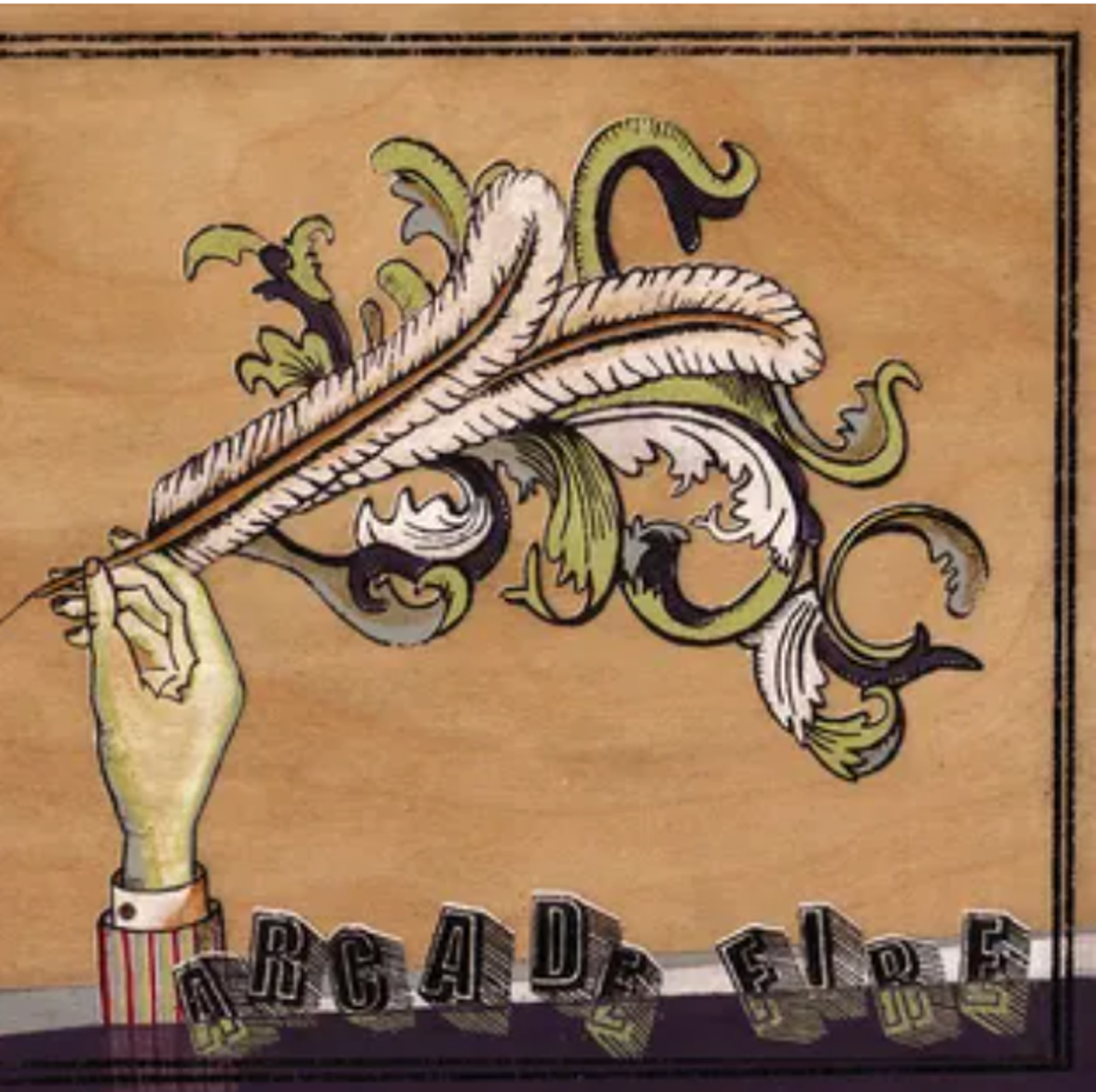
The cover art for Arcade Fire’s ‘Funeral’ (Merge)
“It wasn’t like ‘guys, let’s channel our grief into this album in a quantifiable, conscious way’,” Parry says, but he and Neufeld acknowledge the effect that loss had on the band’s early years. “My dad died when I was 17,” Parry says. “I wouldn’t have started playing music in a real way. I wouldn’t have joined a band and been screaming and wanting to break stuff and get in front of people and sing and harmonise – I wouldn’t have been doing that if that hadn’t happened. I think probably the same for Regine in a similar time period… You don’t have a name for it, but you do have this feeling of ‘I just wanna open up the heart chamber and put it out there’. It does plant something in you that needs to find a place in the world.”
The place Funeral found was an elevated and influential one. “You notice where it’s crept into culture,” Parry says. “I definitely can hear the musical impact of it in its ways, fortunate and unfortunate, out there in the world. Every time you hear annoying songs aping ‘Wake Up’ you’re like ‘urgh’.” For those who made it, though, Funeral’s legacy is more experiential.
“We were growing up,” says Neufeld. “We’d just finished university, all living in this town together trying to pay the rent and make music. It was a crazy time being super-scruffy young people, being in that music. It was so emotionally compelling [as a record] too. I still well up if I hear certain songs from that album.” Dearly beloved indeed.
Source link : http://www.bing.com/news/apiclick.aspx?ref=FexRss&aid=&tid=66e2b87546654f3b87359dc337798d7c&url=https%3A%2F%2Fwww.aol.com%2Fnews%2Fblood-piano-inside-chaos-grandeur-054828939.html&c=17759733766132988552&mkt=en-us
Author :
Publish date : 2024-09-11 21:48:00
Copyright for syndicated content belongs to the linked Source.