A research team led by SMU discovered ancient rocks and fossils in Angola that provide the most complete geological record of the splitting of South America and Africa and the formation of the South Atlantic Ocean. These findings, dating back 130 to 71 million years, offer a unique view of the continents’ separation, with Angola’s coast showcasing each phase of this significant geological event.
Rocks and fossils found in Angola by an SMU-led research team offer an unparalleled view of the formation of the South Atlantic Ocean, illustrating the split of South America and Africa that began about 140 million years ago.
A research team led by Southern Methodist University (SMU) has discovered that ancient rocks and fossils of long-extinct marine reptiles in Angola provide clear evidence of a crucial event in Earth’s history: the separation of South America and Africa and the formation of the South Atlantic Ocean.
With their easily visualized “jigsaw-puzzle fit,” it has long been known that the western coast of Africa and the eastern coast of South America once nestled together in the supercontinent Gondwana — which broke off from the larger landmass of Pangea.
The research team says the southern coast of Angola, where they dug up the samples, arguably provides the most complete geological record ever recorded on land of the two continents moving apart and the opening of the South Atlantic Ocean. Rocks and fossils found date back from 130 million years ago to 71 million years.
“There are places that you can go to in South America, for instance, where you can see this part of the split or that part of it, but in Angola, it’s all laid out in one place,” said Louis L. Jacobs, SMU professor emeritus of Earth Sciences and president of ISEM. Jacobs is the lead author of a study published in The Geological Society, London, Special Publications.
“Before this, there was not a place known to go and see the rocks on the surface that really reflected the opening of the South Atlantic Ocean, because they’re now in the ocean or eroded away,” Jacobs said.
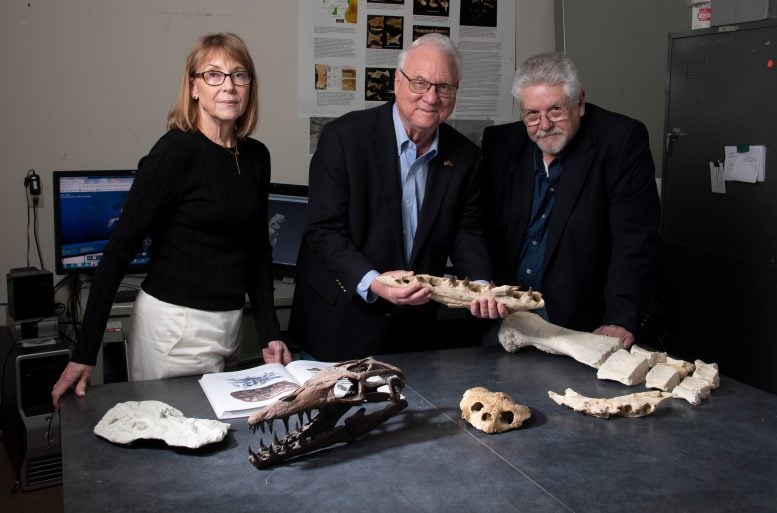
(From left) SMU paleontologists Diana P. Vineyard, Louis L. Jacobs, and Michael J. Polcyn, standing with fossils found in Angola. Credit: SMU, Hillsman S. Jackson
Angola rocks and fossils tell the whole story
Africa and South America started to split around 140 million years ago, causing gashes in Earth’s crust called rifts to open up along pre-existing weaknesses. As the tectonic plates beneath South America and Africa moved apart, magma from the Earth’s mantle rose to the surface, creating a new oceanic crust and pushing the continents away from each other. And eventually, the South Atlantic Ocean filled the void between these two newly-formed continents.
Scientists have previously found evidence of these events through geophysics and well cores drilled through the ocean floor.
SMU paleontologist Louis L. Jacobs, lead author of a study that outlines what rocks and fossils were found in Angola, explains in a video why these findings provide clear evidence of the split between South America and Africa and the subsequent formation of the South Atlantic Ocean. Credit: SMU, Garret Holton
But these tell-tale signs have never been found in one place, or been so clearly visible for anyone to see, said study co-author Michael J. Polcyn, research associate in the Huffington Department of Earth Sciences and senior research fellow, ISEM at SMU.
“It’s one thing for a geophysicist to be able to look at seismic data and make inferences from that,” he said. “It’s quite another thing to be able to take a school field trip out to the rock formations, or outcrops, and say this is when the lava was spreading from eastern South America. Or this was when it was a continuous land.”
Essentially, Angola presents the opportunity for someone to easily walk through each phase of this geologically significant chapter in Earth’s history.
“That gives Angola major bragging rights,” Jacobs said.
Jacobs, Polcyn, and Diana P. Vineyard – who is a research associate at SMU – worked with an international team of paleontologists, geologists, and others to analyze both the rock formations they found in eight different locations on the coast and the fossils within them.
Fieldwork in Angola’s Namibe Province began in 2005. At that time, the research team recognized particular types of sediments, which gave them a good indication of what the western coast of Africa had been like at various stages millions of years ago. For instance, fields of lava revealed volcanic outpourings and faults or breaks showed where the continents were being rifted apart. Sediments and salt deposits showed ocean flooding and evaporation while overlying oceanic sediments and marine reptiles showed completion of the South Atlantic Ocean.
Paleontologists, meanwhile, discovered fossils in Angola from large marine reptiles that had lived late during the Cretaceous Period, right after the Atlantic Ocean was completed and while it grew wider.
By bringing together experts from a wide range of fields, “we were able to document when there was no ocean at all, to when there was a fresh enough ocean for those reptiles to thrive and have enough to eat,” Vineyard said.
Reference: “The Atlantic Jigsaw Puzzle and the geoheritage of Angola” by Louis L. Jacobs, Stefan Schröder, Nair de Sousa, Richard Dixon, Edoardo Fiordalisi, Arthur Marechal, Octávio Mateus, Pedro Claude Nsungani, Michael J. Polcyn, Gustavo do Couto Ramos Pereira, Nathan Rochelle-Bates, Anne S. Schulp, Christopher R. Scotese, Ian Sharp, Carlos Gaudari Silvano, Roger Swart and Diana P. Vineyard, 24 April 2024, Geological Society London Special Publications.
DOI: 10.1144/SP543-2022-301
Many of the ancient fossils are currently on display at the Smithsonian’s National Museum of Natural History “Sea Monsters Unearthed: Life in Angola’s Ancient Seas” exhibit, which was co-produced with SMU – a nationally-ranked Dallas-based private university.
Angolan researchers – Nair de Sousa, a geoscientist and energy consultant at the African Circular Business Alliance, and Pedro Claude Nsungani, a geology professor at the Universidade Agostinho Neto – also played a key role in this research.
Source link : https://scitechdaily.com/?p=400798
Author :
Publish date : 2024-07-30 00:25:15
Copyright for syndicated content belongs to the linked Source.