FA governments also oversaw a massive expansion of genetically-modified soy, which expanded from zero to one million hectares (2.4 million acres) between 1999 and 2019. Meanwhile, imports of pesticides quadrupled from four to 18 million tons between 2000 and 2010. Soy is now one of Uruguay’s top three exports, along with cellulose and beef. Like other so-called Pink Tide progressive governments that came to office in Latin America during the same period, the FA benefited from a rise in global commodity prices driven by demand from China. But they became increasingly dependent on the revenues from exporting these raw materials to fund their social programs and raise living standards, and this economic model—described as “progressive extractivism” by Uruguayan biologist Eduardo Gudynas—entrenched Latin America’s historic position in the world economy as a supplier of commodities to richer countries.
Environmentalists also clashed with the Frente Amplio over plans to open a vast open-pit iron ore mine, which was eventually abandoned due to falling metal prices, and a 2017 “irrigation law” that gave agribusiness the right to siphon off water and create their own reservoirs.
Ana Filippini belongs to the environmental group Coordinación por el Agua. She was once a member of the FA, but like many activists, she became disillusioned with the party. “They might talk about sustainability,” she said, “but their actions are non-existent.”
Popular Movements Enshrine Water as a Human Right
Twenty years ago, the picture was very different. Uruguay was the first country in the world to enshrine water as a human right in its 2005 Constitution, following a popular campaign that began as a struggle against the privatization of two regional water companies and culminated in a nationwide referendum. The campaign was led by the trade union of the state-owned water company, groups of urban residents, environmental NGOs, and academics who together founded the Comisión Nacional en Defensa del Agua y la Vida (CNDAV, the National Commission in Defense of Water and Life).
Frente Amplio supported this popular movement against neoliberal privatization and the commodification of water. The party was elected to government on the same day as the so-called “Water-Referendum” in 2004, in which 65 percent of the population voted for a constitutional amendment declaring water to be a common good and fundamental right. While in office, the FA set up a participatory structure so that citizens could discuss water policy, but Carmen Sosa of the CNDAV says these local committees were increasingly ignored “unless there was strong community pressure, forcing the government to listen.”
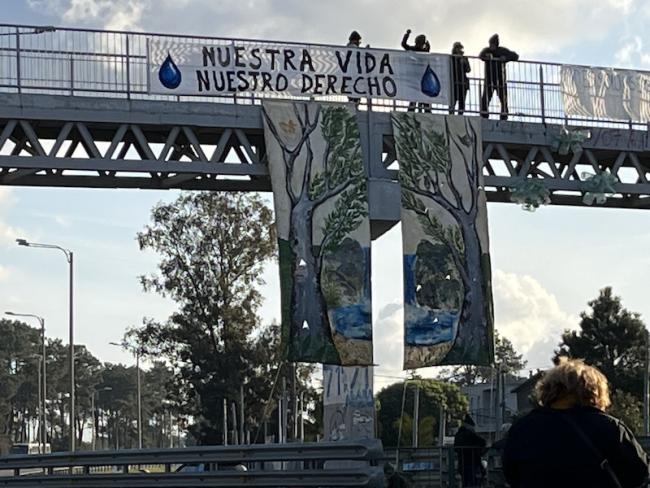
In 2022 a new water protest group, the Coordinación por el Agua, was set up. “We wanted to bring together activists from the different environmental protest groups,” says Daniel Pena, an academic and member of the Coordinación. “We have great respect for the achievements of the CNDAV, but it now mainly works through institutional channels, and we wanted to focus on direct action in the streets.” The group launched itself with a street gathering featuring music and speeches from the crowd.
Just a year later, the reservoir that supplies water to Montevideo and half of Uruguay’s population began to run dry. New spontaneous protest groups emerged after a well-known singer, Sofia Álvez posted a call on Instagram to take action. Organized through open street assemblies and Whatsapp groups, the so-called auto-convocades, or self convened groups, held demonstrations in central Montevideo and then spread out to local neighbourhoods, holding public meetings on street corners. “They held really imaginative events using art and music, with new young activists mixing with old hands,” recalls Pena. “We in the Coordinación participated and tried to amplify their impact by spreading the word.”
María Carmen Blanco is part of a self-convened group. “It just grew spontaneously. Some of us had been involved in human rights groups, we got together and went out on the streets and it spread by word of mouth,” she explains. Since the drought subsided last September the protests have ended and many self-convened groups have dissipated, although Maria Carmen’s group continues to meet.
The center-right National Party of President Luis Lacalle Pou was in power during the 2023 water crisis, and there are some points of consensus between water activists and the Frente Amplio regarding Lacalle Pou’s administration. They agree that Lacalle Pou was slow to respond to the water shortage, waiting months before helping the poorest families to buy bottled water. Similarly, independent activists and the FA oppose the government’s proposed solution “Project Neptune,” which involves building a desalination plant on the Rio de la Plata and contracting private companies to build a long pipeline to the capital. They’re celebrating a recent court judgement that suspends the project; the judge agreed with campaigners that the project entailed the partial privatization of the water industry, and therefore violates the constitution.
Green Hydrogen and Green Extractivism
There is also widespread anger among activists about plans to manufacture green hydrogen and green fuels in Uruguay. Green hydrogen can be used as an alternative to fossil fuels in industry and transport. It’s made by putting an electric current through water; if the electricity used for this is renewable, it is called “green” hydrogen. Green fuels are made by combining a source of carbon—such as forestry waste—with green hydrogen.
There are two major green fuel projects in Uruguay: the German company Enertrag plans to export green methanol from the western town of Tambores using fresh water from Uruguay’s largest aquifer, the Guaraní; and HIF Global—a joint enterprise between Chilean companies and Germany’s Siemens & Porche—intends to build a green fuel manufacturing complex in the department of Paysandú.
Activists say that Uruguay’s water is effectively being exported to fuel Europe’s green transition and are unanimous that this is a form of extractivism. But the arguments are complex. One of the achievements of the Frente Amplio governments was transforming the country’s electricity grid to over 90 percent renewables. The conservative government is now promoting green hydrogen as the next stage of the energy transition, which, it claims, could allow Uruguay to decarbonize its industry and transport systems. But Pena is sceptical, noting that “all the major green hydrogen projects are for export, not for Uruguay. And, as for replacing fossil fuels, every time a new energy source has been created in the 200 years of capitalism, it hasn’t replaced the previous type of energy, it simply adds to energy consumption.” The FA has not yet come to a position on green hydrogen; it is generating internal debate within the coalition because some FA activists living near the proposed schemes oppose them.
The FA has a unique structure in which local party activists—through a network of “base committees” —help draw up the party’s policy directions. The FA’s vice-president, Veronica Piñeiro, says that throughout its period in office there were intense internal discussions: “Those of us who were active on environmental issues argued constantly to make these a priority.” She accepts that the promotion of forestry and cellulose pulping led to a “distancing” with many environmental activists, but notes that these policies “created economic growth and a boost to GDP at a time when the country needed growth.”
The environment is now one of the central axes of the FA’s “base programmatic principles,” she says, “with the understanding that Uruguay needs to develop and grow.” These principles were drawn up over two years of debate at all levels of the party. Addressing child poverty and mental health are two of the key themes that emerged from this grassroots process, which will set the direction for the electoral platform of presidential candidate Orsi. While it’s not clear to what extent the FA will continue to promote the expansion of agro-industries and green fuels, it is certain that this extractive model will continue if the right-wing National Party wins the elections. Campaigners also fear a creeping privatization of the water industry because the National Party wants to give private companies a greater role in building water infrastructure, such as reservoirs and pipelines.
Perhaps surprisingly given the shortages last year, water and the environment have not been central issues in the current Uruguayan election campaign. Parties have focused on living standards, jobs, and improving citizen security, following a rise in drug-related urban violence. Piñeiro hopes that environmental movements will push issues like agro-ecology on the agenda. “We need strong social movements. That is fundamental for a left-wing party like the Frente Amplio. The need for social organization around issues is essential to drive environmental change.”
Grace Livingstone is a journalist and affiliated lecturer at the Centre of Latin American Studies, University of Cambridge. Her books include Britain and the Dictatorships of Argentina and Chile (1973-82) and America’s Backyard: the United States and Latin America from the Monroe Doctrine to the War on Terror.
Source link : http://www.bing.com/news/apiclick.aspx?ref=FexRss&aid=&tid=66d0d9e21f5647298aeae3f2f5c512cb&url=https%3A%2F%2Fnacla.org%2Fits-not-drought-its-plunder-water-conflicts-ahead-uruguays-presidential&c=14624145799565926052&mkt=en-us
Author :
Publish date : 2024-08-29 08:05:00
Copyright for syndicated content belongs to the linked Source.