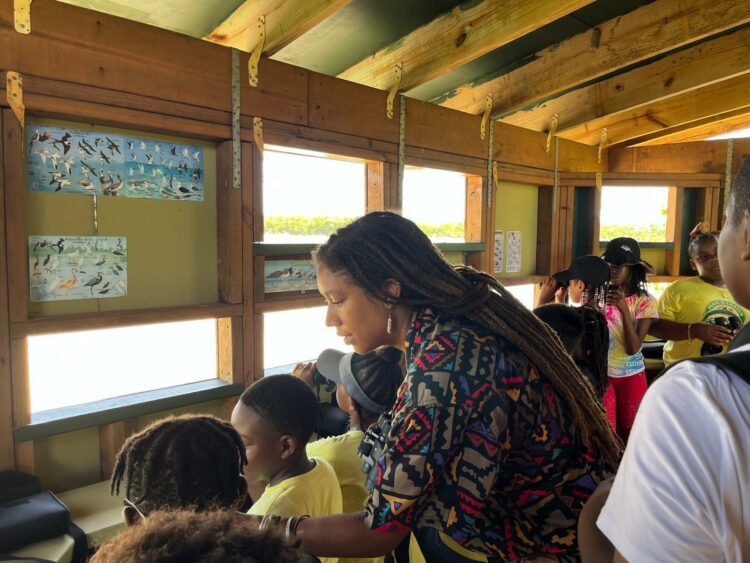
Chickens were roaming the sunny waterfront of Frederiksted, located in the west of St. Croix, the southernmost island of the U.S. Virgin Islands, as I walked under the scorching but beautiful sun to meet Olivia Walton, an environmental educator native to the historic town.
That same waterfront saw her enjoy snorkeling as a child with her mom. Now, for her work at St. Croix Environmental Association — known locally as SEA — a nongovernmental organization focused on environmental conservation, stewardship, and education, she takes students to the spots that cemented the love she feels for her island.
A return home
“I’m really proud of the work that I’ve been able to do so far, and I feel even more connected to my home than I’ve ever really felt,” said the 33-year-old environmental educator when asked how things were since she moved back to her native St. Croix.
Like many residents of our Caribbean islands, Walton left to seek opportunities, graduating with a degree in natural resources from Cornell University and a master’s degree in environmental science from the University of New Haven. Though much of her adult years were spent in the continental U.S., her desire to return home never vanished.
“It was definitely a tougher transition than I thought [to return home]. I feel … the culture shock of being home and having to slow back down, not having as many resources as you may be used to,” she said. “But then I really settled back in and kind of figured out how to navigate the work that I do and want to do as an adult in this space … Being here as an adult has been a learning process, but a beautiful process.”
Walton with some of her students. (Image credit: St. Croix Environmental Organization)
Another adjustment she’s had to make: The places she loved as a child are no longer the same. She sees the damage that climate change has caused in the Caribbean, including coral bleaching, droughts, and stronger hurricanes.
“It is hard, it does bring about difficult emotions,” she said. “I’d like to take a positive framing when I work with my students, and so I do communicate that it has changed drastically, but I also communicate that they can do something about it.”
SEA works to protect and conserve St. Croix’s environment through projects and programs that support islanders’ social well-being. The organization facilitates free snorkeling clinics and other activities that support community-building and resource-sharing, such as environmental advocacy around pollution reduction and mitigation, capacity-building training, and educational programs. The programs include free summer camps for kids and youth, including one that Walton leads.
She said that it is important for the students to build relationships, not only among themselves but with their surroundings to build a sense of connection, which nurtures environmental conservation and stewardship efforts.
“I firmly believe that to protect the future of our environment we must teach our children to love the Earth,” she said.
It is getting hotter
Hot and acidic ocean surface waters have harmed coral reefs in the U.S. Virgin Islands and the whole of the Caribbean. Today, St. Croix is hotter than when Walton was a child, and projections show that the average temperature will continue to increase.
Hurricane Beryl caused damage on Caribbean islands to the west and south a few days before our interview, worrying many residents who are still recovering from the impacts of Hurricanes Irma and Maria in 2017. Those storms ravaged the island and others in the region, exacerbating existing challenges, such as not having a reliable energy supply and grid.
These shocks compound and contribute to people’s vulnerabilities in an import-dependent U.S. territory facing structural and political inequities. And that doesn’t go unnoticed in the summer program.
“I talk with my students about eco-anxiety and climate grief, about how to manage them,” Walton said. “We also go through an activity where they stand along a spectrum whether they agree or disagree on various actions, and we also talk about whether they feel responsible for climate change and about potential solutions at different levels.”
Walton said the responses among the students were mixed: “A lot of them felt like they are not responsible for what has happened, but some of them felt they have the responsibility moving forward for what happens in the future. And some of them didn’t feel like they should have to be responsible for this now, and I can completely understand that it is very frustrating.”
It’s an important discussion given the Caribbean’s long history of colonialism, systemic inequality, and racism that has put the region at a disadvantage in facing the effects of climate change.
Studies have shown that young people around the world are feeling worried and anxious about climate change.
“I can completely understand their frustration,” Walton said. “Even those that feel very passionate about it struggle with the fact that it feels like a lot of pressure on them.”
Walton wants them to be just as mindful of the mental health and emotional impacts of climate change as its physical impacts: “I do see a shift throughout the programming to a space where they are more informed, but also feel more agency.”
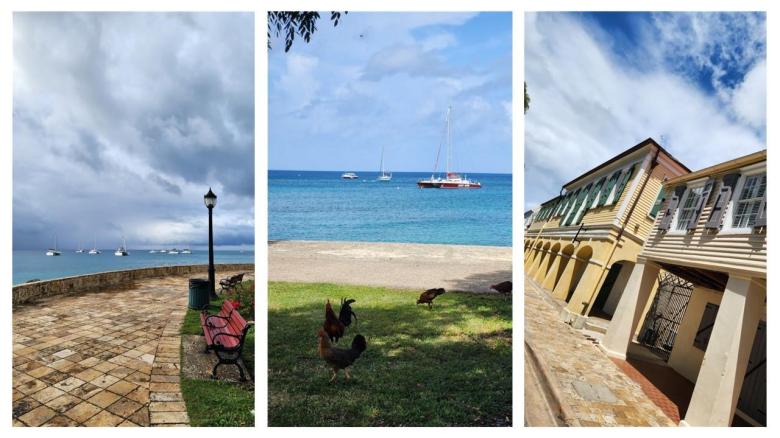 A series of photos of Frederiksted, one of the two main towns on the island of St. Croix (Image credit: Luis Alexis Rodriguez Cruz)
“Basically, they take an environmental issue that they’ve found interesting, or they’re passionate about, and they do something about it,” she added. “I like to encourage them to think outside of the box.”
Students participate in educational campaigns, community outreach activities, and science communication projects. One year, the kids ran a campaign transforming a popular jingle to share environmental conservation messages.
“[The students] took one of the popular ones about a tire shop, and they revamped it to the same tune, but they talked about leaving tires on the roadside, about pollution, the environmental harm it does in terms of, you know, it can be marine debris but also breeding grounds for mosquitoes and the impacts of actually leaving tires by the roadside instead of disposing of them properly,” she recalled, her face lighting up.
She also takes students to see and participate in climate mitigation and adaptation work being done in St. Croix, such as coral restoration projects, environmental stewardship campaigns, local food production, and others, providing them with glimpses of possibilities and transformation that they can lead or be part of.
Her work is paying off: Walton was recognized by the North American Association for Environmental Education in a 30 under 30 class that highlights educators contributing to a sustainable future.
It’s not just about the kids
Beyond positively impacting broader communities, students have touched their own families.
“I’ve had parents of students show up at events and get more involved in the environmental field because their children are showing interest in it,” Walton said. “The most common thing is just that they’re so happy that their kids really did something that they were really proud about.”
At an open house for Walton’s program, students brought family and friends to kayak on a protected reserve. One student brought their entire family, she said. Another component of the program is to get students to fortify and expand their ties with their communities, to better understand their surroundings and to assess climate risks and vulnerabilities with their families.
Walton underscored that mutual aid and community ties are important in building resilience in the Caribbean – by sharing resources to navigate the impacts of climate change and to better anticipate and prepare for those impacts.
And that is something that is also built into the program: It broadens community bonds and friendships.
“I have so much faith and trust in my community that I know I will be OK, that whatever happens, we’re going to come together,” Walton said. “My neighbor’s not going to go hungry, and I’m not going to go hungry. We’re going to make sure that we have collectively the things we need in our small pockets of community.”
Editor’s note: This interview was conducted in July before Tropical Storm Ernesto affected the U.S. Virgin Islands.
We help millions of people understand climate change and what to do about it. Help us reach even more people like you.
Source link : http://www.bing.com/news/apiclick.aspx?ref=FexRss&aid=&tid=66fd36b079894b809b75a9d94d20cb20&url=https%3A%2F%2Fyaleclimateconnections.org%2F2024%2F10%2Fus-virgin-islands-native-returns-to-st-croix-to-support-environmental-change-makers%2F&c=10417224461908438054&mkt=en-us
Author :
Publish date : 2024-10-02 00:11:00
Copyright for syndicated content belongs to the linked Source.