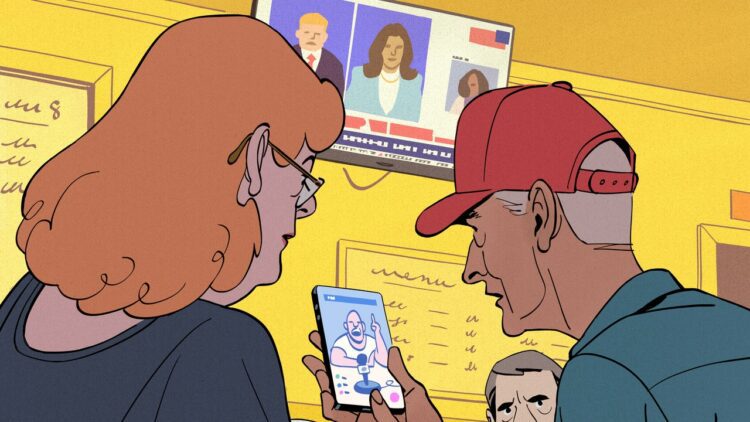
Monica Sheppard lives in Rome, Georgia, where she runs a bee-themed arts-and-crafts shop. Rome is a right-leaning town in the rural, poor, and intensely conservative northwest corner of the state. Education rates are low, and mainstream news does not easily take root. Marjorie Taylor Greene, who became the district’s congresswoman in 2021, was elected in part because, for many voters, identifying with the QAnon conspiracy theory, as she’d recently done, was less troubling than identifying with the Times. Sheppard, who is fifty-seven, is an occasional Times reader, but she has plenty of friends in the area who do not share her news-reading habits or her mostly liberal views. And, despite what Sheppard calls the “brick-wall-head-beating of it all,” she often engages with them over political issues online. “I guess I’m just fascinated by how people think,” she told me.
Recently, Sheppard showed me one of many Facebook posts that have concerned her. A friend named Scott had shared a meme from a Facebook page called The Absolute Truth, which takes scattershot aim at science, liberals, the media, Bill Gates, Stephen Hawking, and the TV show “The View,” among other things. Its ethos is neatly outlined in one of its posts: “You get used to it, I don’t even see the news anymore. All I see is false flag, psyop, bullshit.” The meme that he posted showed an image of a Chili’s storefront. “Another major American franchise bites the dust,” it read. Scott added in his post, “I saw on U tube that 10 other big chain restaurants are on the endangered list including Fudruckers, Krystal, Red lobster, and others you know!” Some commenters noted other “major American” restaurant chains on the brink of collapse, and others made mocking reference to Joe Biden’s economic policy (“Build back better you know”), which they seemed to hold responsible for the closings. Still other commenters pointed ominously to larger forces at play. “A BIG reset is coming,” one woman wrote.
After stumbling across this discussion on Scott’s Facebook page, Sheppard told me, “I did a quick Google search and found multiple articles about these viral memes about restaurants closing that are not true.” Beneath Scott’s post, Sheppard wrote, “This actually isn’t true.” Scott responded gracefully, by the standards of the medium, but without quite giving in. “I do hope you are right but business closing and layoffs are appearing more each day for some apparent reason?” he wrote. A woman named Deena added, “Show us how it isn’t true?” Sheppard replied, “All I had to do is search ‘Chili’s closing all stores’ and found many news stories about it not being true and about a rash of viral memes like this one . . . none of which are true.” She went on, “It is always wise to research a meme before taking it as fact!” Arguing ensued about how many stores Chili’s was closing—fewer than twenty, it turned out, out of more than fifteen hundred—and what this meant. Many suggested that the meme was pointing to deeper truths: the economy was bad, Biden was responsible for it, and anyone saying otherwise was not to be trusted. “We also know that the media lies,” Deena said.
A commenter named Heather questioned Sheppard’s methodology. “And you believe google?” she wrote. Sheppard decided to log off. “I found it scary that she would trust a meme that her friend posted on Facebook, but would not trust Google providing multiple sources from which to choose for more reliable information,” Sheppard told me. She noted that this was not her first encounter with poorly informed Georgians. A family member, she said, gets some of her news from televangelists.
I reached out to Scott, who works in private equity. He stuck by his guns. “I love Monica,” he told me. “But I think Monica goes directly to sources of information.” This, he suggested, was not the right approach. “Use common sense,” he went on. “Food is much higher now. There’s so many things against restaurants right now.” The Biden-Harris Administration was at fault, he concluded. “They created this.” He mentioned a right-wing YouTube channel called Liberal Hivemind, where he gets some political news. The only other person from the Facebook thread whom I reached was Heather, a real-estate agent. She was friendly on the phone, and we spoke as she prepared for a cookout she had planned that evening. She told me that she is “very, very conservative,” and, like Scott, would be voting for Donald Trump, but that she doesn’t consume a lot of news beyond what she gleans from the right-wing TV network Newsmax. She also engages in political discussions on Facebook, adding, “I probably shouldn’t.” She went on, “It’s hard for me to even watch the news, because it kind of nauseates me.”
A few weeks later, Sheppard alerted me to another Facebook conversation. This time, someone had posted a chart that compared the Biden and Trump Administrations using metrics like inflation rates, average hourly earnings, and the costs of gas, groceries, and electricity. The chart made a compelling case for Trump. But there was a problem: a label added by the platform’s fact checkers noted that it included “partly false information.” Sheppard pointed that out in a comment. A man named Danny responded, “Whole Lotta stuff be labeled ‘not true’ on Facebook. Almost like Facebook has its own agenda.” Sheppard asked him what news sources he trusted. “I don’t trust any media . . . nor google . . . nor Facebook,” he said. “I trust what I see.” Sheppard later told me, “I don’t know whether to laugh or cry. I’d be electing my cat if I only relied on the behavior that I see!”
In April, NBC News released the results of a poll that looked at how a thousand respondents consumed political news, and how they planned to vote. At the time, Biden was the overwhelming favorite among people who read newspapers, watched network news, and followed online news sites. Trump, meanwhile, led among those who frequently got their information from social media, cable news, and YouTube. The poll also showed that Trump most dominated among a subset of people described as “low-information voters.” Definitions of this group vary among experts, some of whom begin by pointing to the ubiquity of ignorance. “If you know what the F.T.C. did last week, you’re a freak,” David Schleicher, a professor at Yale Law School, told me. There were gaps in basic political knowledge even among law professors he knew. “It’s just a matter of degree,” he said. Nonetheless, he continued, low-information voters tend to have “fewer observations about politics with which to make vote choices.”
Joshua Kalla, a professor of political science at Yale, notes that being low-information is not necessarily a problem. A better question is whether voters know about the specific things that matter to them. “You may think, incorrectly, that the 2020 election was stolen—but, if you know which party will cut your taxes and that’s all you care about, then does it matter?” Kalla asked. “The important thing is that you’re informed on issues you care about.” Of course, finding good information is increasingly difficult. Decades ago, there were just a few channels on television; the Internet has broadened the choices and lowered the standards. “Now people might seek out information about a particular candidate on a particular policy and think they have genuine info, but they’re being misinformed or misled,” Kalla said. The decline of newspapers has led to a decrease in split-ticket voting: voters know less about the candidates in their districts, so they simply vote along party lines. This has helped to nationalize politics. Cable news, which voters increasingly rely on, “carries a lot less information than the New York Times,” Schleicher said.
Richard Fording, a professor of political science at the University of Alabama at Tuscaloosa, who has written about low-information voters, told me that they “generally just vote in Presidential-election years—if they vote at all.” These voters seem to have once been spread pretty evenly between the political parties. Low-information voters who turned out for Bill Clinton in 1992 may have known little more than that he played the saxophone; some George W. Bush voters may have simply associated the former governor of Texas with the South. Partisan pundits have long blamed the successes of candidates they oppose on such voters. In 2012, the late right-wing radio host Rush Limbaugh pointed to them to explain Barack Obama’s popularity. “We’re gonna have to redefine low-information voter,” Limbaugh said. “They’re not just people watching TMZ. In fact, I would venture to say that over half of the average, ordinary Democrats voting for Obama have no clue what they’re really doing.”
By 2016, Fording told me, low-information voters appeared to be moving to the right. (His analysis specifically examined white low-information voters, whom he defined as those unable to correctly answer two of the three following questions: how long is a U.S. senator’s term, which party currently controls the House, and which party controls the Senate.) “Trump’s whole playbook was to attract these people,” Fording stated. Low-information voters, he found, are more likely to embrace stereotypes of other groups, and less likely to fact-check claims made by politicians. “Trump was kind of the perfect candidate for them,” he said. After the “Access Hollywood” tape leaked, and voters largely stuck with Trump, Fording dug deeper into the low-information category. He came across a metric in psychology called the “need for cognition” scale. “A question that really caught my attention on the scale is an agree or disagree: ‘Thinking is not my idea of fun,’ ” Fording recalled. He and a colleague ran a study to see whether agreement with the statement correlated with support for Trump. It did.
Fording admits that the concept “sounds very condescending.” But, he told me, “it’s been extensively studied for decades: people vary in terms of the enjoyment they get out of searching for new information.” It’s not a measure of intelligence, and, though it correlates with education level, it’s not the same thing: some low-information voters have college degrees. Whatever their education, low-need-for-cognition voters are less likely to seek out alternative views, and more likely to trust people they respect. In November of 2016, as Fording had anticipated, they showed up in significantly larger numbers for Donald Trump than for Hillary Clinton. Given that they are not highly mobilized voters, Fording said, “it was kind of an impressive feat Trump pulled off.”
Americans have been believing bad information since long before birtherism, or the idea that the 2020 election was stolen. How many people, Schleicher asked me, believe conspiracy theories about the assassination of J.F.K.? “More than you’d think,” he said. But, he cautioned, “this does not mean people are stupid.” He brought up Joseph Schumpeter, the famous Austrian economist and political scientist from the nineteen-thirties, who found that many people demonstrate a high degree of intelligence in their day-to-day business affairs, but suddenly sound like fools when they talk about politics. Schumpeter wondered why. “The answer is they have incentives to know something about their business,” Schleicher said. “And their incentive to know specifics about politics is extremely weak.”
Source link : http://www.bing.com/news/apiclick.aspx?ref=FexRss&aid=&tid=66c96fe8702743e7b523cce84460da97&url=https%3A%2F%2Fwww.newyorker.com%2Fnews%2Fletter-from-the-south%2Famong-americas-low-information-voters&c=15657678002003666337&mkt=en-us
Author :
Publish date : 2024-08-21 23:00:00
Copyright for syndicated content belongs to the linked Source.