
Federal judges and especially Supreme Court justices, unlike politicians, never need to shake hands across a rope line. Accessing their world required creativity. I found it through the little-known Supreme Court Historical Society. Founded by the late Chief Justice Warren Burger, the independent nonprofit holds an annual dinner hosted by the chief justice and attended by most associate justices. Tickets are strictly controlled. By establishing a close relationship with the society’s staff, I managed to secure seats each year for several of my donors, whom I would coach on how to connect with the justices attending the event. As a result, two of my most active participants, Don and Gayle Wright of Dayton, Ohio, ingratiated themselves with the Alitos, Scalias, and Thomases.
When I trained my donors to interact with conservative justices on the court, I told them to reinforce for their powerful new friends how important their decisions were to the country’s future, and how critical Judeo-Christian values are to America’s success. I encouraged them to underscore how millions of citizens thanked God for their presence on the top court.
In a notable instance, the Wrights were tipped off about a pending decision before it was announced to the public. As I later told the House Judiciary Committee, “Gayle relayed that she had learned the outcome of the Burwell v. Hobby Lobby case while at the meal with the Alitos, that it was in Hobby Lobby’s favor, and that ‘Sam is writing it.’” The ruling would affirm that companies with religious objections were not required to provide contraceptive coverage in their health insurance packages. I also told the House committee that Gayle had shared the news with me and that I told the president of Hobby Lobby, Steve Green—his parents were donors to my organization—that they had won the case. The Green family found themselves in the enviable position of using the advance notice to prep their spokespeople so they could be ready at the microphone outside the court following Alito’s reading of the majority opinion. They could shape the public narrative, a distinct advantage over their opponents.
When word of our campaign eventually broke in the New York Times, Justice Alito responded, “I never detected any effort on the part of the Wrights to obtain confidential information or to influence anything that I did in either an official or private capacity, and I would have strongly objected if they had done so.” He added, “I have no knowledge of any project that they allegedly undertook for ‘Faith and Action.’” Gayle Wright denied obtaining or passing along any such information. Steve Green declined to comment to the Times, and his mother told the paper he hadn’t been notified in advance. Let’s just say this is not how I remember what had happened.
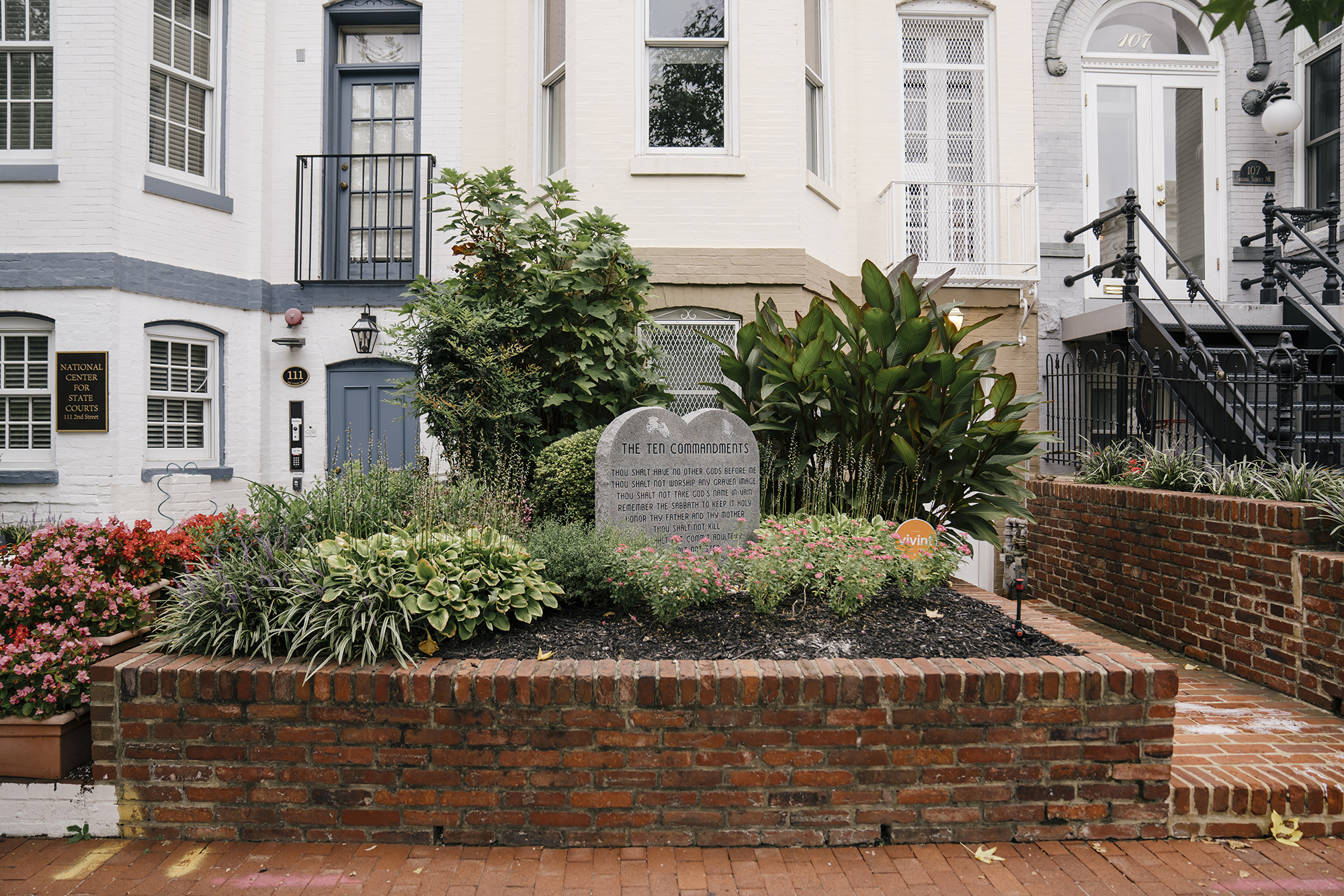 The office of Faith and Action, where a plaque of the Ten Commandments faces the room where justices deliberate. Schenck spent years raising tens of millions of dollars to convert each branch of the government, including the Supreme Court, toward Christian conservatism.Lexey Swall
It took years for the scales to fall from my eyes. A major turning point occurred when I took a leave of absence from Faith and Action to pursue a late-in-life doctorate. Part of my research involved the German Christian movement of the 1930s, which supported the Nazi Party. One of the most respected Bible scholars of that period, Paul Althaus, declared Hitler’s ascent to the chancellorship to be a “gift and miracle from God.” I began to suspect that we evangelicals were similarly allowing our faith to be co-opted for political purposes. Devastating consequences seemed inevitable for evangelicalism and for our country.
These fears were reinforced when I attended a tribute banquet for Pat Robertson around 2010. Virtually every evangelical luminary was there. When Robertson introduced his guest of honor, Donald J. Trump, I was shocked. In Bible college, my preaching instructor had suggested that the New York playboy was a perfect illustration for what it meant to not live as a Christian. I asked a friend of Pat’s why Trump was there. They both were “members of the billionaires’ club,” he explained. “Besides, he may make a good president someday.” Trump worked the room, filled with the biggest names on the religious right, garnering hearty applause.
When Robertson introduced his guest of honor, Donald J. Trump, I was shocked. In Bible college, my preaching instructor had suggested that the New York playboy was a perfect illustration for what it meant to not live as a Christian.
Another reckoning came after working with Abigail Disney on a film about American evangelicals’ love affair with firearms. The Armor of Light won an Emmy, but many of my colleagues labeled me a sellout to liberal gun grabbers. Pastors told me my appearance in the film created tensions in their congregations. When I visited one church as a guest preacher, my host forbade me from mentioning guns in his pulpit. “I have 50 armed people sitting out there every Sunday,” he warned, “and I don’t know what they’ll do if they get mad at you.” He gave me a wry smile. “Seriously.”
Meanwhile, as a Republican presidential candidate, Trump displayed pomposity and an ugly denunciation of the most vulnerable, both of which are diametrically opposed to the Christian virtues of humility, kindness, love for neighbors, and care for strangers. In June 2016, when his campaign invited scores of my closest friends and longtime colleagues to meet with him in New York, I declined. My contacts texted me from the gathering, reporting on the deal they were striking with him. Trump essentially promised to appoint anti-abortion federal judges and Supreme Court justices in exchange for our constituents’ loyal support. James Dobson, founder of the enormously influential Focus on the Family, assured attendees that Trump was a “baby Christian.”
When I arrived at the Republican National Convention in Cleveland, Trump’s nomination was a fait accompli. Sitting at a luncheon table with evangelical leaders, I expressed bewilderment over our support of him. Repeatedly, I was assured he would advance our cause. After Trump’s acceptance speech, I decided to leave the fold.
It took two years to extract myself. I dismantled the organization I had spent more than two decades building, walking away from a multimillion-dollar donor base. I called countless people to explain why I was leaving the movement I’d helped lead. I reached out to others to beg their pardon for the harm I had inflicted. I repented in prayer for my errors and the damage they caused. Then, I privately dedicated the rest of my life to doing as much repair as possible.
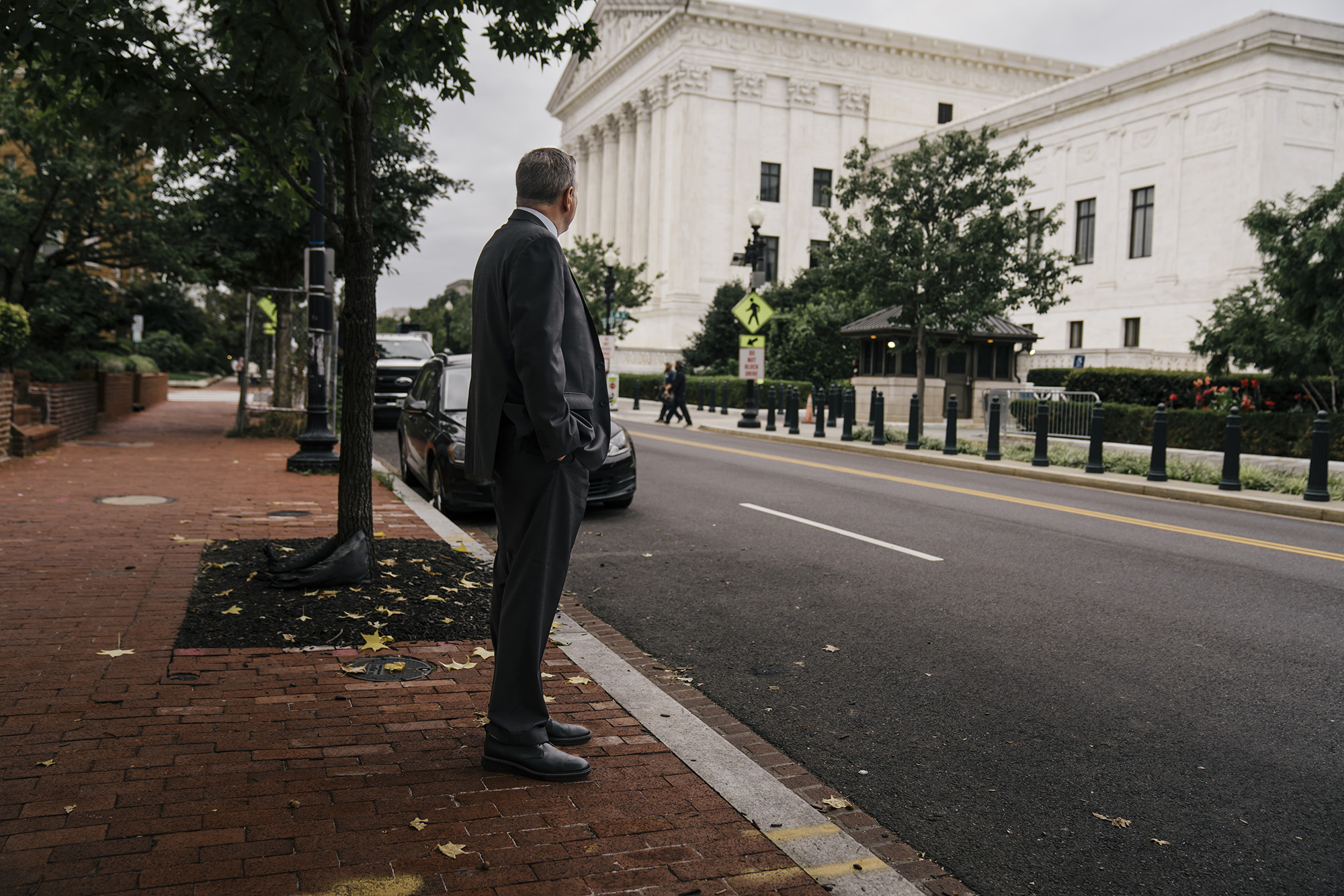 Schenck stands half a block from the Supreme Court, in front of his former office.Lexey Swall
Following the insurrection of January 6, when Christian banners, Bibles, and prayers in Jesus’ name appeared in the assault on the Capitol, I felt even greater urgency in warning my fellow evangelicals of the grave danger Trump and his MAGA cult posed to Christianity and US democracy.
My change of course so late in life has been painful, disorienting, and costly. Besides losing decades-long friendships and enduring menacing threats, my wife and I have faced a significantly reduced income. I’ve even driven Uber to cover household expenses. One night, I picked up an organizer of the National Prayer Breakfast, an event in which I had once played a significant role. I was wearing a mask and said little, but then, with trepidation, I realized I would be dropping him at the home of a congressman I had worked with closely for more than 20 years. When my passenger got out, I was relieved to have gone unrecognized. Still, I’ve never questioned the decisions that brought me to that moment.
In my third conversion, I realized that when religion is placed at the service of a political party, it corrupts both. To claim that one political figure uniquely represents God’s will for the body politic is a form of anti-Christian idolatry. To elevate one set of spiritual beliefs above another and do it by force of law removes a nonnegotiable tenet of evangelical faith—free will. We are born again when we choose to believe in the Lord Jesus Christ, not when we’re forced to do so.
Because it is immoral, I believe Christian nationalism is inevitably doomed. But in the meantime, the pain, suffering, and injury it will inflict will be enormous—just consider women facing difficult pregnancies, trans children seeking care, librarians attacked for certain books. “We want to fill our culture again with the Christian spirit. We want to burn out all the recent immoral developments in literature, in the theater, and in the press—in short, we want to burn out the poison of immorality, which has entered into our whole life and culture as a result of liberal excess.” This may sound familiar—maybe some overheated Republican talking points. In fact, it’s what Adolf Hitler promised the German people in 1933.
Source link : http://www.bing.com/news/apiclick.aspx?ref=FexRss&aid=&tid=66f44e4e2a374545a7adba978ce521ad&url=https%3A%2F%2Fwww.motherjones.com%2Fpolitics%2F2024%2F09%2Frob-schenck-confessions-of-a-former-christian-nationalist%2F&c=17555879308059798320&mkt=en-us
Author :
Publish date : 2024-09-24 23:00:00
Copyright for syndicated content belongs to the linked Source.