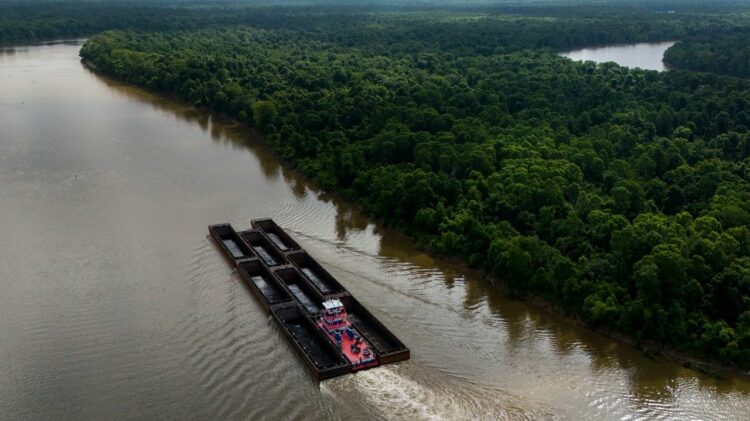
Downtown Mobile is visible from the Mobile–Tensaw Delta, Tuesday, June 4, 2024, near Mobile, Ala. Credit: AP/Mike Stewart
Forests of giant cypress and water tupelo were clear cut as recently as the 1980s by loggers who used helicopters to airlift logs from swamps. Chemical plants, paper mills and a factory that made the now-banned insecticide DDT have contaminated land and water. Upstream dams altered waterflow into the delta, blocked fish passage and led to extinction of dozens of freshwater species, some found only in the watershed.
Over 21 million tons of coal ash stored in an unlined pit near the Mobile River also present a potential threat to the delta, though the coal-fired power plant that generated the waste agreed in January to remove it. The state did not require its removal, although a breach could be potentially catastrophic for the delta. The EPA recently denied the state’s request to handle coal ash permits, saying its policies weren’t protective enough.
But other threats are unresolved. A canal built to connect the Tennessee and Tombigbee rivers in northern Alabama could allow invasive Asian carp to reach the Mobile River system and the delta, potentially devastating native fish. The Fish & Wildlife Service says a few carp have been found and removed downstream of the canal, with biologists relying on early detection while other control measures are considered.
Stronger hurricanes and saltwater surges also have caused serious erosion and killed trees, biologists say.
Increased rainfall and sea level rise with climate change also will push saltwater farther into the delta — potentially causing forested areas to convert to marshland and shrinking the important area where saltwater and freshwater mix. That adds urgency to efforts to acquire more land outside the delta for species to move in the future, says Judy Haner, the Alabama Nature Conservancy’s coastal programs director.
Plans in progress
This spring, The Nature Conservancy of Alabama bought 8,000 acres (3,237 hectares) of forested wetland between the Tombigbee and Alabama rivers at the top of the delta. The land, which regularly floods and is an important bird habitat and fish-spawning and feeding area, was in danger of being logged to produce wood pellets for European power plants.
“It would’ve been a horrible loss to the system,� says Conservancy Director Mitchell Reid, who calls the land “a critical piece of the puzzle� as the group works to protect the upper delta by keeping large tracts intact.
The Nature Conservancy also is working with the U.S. Army Corps of Engineers to design fish bypasses around two aging dams on the Alabama River to allow species to swim up from the Gulf and delta to historical spawning grounds.
While similar projects out West often focus on one species, Reid says, the Alabama plan could benefit about 20. Biologists hope it will lead to rediscovery of the critically endangered Alabama sturgeon, which hasn’t been seen for more than 15 years, and recovery of the threatened Gulf sturgeon in the Mobile River watershed.
The conservancy also is working to restore ecosystems in urban areas as far north as Birmingham, about 200 miles (322 kilometers) from Mobile, to prevent floodwater from sending sediment down rivers that could harm the delta.
Source link : http://www.bing.com/news/apiclick.aspx?ref=FexRss&aid=&tid=66bb8697f6d04cee896f81c7725b3af1&url=https%3A%2F%2Fwww.newsday.com%2Fnews%2Fnation%2Falabama-mobile-tensaw-delta-conservation-climate-q17349&c=8947956362496537897&mkt=en-us
Author :
Publish date : 2024-08-13 04:16:00
Copyright for syndicated content belongs to the linked Source.