“We think Alaska is going to play an important role,” Webb said.
The buzz around Alaska’s potential to supply the country with this seemingly obscure yet widely used element underscores how the state’s mining industry is looking to capitalize on increased demand, and government support, for domestic mineral production.
China is currently the dominant global producer of numerous essential minerals, and U.S. policymakers have been pushing for more diverse supplies amid increasing political tensions with the Asian nation.
Alaska could be a source of many of those materials, government geologists and industry leaders say. It’s thought to hold deposits of 49 of the 50 minerals, like antimony, that the U.S. Geological Survey considers “critical” to the American economy and national security.
Webb’s company, as its name implies, has been largely focused on finding gold, which is not on the geological survey’s “critical minerals” list. But the company announced this fall that it could also start commercially mining antimony at its Treasure Creek site near Fairbanks as early as next year.
Meanwhile, another Australian company that’s also mostly targeting gold, Nova Minerals, says it discovered antimony at an exploration project on state land across Cook Inlet from Anchorage. It’s now looking at the possibility of extracting and even refining the mineral there.
And U.S. Antimony, an American company that operates the country’s only antimony smelter, recently staked nearly 4,000 acres of claims around a World War I-era antimony mine in Alaska’s Iinterior, some 20 miles southwest of Tok.
The company’s refinery, in Montana, is running at only 50% capacity, according to co-chief executive Gary Evans.
“We could use material yesterday,” Evans said on a recent call with investors.
Like Nova and Felix, U.S. Antimony is also looking to the federal government for support.
Though the Pentagon has not yet subsidized any Alaska antimony projects, it has invested directly in other projects targeting “critical minerals.” If awarded money, Nova or Felix would become the second company in Alaska in two years to receive Defense Department dollars intended to boost mining in the state.
The Pentagon last year announced a $37.5 million grant for Graphite One, a Canadian company that hopes to mine America’s largest known deposit of graphite, on the Seward Peninsula north of Nome. Like for antimony, the U.S. has heavily relied on China for graphite, a key component of electric vehicle batteries.
Defense Department officials have also directed some $75 million to a proposed antimony and gold mine in Idaho.
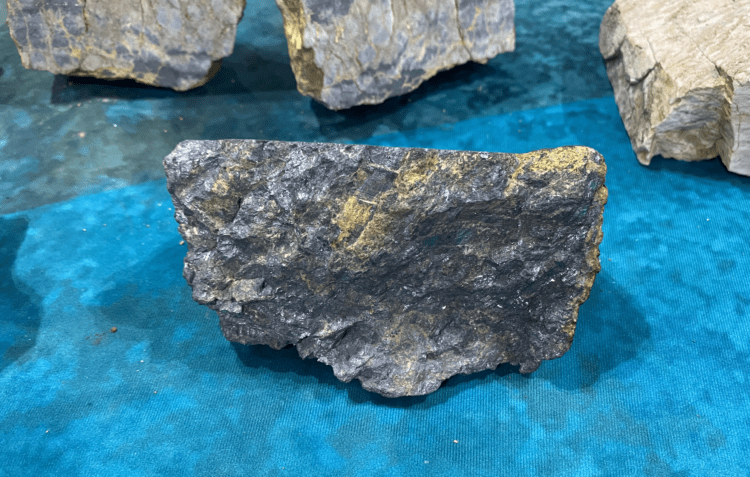
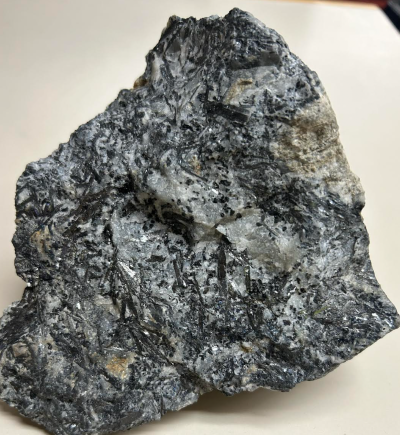 A piece of ore from the Stibnite Creek antimony prospect in the Alaska Range. (Alaska Division of Geological and Geophysical Surveys)
Antimony is a shiny silver metalloid, an element that’s almost but not quite a metal.
It’s often used to harden and strengthen actual metals, like lead. And though it’s best known for its use in ammunition and flame retardants, it’s also in a long list of other products, including smartphones and batteries.
A significant fraction of the country’s antimony supply, about one-fifth, comes from recycling. But the vast majority is imported: Nearly two-thirds of the antimony consumed in the U.S. between 2019 and 2022 came from China, according to the geological survey.
China’s new export limits “will put a real squeeze on the U.S. and European militaries,” an analyst told Reuters in August.
Until the 1980s, the U.S. was a major antimony producer. Production tended to ramp up during times of war — including, at various points, at some 25 sites across Alaska, from Ketchikan in the southern end of the state to the Brooks Range in the Arctic.
During World War II, the Stampede Mine, located in what’s now Denali National Park, accounted for three-fourths of the country’s antimony production, according to a white paper prepared this fall by the Alaska Department of Natural Resources.
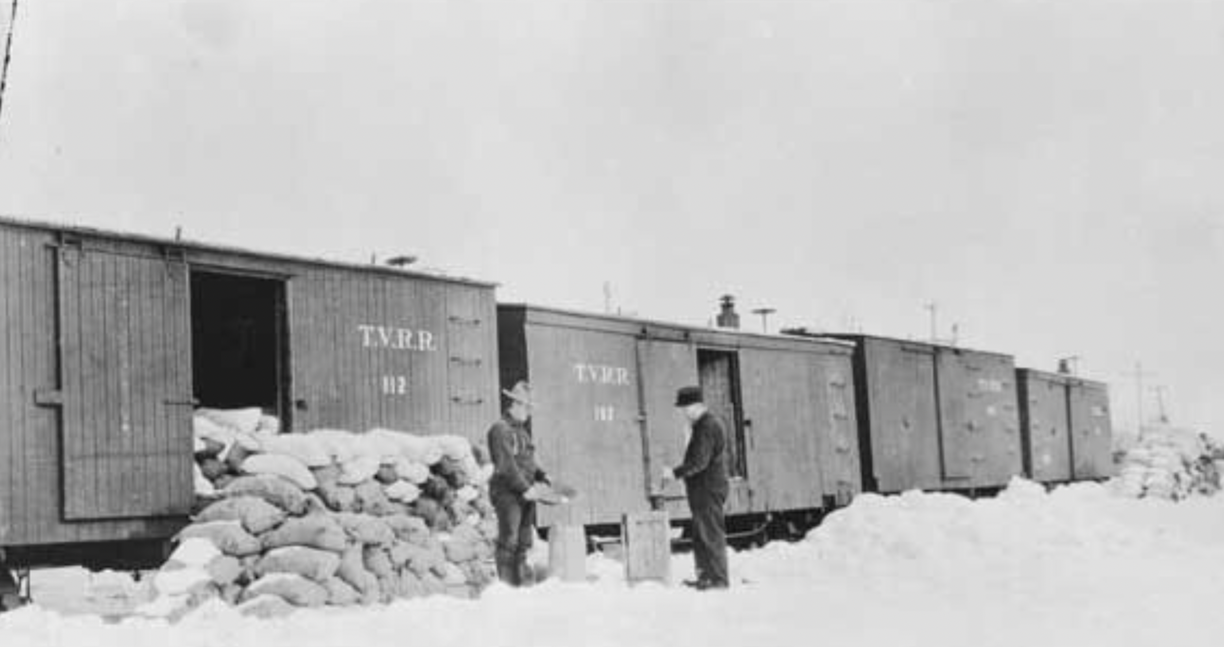 Antimony was once mined in large quantities in Alaska mines before production centralized in China. This photo shows antimony ore awaiting shipment from Alaska’s Interior on the Tanana Valley Railroad in the early 20th Century. (Alaska’s Digital Archives, Coleen M. Platner collection, UAF-1986-46-CO)
“It’s all over the place,” said Dave Szumigala, the state geologist who wrote the white paper. “I’ve probably been at over 60 prospects where I’ve picked up a chunk of antimony.”
Still, Szumigala said it’s an open question if the state’s deposits are substantial enough for modern day companies to mine them profitably. Doing business in Alaska can be more costly than in other states because deposits are often in remote areas and lack road access and other infrastructure.
The state’s white paper says near-term production of antimony in Alaska is “unlikely” due to long lead times and other obstacles.
One of the state’s largest known antimony reserves that’s not bound up in a national park is at the historic Scrafford Mine near Fairbanks, Szumigala said.
Scrafford is one of two dormant antimony mines encompassed by Felix Gold’s Treasure Creek project, which spans about 45 square miles.
That project is generating some local opposition, in part because mining could occur within a few miles of a Fairbanks-area subdivision.
“I would argue that developing a mine — whether it’s for gold or antimony — right across the road from a neighborhood is a pretty inappropriate area,” said Katie McClellan, who works with a Fairbanks-based conservation group, Northern Alaska Environmental Center. “We would not be in support of that kind of development.”
McClellan also said she’s concerned that federal funding intended for antimony production could have a side effect of advancing Felix Gold toward larger-scale mining for gold.
“Antimony is kind of the foot in the door,” she said.
Both Felix and Nova Minerals, the company with the project outside Anchorage, have mostly been focused on gold. Antimony is often found near gold, and both companies have recently started promoting their antimony prospects as well, with the market surging and government interest growing.
They are now pitching stand-alone antimony mines separate from any major gold mining that could occur on their claims later on.
That concept is distinct from the Pentagon-subsidized Stibnite project in Idaho. The development, which could cost as much as $1.8 billion, would be a big gold mine that also would target antimony — though active commercial production there is still several years away.
Nova Minerals’ concept at its Estelle project, on state land at the end of the proposed 100-mile West Susitna access road, is an antimony mine with a much smaller size and associated investment.
“Everything is much smaller,” Christopher Gerteisen, the company’s chief executive, said in an interview.
Initial startup costs could be as low as $25 million, and the company could begin production within 18 months of receiving a grant, Gerteisen said. Nova is still waiting for a funding decision from the Defense Department.
An agency spokesperson declined to comment.
Felix Gold announced recently that it could begin antimony production by the end of 2025. That “ambitious” target could be possible, said Webb, its director, because Felix has historical data from the dormant mine and is anticipating a very small-scale operation.
“Ultimately, we’ll need to go through the due process required by the regulatory bodies to ensure we’re taking every appropriate step through this,” he said.
Northern Journal contributor Max Graham can be reached at [email protected]. He’s interested in any and all mining related stories, as well as introductory meetings with people in and around the industry.
This article was originally published in Northern Journal, a newsletter from Nathaniel Herz. Subscribe at this link.
GET THE MORNING HEADLINES.
SUBSCRIBE
Source link : http://www.bing.com/news/apiclick.aspx?ref=FexRss&aid=&tid=673c008b64914ad787054f9e5ee3fea6&url=https%3A%2F%2Falaskabeacon.com%2F2024%2F11%2F18%2Famerica-needs-antimony-for-weapons-and-solar-panels-the-mining-industry-is-looking-to-alaska%2F&c=2374045499586016430&mkt=en-us
Author :
Publish date : 2024-11-18 14:02:00
Copyright for syndicated content belongs to the linked Source.