Subscribe to Technology Networks’ daily newsletter, delivering breaking science news straight to your inbox every day.
Subscribe for FREE“We know that lack of food is one of the main threats facing the endangered southern resident killer whales,” said Van Cise. “We figured that if we could compare their diet to the dietary habits of a healthy and growing population, it might help us better understand how we can steward and protect this vulnerable population.”
While the rivers of Alaska, British Columbia and the Pacific Northwest have historically provided resident killer whales with abundant levels of salmon, humans have recently disrupted this food supply — both directly by polluting waters and building dams that reduce salmon runs, and indirectly by generating noise pollution that interferes with hunting. In addition, in the latter half of the 20th century, resident killer whales — particularly southern residents — were captured and penned in amusement parks, which disrupted their social structure and further reduced their numbers.
This anthropogenic impact has left its mark. While Alaska resident killer whales number in the thousands and the northern resident killer whale population is growing steadily, southern resident killer whale numbers have plateaued at approximately 75 individuals. Recent research has implicated noise pollution from cargo vessels and higher rates of pregnancy failure as factors.
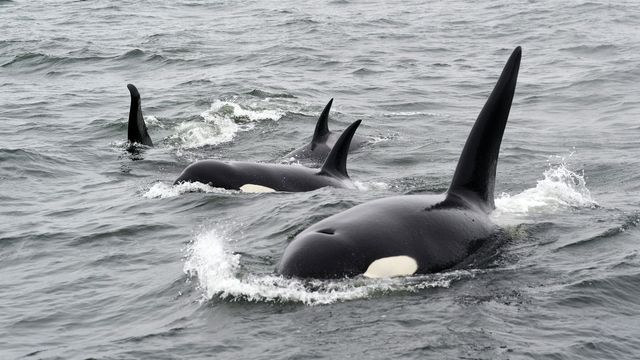
For this study, the team from 2011 to 2021 collected fecal samples from both southern resident and Alaska resident killer whales at various points during the year. The researchers analyzed DNA in the fecal samples to determine what the killer whales were eating. They discovered that the summer diet of Alaska residents included more chum and coho salmon, in contrast to the Chinook-heavy summer diet of a southern resident killer whale.
“Chinook are clearly an important resource for resident killer whales in any population. They’re large and energy-rich, which makes them a delicious and nutritious meal,” said Van Cise. “But what we’ve learned from the Alaska residents is that stable sources of other fishes — chum and coho salmon, even flatfishes like arrowtooth flounder — may be an important nutritional supplement helping this population thrive.”
In recent years the team has obtained more fecal samples outside of the summer months. Those samples revealed an unexpectedly diverse diet for resident killer whales. Sablefish, arrowtooth flounder, lingcod, Pacific halibut and big skate all feature in the diets of these whales, which were previously thought to eat salmon exclusively. The two populations differ in the non-salmon species they choose to supplement their diet, and when they switch among species. These dietary patterns reflect a delicate balance between regional abundance of different fish species, as well as a matriarch’s knowledge of reliable foraging locations.
“The survival of her family depends on whether the foraging sites she knows are reliable from year to year,” said Van Cise.
In both the United States and Canada, resident killer whales have gained fame, particularly the very public plight of southern residents. The team believes that their findings and follow-up dietary studies are key to aiding their recovery.
“While protecting key populations of Chinook salmon will always be vital to supporting the recovery of the endangered southern resident killer whale population, this study has taught us that we might need to think more holistically about how we can conserve the whole ecosystem of fishes that together make up the annual diet of predator populations like this one,” said Van Cise.
Reference: Van Cise AM, Hanson MB, Emmons C, et al. Spatial and seasonal foraging patterns drive diet differences among north Pacific resident killer whale populations. Roy Soc Open Sci. 2024;11(9):rsos240445. doi: 10.1098/rsos.240445
This article has been republished from the following materials. Note: material may have been edited for length and content. For further information, please contact the cited source. Our press release publishing policy can be accessed here.
Source link : http://www.bing.com/news/apiclick.aspx?ref=FexRss&aid=&tid=66ed423a1c15403bbea6dfa8d74f015f&url=https%3A%2F%2Fwww.technologynetworks.com%2Ftn%2Fnews%2Fall-orcas-off-americas-west-coast-prefer-salmon-but-some-supplement-their-diet-in-different-ways-391193&c=15465428747730701863&mkt=en-us
Author :
Publish date : 2024-09-19 13:00:00
Copyright for syndicated content belongs to the linked Source.