
Thus, all research that analyzes racial inequalities has to be understood as limited in some sense. The organization of data into facts that allegedly apply to “whites” versus facts that allegedly apply to “blacks,” while necessary for statistical research and useful in understanding social inequalities, rests upon and can reinforce ideas of permanent racial identity that are, at their core, false. Race is not the same thing as class, which is an objective category that necessarily emerges out of the economic system and is the ultimate determinant under the capitalist social order.
But inasmuch as oppression along the “color line” is a major fact of American history and American capitalism, a critical study of racial inequalities is necessary. The danger in doing so emerges when an honest study of social reality is transformed into a subjective search for categories of identity so that people can be targeted for persecution (i.e., the Japanese immigrants and their descendants in America during World War II, the Jews in Germany under the Nazis) or, on the flip-side, showered with privileges. The wish, for instance, of Nikole Hannah-Jones, the racialist creator of the 1619 Project, to create a new racial category for “Descendants of American Slavery” has nothing to do with trying to understand the conditions of a sub-population and everything to do with making sure she and her social layer get more money.
The study led by Harvard economist and Distinguished Professor Raj Chetty is free of both of these maladies. It examines how the economic prospects of children from low-income versus high-income families have changed over recent years. They define low-income families as those at the 25th percentile of the national income distribution, which in 1992 were households with an average (median) income of $32,020. High-income families are those in the 75th percentile of the national income distribution, with a (median) household income in 1992 of $124,500. Thus, the study does not address inequality between the working poor and the truly rich. A family surviving on just over $30,000 lives in a state of absolute deprivation. A family making four times that much, however, which might include a teacher nearing retirement and a veteran autoworker, is not in the lap of luxury. While more secure than the impoverished majority and generally able to afford necessities, such households are often one major medical bill, or one job loss, away from crisis.
Working with these definitions, the researchers find that economic mobility has changed rapidly in the last 15 years. “Between 1978 and 1992,” note the authors, “household incomes in adulthood fell sharply for white children growing up in low-income families. At the same time, incomes increased for white children growing up in high-income families.” The gap in average earnings between adults born into poorer white families and those born into better-off white families in 1978 was $17,720. By the time those born in 1992 were 27 years old, that number had grown to $20,950. The cause of this increasing gap was primarily that whites from households toward the bottom saw their incomes decline during that period.
At the same time, “white-Black race gaps for low-income families shrank: the gap in average household incomes between white and Black children raised in low-income families fell by 28%, from $20,810 for children born in 1978 to $14,910 for children born in 1992.”
The lessening of this divide was driven by two factors. First, there has been some improvement for blacks born into the bottom rungs of society, with many escaping the depths of poverty as they entered their late 20s. In 1978, black children born into the bottom income quintile (the lowest 20 percent of income earners) were 14.7 percentage points more likely to remain in that quintile than their white counterparts. By 1992, however, that number had shrunk to 4.1 points. Second, the worsening situation for low-income white children also helped close the gap. About half of the narrowing of the white-black divide among the working poor was driven by “an increase in white children’s chances of remaining in the bottom quintile.” In short, the experience of being born poor and then remaining poor into adulthood is increasingly shared across the racial divide.
Simultaneously, the chances of a low-income child, from either a black or a white family, becoming a high-earner did not improve at all. Just 3 percent of black children born in 1992 into the bottom income quintile moved into the top quintile, the same number as in 1978. During this period, the prospects for white children worsened somewhat along the same measure. Whereas in 1978, 13.7 percent of those born into low-income families could expect to enter the ranks of the best-off, by 1992 that had fallen to 11.9 percent. Simultaneously, children from high-income Black households experienced some upward mobility, such that “the class gap among Black families …remained essentially unchanged.”
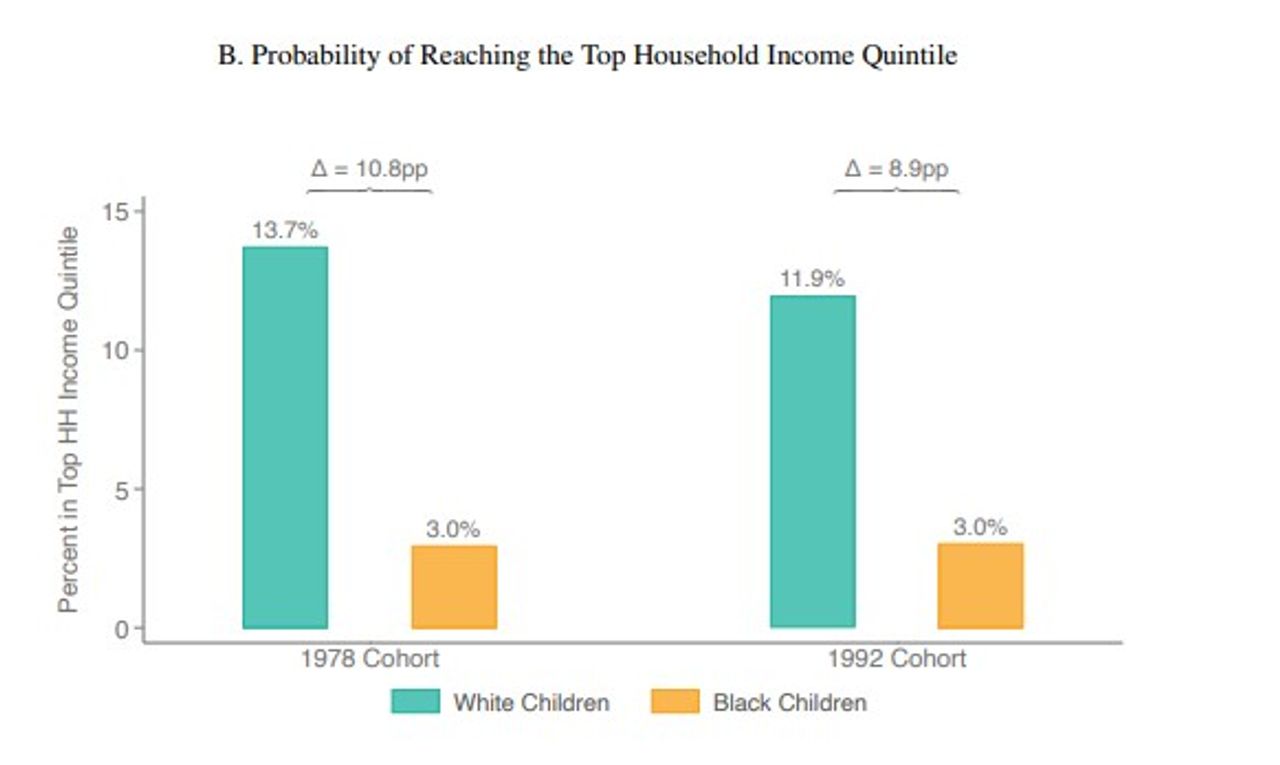 Chances of child from a low-income (bottom quintile) household becoming a high-income (top quintile) household, by race and birth cohort. Chart shows that upward mobility has stagnated for poor blacks and declined for poor whites. [Photo: “Changing Opportunity Sociological Mechanisms Underlying Growing Class Gaps and Shrinking Race Gaps in Economic Mobility.” Figure II. Panel B. Page 86.]
Thus, while the circumstances facing working class poor families of both races are converging, the bottom layer of African-Americans has not, after decades of racially based affirmative action policies that were billed as the solution to oppression, seen any progress in terms of closing the class gap between themselves and higher-income layers within their own racial group.
The researchers also found that the pattern of decreasing racial differences and increasing class differences was replicated across other major indicators of social well-being, including educational attainment and standardized test scores, as well as marriage, incarceration and mortality rates. “For example, the white class gap in early adulthood mortality more than doubled between the 1978 and 1992 birth cohorts, while the white-Black race gap in early adulthood mortality decreased by 77 percent.”
Incarceration rates are also leveling out between low-income members of these groups. By 2014, the incarceration rate for poorer whites had risen to 1.43 percent, up from 1.16 percent in 2000. During that same period, it fell for blacks of the same income strata from 4.53 percent to 4.28 percent. This poor layer of African-Americans has an incarceration rate that is more than double that of higher-income blacks.
In seeking the cause of these shifts, the study shows that parental employment rates within communities powerfully shape kids’ future economic mobility. The researchers insist that the issue is not so much whether any particular individual child’s parents are employed, but whether the parents of those with whom these children interact at their schools, in their neighborhoods, through their social networks, etc., have jobs. When those adults do not, it is damaging to children, not just, or even primarily, in terms of the overall amount of money that a community has (or no longer has), but in terms of the overall health of the social environment. To underscore their point, Chetty and his co-authors quote from sociologist William Julius Wilson’s 1996 book When Work Disappears: The World of New Urban Poor—“crime, family dissolution, welfare, low levels of social organization, and so on … are fundamentally a consequence of the disappearance of work.”


The researchers conclude that “the growth in the white class gap and the reduction in the white-Black race gap can be explained almost entirely by the sharp fall in employment rates for low-income white parents relative to low-income Black parents and high-income white parents over the period we study.”
In communities that are more racially mixed, where there are higher rates of interracial marriage and children are interacting more with peers across racial boundaries, falling employment rates among low-income whites have a negative impact on all children’s future economic prospects within the community, regardless of race. At the same time, however, “The areas in which outcomes of children born to low-income Black families improved the most tend to be areas in which outcomes of children born to low-income white families deteriorated the least.” Therefore, “the gains for children born to low-income Black families did not come directly at the expense of their white counterparts in the same areas.”
In other words, the data indicate that securing and improving the job prospects of all working class people—not doling out opportunities to this or that person on the basis of their perceived skin color—will help the conditions of oppressed minorities improve.
In the conclusion of their study, Chetty and his co-authors make a point that is a rebuke, albeit extremely timid, to racialists’ claims that minorities must self-segregate in order to shield themselves from their white oppressors. Rather, “One approach to increasing opportunity is … to increase connections between communities. For example, policies might focus on reducing racial and income segregation—e.g., by changing zoning restrictions, school district boundaries, or increasing the availability of affordable housing in high-opportunity areas—and fostering cross-race and cross-class interactions—e.g., forming groups designed to cut across existing lines of interaction.”
This is hardly a radical proposal. It is the sort of thing that American liberalism of a different era would have put forward as a rule. But in the present circumstances, with American democracy in its death throes, the idea that the breaking down of racial boundaries is the road to progress appears almost as a radical notion. It is rejected, in different forms, by both the Democrats and Republicans. The myopic component of the authors’ proposed policy solution lies not in the racial element, but in the class element. Capitalist society, which rests upon class inequality, cannot produce “cross-class interactions,” but rather intensified cross-class exploitation.
Critics of this study will point to the fact that, despite the trend towards lessening racial inequality among low-income households, there remain notable racial differences in terms of median incomes, chances for upward mobility and risks of downward mobility, incarceration rates, etc. Many points can be made about these facts and the underlying data, not the least of which is that averages and probabilities only reveal so much. They are, not infrequently, a great mystifier of social reality.
Beyond that, the racial gaps for working class people are dwarfed many times over by the class gaps between workers of all backgrounds and the rich of all colors. And with regards to this specific study, the researchers were not able to investigate the experience of truly wealthy populations—both black and white—because they had to “top-code” incomes above $1 million. This statistical method, leveling down the stratospheric income and wealth figures of the super-rich to make calculations possible, limits understanding of the full dimensions of economic inequality.
More broadly, however, the fact that certain racial inequalities persist and that the burdens of deprivation fall more heavily on or, rather, have particular features for some racial groups more than others, is hardly a surprise. For all the great battles waged by working people of all races against inequality and despite major conquests and cultural changes, American capitalism could never and will never resolve this problem.
Capitalism is rooted in inequality—a few own and exploit, while most do not own and must labor instead. The entire social and economic order rests upon that division and thus inequalities seep into all the differences in the human condition that are a part of social reality—not just race, but also geography, age, immigration status, and so forth. To combat these particular inequalities, one has to reject the principle of inequality itself, the very right of inequality to exist. That requires the overthrow of capitalism and the establishment of socialism.
Sign up for the WSWS email newsletter
Source link : http://www.bing.com/news/apiclick.aspx?ref=FexRss&aid=&tid=66d78b1f78854d63acb537c44bc7c73e&url=https%3A%2F%2Fwww.wsws.org%2Fen%2Farticles%2F2024%2F09%2F03%2Fjmth-s03.html&c=2748596948178213264&mkt=en-us
Author :
Publish date : 2024-09-03 10:05:00
Copyright for syndicated content belongs to the linked Source.