2 / 2
Show Caption +
Hide Caption –
An Alaska Cable System crew lays submarine cable from flat cars along White Pass and Yukon Route Railroad. During winter of 1946-47 the severe storms caused almost continued circuit outage so the cable is laid to replace the wire lines. 1 February 1947
(Photo Credit: CECOM History Archive Photograph Collection (#4161))
VIEW ORIGINAL
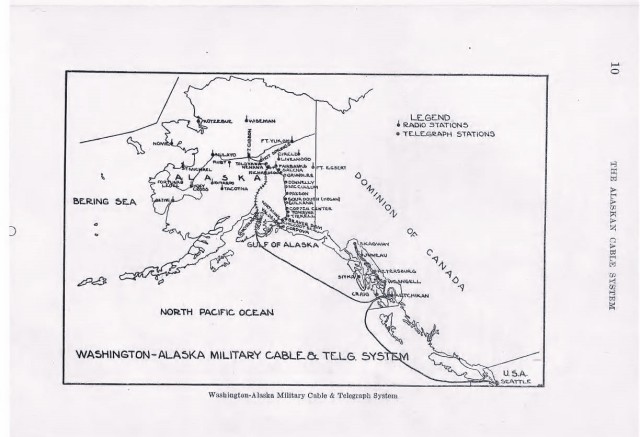
In 1900, the Signal Corps began building the Washington-Alaska Military Cable & Telegraph System to provide basic communications to the area. The completion of the Alaskan Cable System in 1904 was heralded as one of the great achievements of the Signal Corps up to that point, which opened the then-territory for further settlement and development, as well as enhancing the well-being of the citizens. It would be the last frontier telegraph lines built by the Signal Corps. The cable was laid primarily to connect the telegraph systems of the United States with those of Alaska for the transmission of official messages in connection with the administration of military, judicial, and territorial affairs. The Military Department of Alaska was created by the War Department in 1900, after the influx of people to the territory after the discovery of gold at Camp Nome, to safeguard life and property, and to direct and coordinate surveys and exploration. Originally meant for internal communications, the addition of a submarine cable connected Alaska with Seattle, Washington.
In 1921, efforts were undertaken to replace the original submarine cable, which no longer could handle the large volume of telegraph traffic. A new steam-powered cable ship, the Dellwood, was acquired. A route was established with the assistance of the U.S. Navy, and the Dellwood began the installation of the new cable in May 1924, completing the laying of approximately 1500 nautical miles of cable by October 1924. The new cable allowed for open communications – messages could be sent and received by cable, telegraph, or radio from the largest town or smallest settlement in Alaska to any point in the United States or Europe and was open for commercial and governmental use. As of 1925, the Signal Corps maintained and operated the Alaska Cable System, comprising 2655 statute miles of submarine cable, 20 radio stations, and 840 circuit miles of telegraph lines connecting 44 offices.
As documented in Rebecca Robbins Raines’s “Getting the Message Through: A Branch History of the U.S. Army Signal Corps,” the WAMCATS system continued to be a lifeline to the citizens of Alaska. It was used extensively during a devastating fire that affected the city of Nome in 1934, coordinating relief and rescue work. The Signal Corps radio operator near Point Barrow, Alaska learned of the plane crash involving Will Rogers and Wiley Post in August 1935, from a native runner. SGT Stanely R. Morgan rushed to the site to render aid, only to find both men had died instantly. Morgan returned to his station to provide news of the tragedy to the world. Alaska experienced a major military build-up in 1942, with the construction of Fort Greely, named for the Chief Signal Officer who oversaw the first construction of WAMCATS. The Signal Corps’ experience in Alaska was essential for building 10 new stations and improving existing facilities, as well as engineering and building post telephone systems, harbor defense control systems, and radar sites. Beginning in the summer of 1942, the Signal Corps installed an open wire telephone line parallel to the Alaska-Canada Highway that was being constructed to connect military airfields and enhance the defense of the territory. Using mostly commercial crews, it was completed in just 15 months, despite requiring the setting of 95,00 poles in frozen ground and the stringing of 14,000 miles of wire.
In 1950, Fort Monmouth soldiers spent time working on maintaining the system and began planning for a chain of radar stations to be placed in the region to combat the emerging Cold War threat. The Signal Corps maintained responsibility for the system, renamed the Alaska Communication System until 1962 when it was transferred to the Air Force. In 1971, the Air Force sold the system to RCA, ending three-quarters of a century of military communications in Alaska.
Source link : http://www.bing.com/news/apiclick.aspx?ref=FexRss&aid=&tid=67c17eb8ac5d4c63a97b1df53e47e8a1&url=https%3A%2F%2Fwww.army.mil%2Farticle%2F282982%2Fsignal_corps_opens_communications_with_alaska&c=1887494889299134749&mkt=en-us
Author :
Publish date : 2025-02-23 11:00:00
Copyright for syndicated content belongs to the linked Source.