Photo illustration by Slate. Photos by Getty Images Plus and supremecourt.gov.
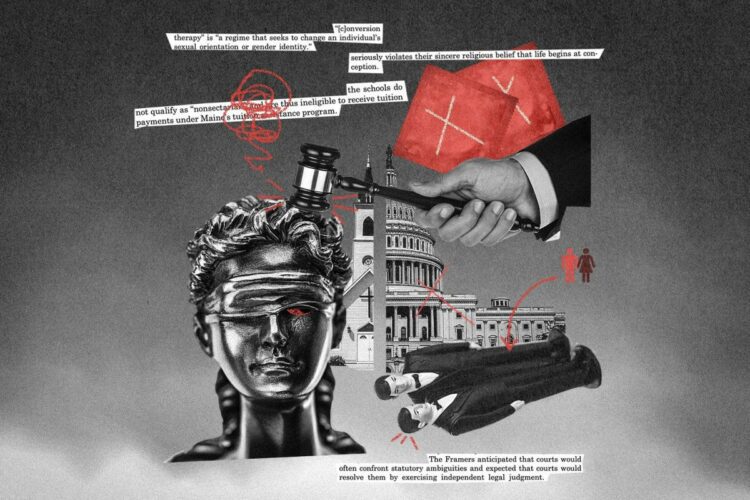
In 2015, when the Supreme Court struck down bans on same-sex marriage in Obergefell v. Hodges, it was a devastating loss for religious conservatives. Now that Roe is gone, Obergefell is a top target, since its reasoning relied on similar arguments of substantive due process rights under the 14th Amendment.
Conservatives call these cases “court-invented rights.” And Justice Clarence Thomas wrote in his Dobbs concurrence that the court should overturn Obergefell, Griswold, and Lawrence v. Texas, a 2003 case legalizing same-sex intimacy.
Cases: Masterpiece Cakeshop v. Colorado Civil Rights Commission (2018), 303 Creative v. Elenis (2023), Emilee Carpenter Photography v. James (ongoing)
Stated goal of the cases: To seek religious exemptions to antidiscrimination laws via plaintiffs who are “creative professionals” in the wedding industry. ADF claims that laws banning businesses from discriminating against LGBTQ+ people amount to First Amendment coercion or “compelled speech” because people have to endorse or promote things they oppose on religious grounds.
Key quote: “I think [Obergefell] is wrong and it should be reversed, but I don’t wake up in the morning thinking about how to do that.” —Waggoner to the New Yorker in 2023
Long-term goal: ADF wants to get the court to create a right to object to same-sex marriage. This would undercut Obergefell and clear the way for it to be overturned, allowing states to ban gay marriage or refuse to recognize it. The conservative justices would then be able to claim that same-sex marriage is not part of our history and traditions, akin to the Dobbs test. Justice Samuel Alito noted this in his Obergefell dissent too, quoting a precedent that said “due process” includes only rights that are “deeply rooted in this Nation’s history and tradition.” Alito added: “It is beyond dispute that the right to same-sex marriage is not among those rights.”
ADF’s CEO has said that she doesn’t believe in transgender identity, only gender dysphoria, and that the group’s next priority is fighting “the radical gender-identity ideology infiltrating the law.” Previously, ADF wrote model legislation for the 2016 North Carolina bathroom bill, which was a public-relations disaster; the bill was later repealed. Now ADF is working to establish “parental rights” that would suppress trans rights.
Cases: B.P.J. v. West Virginia, Hecox v. Little, Soule v. Connecticut, Poe v. Labrador, Mead v. Rockford Public School District, five suits against the Biden administration Title IX rule change (all ongoing)
Model legislation: ADF has authored model legislation that would require parental consent for schools teaching “gender ideology,” ban transgender kids from participating in sports, and ban minors from receiving puberty blockers or hormone treatments.
Stated goal of the cases: To ban trans kids from playing school sports (on grounds of “fairness” and “privacy” for cis kids), prevent kids from transitioning with medical care (treatment the organization frames as permanent “sterilization and chemical castration”), and limit even social transition, like teachers honoring kids’ pronouns (a “powerful psychosocial intervention”). Of course, such outright bans restrict the rights of parents who support their children’s choice to transition, but the group appears unconcerned with those rights.
Key quote: “It’s not that the Court is going to say, ‘Gender ideology is bad.’ But I do think the Court could say, ‘Parental rights are fundamental rights.’ ” —Waggoner to the New Yorker in 2023
Long-term goal: These cases suggest that ADF wants to prevent any child from taking puberty blockers or transitioning before age 18. And the “parental rights” the group seeks to create would effectively give parents the authority to demand that their children only ever be around cisgender kids.
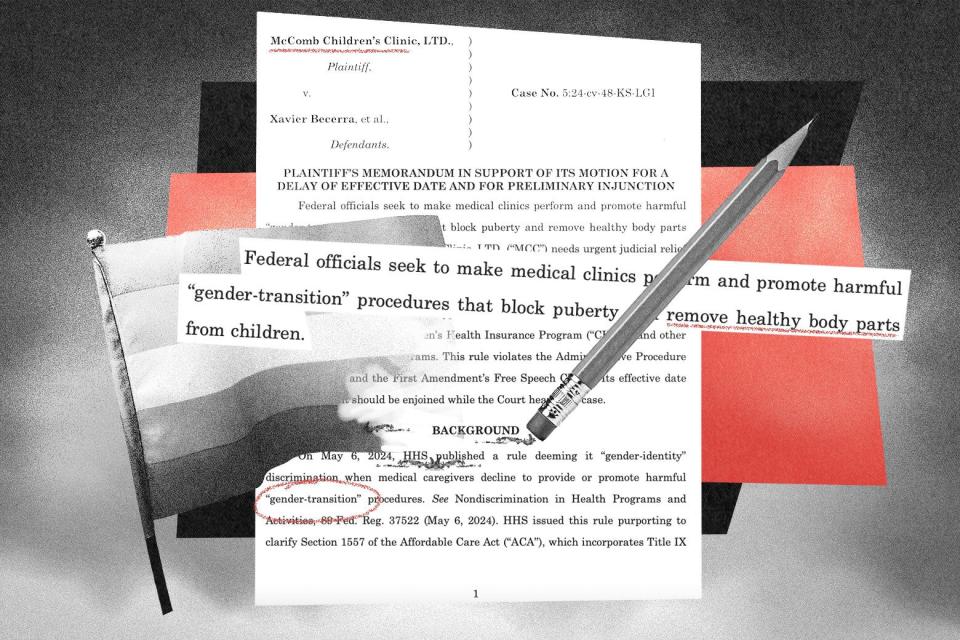
Photo illustration by Slate. Photos by Getty Images Plus and supremecourt.gov.
ADF suffered a rare loss in 2020, when it asked the court to rule that any employer could fire someone for being trans; the organization represented the religious owner of a Detroit funeral home. Justice Neil Gorsuch wrote a majority opinion saying the Civil Rights Act’s Title VII provisions against sex discrimination include gender identity and sexual orientation. But he suggested that future plaintiffs could try for a religious exemption to the law.
Cases: Bostock v. Clayton County (2020); State of Missouri v. Becerra, State of Florida v. U.S. Department of Health and Human Services, McComb Children’s Clinic v. Becerra (all ongoing)
Stated goal of the cases: To establish that religious freedom allows employers to refuse to hire trans people, and to undo nondiscrimination provisions of the Affordable Care Act (Section 1557) so medical providers and insurance companies don’t have to perform, refer for, or cover gender-affirming care.
Key quote: “It is no defense to liability under the rule that in a healthcare entity’s medical judgment, removing a healthy organ for ‘gender-transition’ purposes is never medically necessary or beneficial.” —ADF complaint regarding ACA rule change
Long-term goal: If ADF prevails in these cases, the group would succeed in making it financially ruinous to be a trans adult, via medical costs and even more precarious employment prospects. This would also open the door for insurance providers to drop other medical care to which they object, like PrEP for HIV.
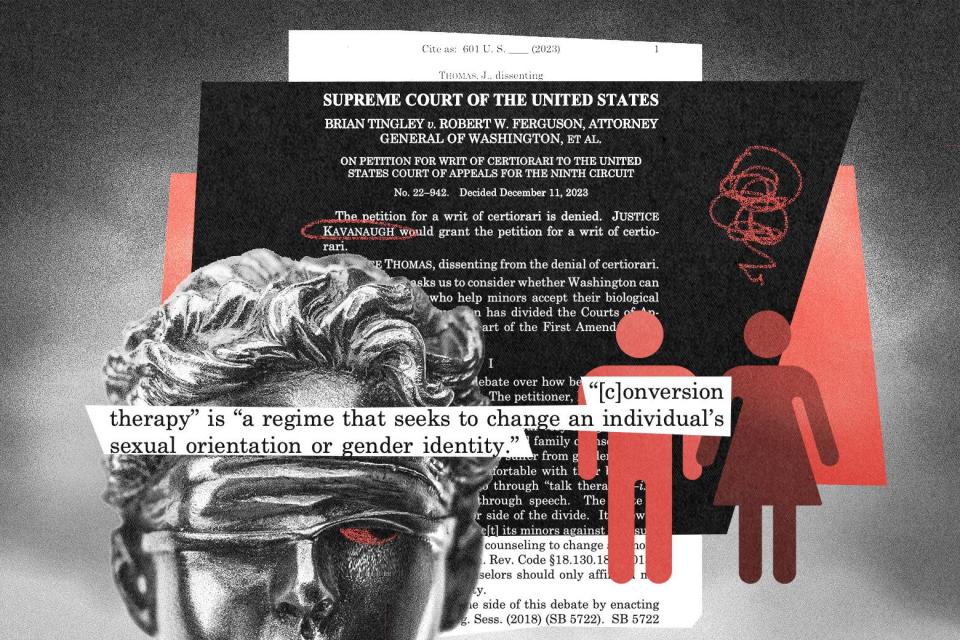
Photo illustration by Slate. Photos by Getty Images Plus and supremecourt.gov.
Currently, sex and sexual relationships are protected under a right to privacy first established in Griswold regarding birth control, and later reaffirmed by Roe. In another abortion case, 1992’s Planned Parenthood v. Casey, the majority wrote that intimate relationships are a constitutionally protected liberty, and “at the heart of liberty is the right to define one’s own concept of existence, of meaning, of the universe, and of the mystery of human life.”
Groups like ADF have revolted against this view of sex as a form of self-expression, untethered from procreation. In the 2003 case Lawrence v. Texas, ADF filed a brief defending the state’s ban on gay sodomy. The group argued that the law should stand in part because the court had “long recognized the validity of state regulation of public health and morality.” Texas lost the case, but since then, ADF’s international arm has defended similar anti-LGBTQ+ laws globally that have criminal punishments.
Case: Tingley v. Ferguson (2023)
Stated goal of the case: To fight state censorship. ADF is representing a Christian therapist challenging a Washington state ban on conversion therapy, the practice of trying to convince LGBTQ+ clients that they are straight or cisgender. But as a lawyer for Equal Rights Washington pointed out, the plaintiff isn’t currently violating the law and hasn’t said he plans to. In that way, the case has shades of 303 Creative, in which the web designer didn’t actually create wedding websites. In December, the court declined to take the apparently manufactured Tingley suit. The vote was 6–3, with Justices Thomas, Alito, and Brett Kavanaugh saying they would have heard the case. ADF attorney John Bursch said in a statement that the denial doesn’t end the fight: “There is a circuit split on the issue, and 20 other states and the District of Columbia have similar laws. We urge the Supreme Court to take a similar case when the time comes.”
Key quote: “Major historic faiths including Judaism, Christianity, and Islam, have long taught that the only moral context for sexual relationships is within a heterosexual marriage … the ability to form one’s own natural family has been recognized as one of the greatest joys in life, and one of the most fundamental human rights, across cultures and history. Of course, this can only happen in a heterosexual relationship.” —ADF petition for certiorari in Tingley
Long-term goal: ADF’s public statements make clear that it wants to oppose sexual relationships that are not heterosexual, in the context of marriage, and with the goal of procreation. The group continues to promote the idea that being gay is not an identity for which someone could be discriminated against—that, rather, there are simply people “who experience same-sex attraction.”
In 2021 the court sided with Catholic Social Services against a Philadelphia policy that foster agencies had to work with same-sex couples. ADF then sued the Biden administration, on behalf of a Tennessee organization, for requiring that federally funded adoption agencies work with same-sex couples. (ADF’s client later rejected a Jewish couple in 2022 on grounds of religious freedom; the couple is suing.)
Cases: Holston United Methodist Home v. Becerra (2021); Bates v. Pakseresht, DeGross v. Hunter, Wuoti v. Winters (all ongoing)
Stated goal of the cases: To secure religious exemptions to the nondiscrimination policies of adoption and foster agencies in Oregon, Washington, and Vermont.
Key quote: “If we truly believe that life begins at conception, then this should influence how we think about assisted reproductive technologies like IVF.” —ADF article about Alabama Supreme Court ruling on IVF embryos
Long-term goal: Based on these cases, ADF wants foster and adoption agencies across the country to be able to reject applicants who are gay and give preference to heterosexual Christian couples who will raise children religiously and not support kids who may question their sexuality or gender. Paired with ADF’s views on discarded IVF embryos (see item No. 1), it seems clear the group wants to severely limit the ability of LGBTQ+ people to raise children.
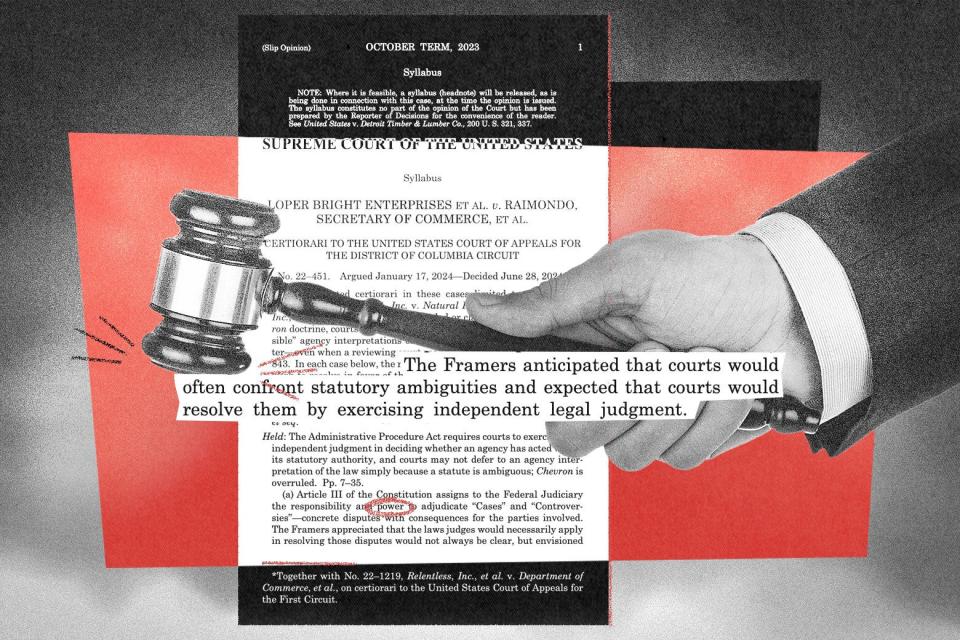
Photo illustration by Slate. Photos by Getty Images Plus and supremecourt.gov.
Conservatives recently celebrated a big victory in their ongoing fight against the administrative state: They got the court to overturn Chevron v. NRDC, a 1984 case that held that when Congress says federal agencies should enforce regulations, judges should defer to those expert agencies’ interpretations. Now, when people sue over regulations, judges have much more power to simply overturn them—and ADF has a slew of regulations on sex and gender in its sights.
Case: Amicus brief in Loper Bright Enterprises v. Raimondo (2024)
Stated goal of the case: The ADF brief filed in July 2023 argues that agencies are weaponizing both “federal healthcare laws to violate the right to life” and “federal civil rights laws to impose radical gender ideology.” The brief claims that Biden administration actions on abortion violate the Comstock Act and that nondiscrimination rules for trans people force employers to pay for “amputating healthy organs.” (In 2016, before joining ADF, Erin Hawley convened a conference called A Future Without the Administrative State. Hawley, the wife of Missouri Sen. Josh Hawley, is a co-author on the brief.)
Key quote: “Now, the court has wiped away a major roadblock that prevented Americans from holding government officials accountable.” —ADF statement on the Loper Bright decision
Long-term goal: Thanks to the ruling here and in Corner Post, ADF is more likely to prevail in its cases restricting abortion (emergency abortions, abortion pills) and its cases opposing trans rights (Title IX, Section 1557).
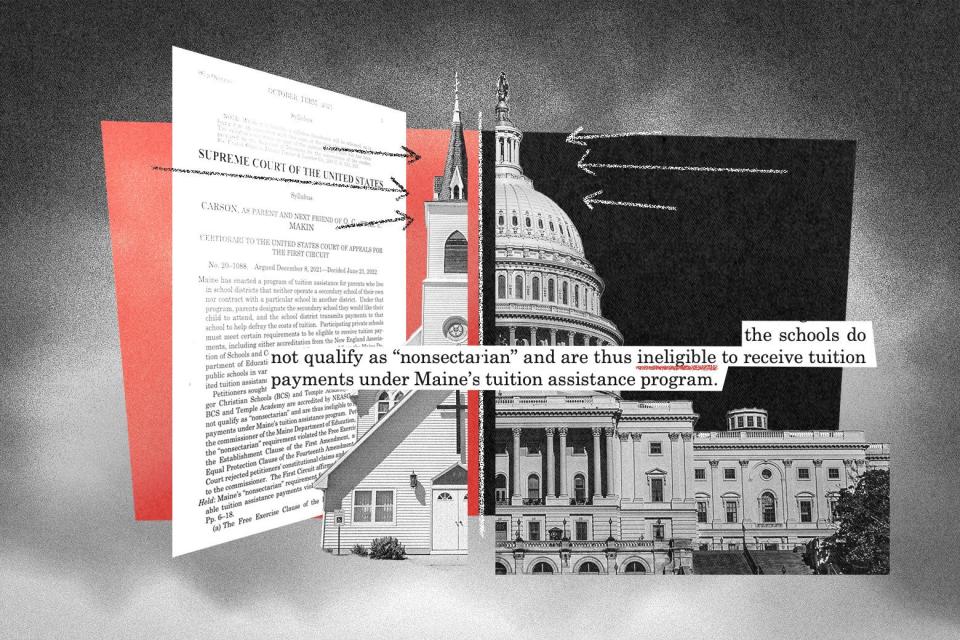
Photo illustration by Slate. Photos by Getty Images Plus and supremecourt.gov.
ADF was founded in 1993, the year after the court upheld Roe in Planned Parenthood v. Casey and prohibited prayer at school-sponsored events in Lee v. Weisman. Lee upheld the separation of church and state from a ’70s-era ruling, Lemon v. Kurtzman. ADF’s first big win was in a 2014 case in which it pierced the armor of Lemon by getting the court to agree that public prayer was allowed before City Council meetings in Greece, New York. The group further wounded the precedent in a 2017 case requiring Missouri to resurface the playground of a church preschool under a state program. Finally, the court effectively overruled Lemon in a 2022 case involving a high school football coach who wanted to pray on the field after games—but the court didn’t say what legal test would replace it. ADF framed these cases as victories against government censorship and “neutrality” in public benefits.
Cases: Town of Greece v. Galloway (2014), Trinity Lutheran v. Comer (2017), Espinoza v. Montana Department of Revenue (2020), Kennedy v. Bremerton School District (amicus 2022), Carson v. Makin (amicus 2022)
Stated goal of the cases: To ensure that governments can’t exclude religious schools from public funds and that public employees have a right to private prayer at work. (In actuality, Kennedy, a football coach, led public prayers for his team.)
Key quote: “American citizens don’t give up the right to prayerfully practice their faith during working hours when they accept a job with a public employer.” —ADF statement on Kennedy victory
Long-term goal: With these cases, ADF is pushing the court to write a new legal test regarding what’s left of the separation of church and state. A new test could give the organization an opening to restore mandatory prayer in public schools and siphon more public funds for religious schools, making them more desirable than public ones.
The school district that includes Charlottesville, Virginia, began developing an anti-racist curriculum after white supremacists held a violent rally there in 2017. One parent contacted ADF, and a group is suing over the lesson plans.
Case: Carlos Ibañez v. Albemarle County School Board (ongoing; state court)
Stated goal of the case: To establish parents’ rights to object to anti-racist education or “critical race theory” in schools. (The complaint cites anti-CRT warrior Christopher Rufo.) The complaint argues that schools teaching about racism violate civil rights laws by classifying people as either “perpetually privileged oppressors or perpetually victimized members.” In ADF’s appeal to the state Supreme Court, it cites both the 14th Amendment and Title VI of the Civil Rights Act.
Key quote: “The district is violating students’ civil rights by treating them differently based on race, and … it has violated parents’ rights by indoctrinating their children, undermining their children’s humanity, and denigrating their deeply held beliefs.” —ADFlegal.org FAQ on the case
Long-term goal: The logical conclusion to draw from this suit is that ADF wants to ban public schools from teaching about race. And given its attacks on other parts of the Civil Rights Act (Title VII in Bostock), there may come a day when ADF tries to ban employers from considering race and gender in hiring decisions—à la the ruling in Students for Fair Admissions v. Harvard (2023), which essentially ended affirmative action as we know it.
Source link : http://www.bing.com/news/apiclick.aspx?ref=FexRss&aid=&tid=6709492a2b5646beae17326381f2f742&url=https%3A%2F%2Fnews.yahoo.com%2Fnews%2Fone-most-powerful-conservative-legal-094500374.html&c=12836225315004690745&mkt=en-us
Author :
Publish date : 2024-10-11 04:40:00
Copyright for syndicated content belongs to the linked Source.