The U.S. run of medal dominance has been fueled in part by unicorn medal-winners like Michael Phelps, who won an astounding 28 medals across four Olympics. (Al Bello / Getty Images)
The latest one, the 22-year-old swimmer Léon Marchand, happens to be French, though he spent the last three years training at an American college, a point that Olympic organizers were urging NBC and any other outlet they could to hammer home.
Marchand has plenty of company. Julien Alfred of Saint Lucia became the so-called world’s fastest woman by winning the 100 meters. She attended the University of Texas. Josh Kerr of Scotland, who ran for the University of New Mexico, won silver in the 1,500 meters, a battle Coe called “a race for the ages.”
“It’s critical for Team USA, but it’s also something America can celebrate, that we help produce all these athletes,” Sarah Hirshland, the chief executive of the USOPC, said during an interview on Friday, hoping her message was landing with college presidents and administrators. “We need them to be very thoughtful about what collegiate sports mean on campus.”
Swimming, Hirshland pointed out, doesn’t generate much in the way of profits for a university, “That doesn’t mean it doesn’t deserve to be on a college campus.”
Hirshland said the USOPC is in the midst of a continuous lobbying campaign in Washington, D.C., where politicians are contemplating legislation that could mandate certain treatment and pay for collegiate athletes. The focus is largely on football and basketball players, who want to share in the revenues they produce, but it may also change the status of athletes in sports that don’t make a profit. If Congress makes those costs too high, more colleges might try to cut more Olympic sports.
Harris and Hirshland know how calamitous that could be.
“If Oregon were to ever cut track, that would be a huge problem for us,” Harris said. “If Stanford ever cut swimming, that would be a huge problem.”
Beyond the direct financial support, coaching and training that college delivers, there is the hard-to-replicate competitive experience.
Justine Wong-Orantes, the libero for the U.S. women’s volleyball team, had plenty of digs and sets that kept the American hopes for a second consecutive gold medal alive against Brazil Friday afternoon. The Americans prevailed in five sets playing in front of a loud and hostile Brazilian crowd.
Wong-Orantes was quick to credit her experience at the University of Nebraska, where women’s volleyball is big and sometimes takes place in a sold-out football stadium.
“I know what playing in a big atmosphere is like,” she said.
Then there is the collegiate knock-on effect on how parents raise their kids. Would American parents invest what can amount to tens of thousands of dollars every year to support their childrens’ athletic development if the carrot of a potential college scholarship or a leg up in getting into a prestigious college wasn’t out there?
The U.S. fencing program is essentially a collection of Harvard, Princeton and Columbia students and graduates. Adrian Weinberg, the goalie on the American men’s water polo team that will play for a bronze medal Sunday, graduated from the University of California-Berkeley in 2023.
Weinberg grew up in Los Angeles, where admission to Cal is akin to a hard-earned lottery ticket. His decade of youth, club and high school volleyball surely helped him get it.
And therein lies the not-so-secret sauce that American Olympic officials and young athletes, both in the U.S. and elsewhere, hope remains intact. The through-line to the overwhelming majority of Olympic medals of all colors is that they come from sports that have a presence on college campuses.
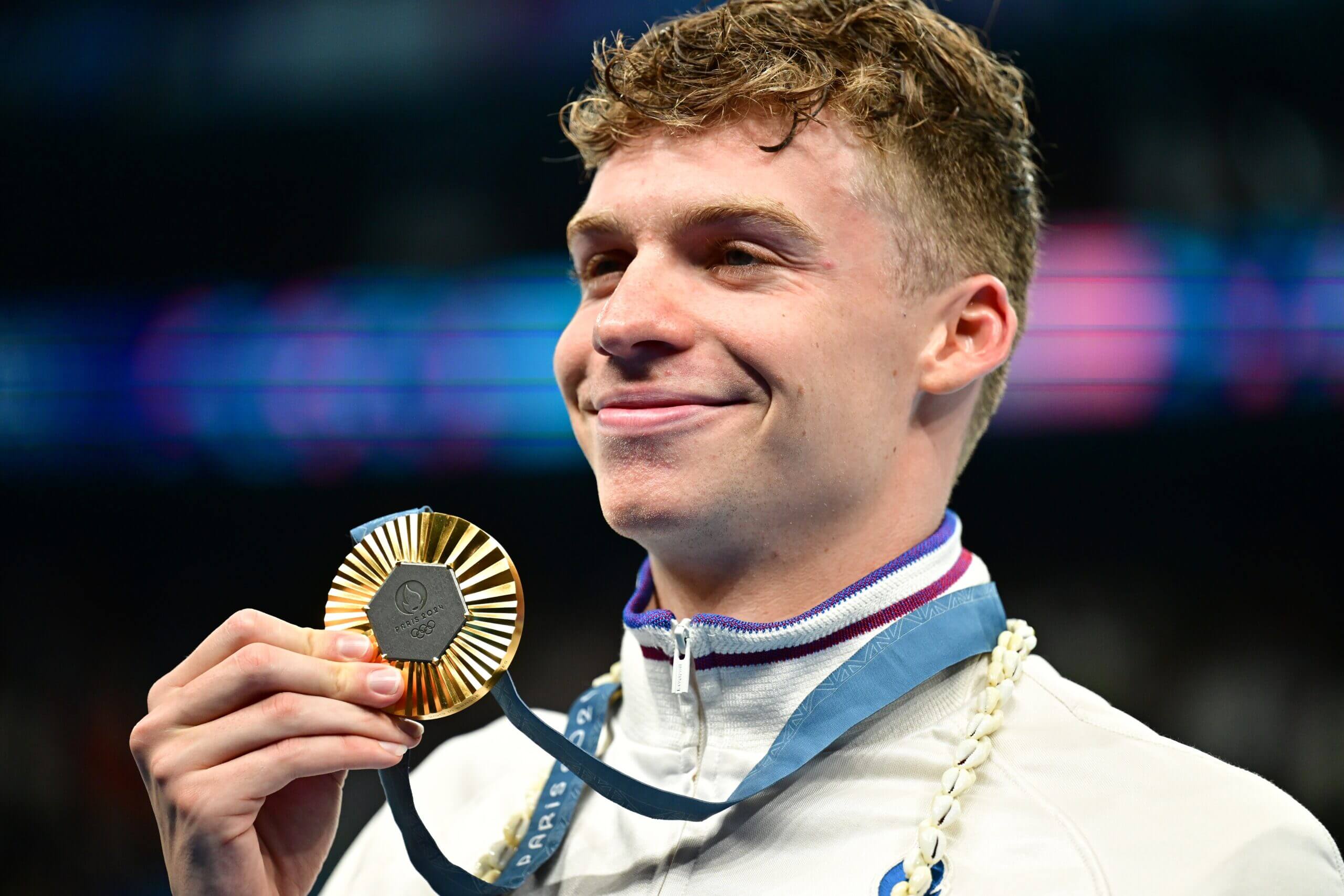
The NCAA system isn’t just helping Americans. French star Léon Marchand is one of many foreign Olympians training at U.S. colleges. (Christian Liewig – Corbis / Corbis via Getty Images)
Track? Check.
Swimming? Check.
Fencing? Check.
Volleyball? Check.
Women’s rugby? Check.
Taekwondo? Canoeing? Not so much.
Behind another 100-plus medal performance and a down-to-the-wire race for the most gold medals are tentacles that stretch from the most hallowed academic halls to the after-school recreation program at the local YMCA. It includes famous and not-so-famous coaches on the cutting edge of their sports, and millions of anonymous parents nudging their children to compete in a talent pool that is, in part, so broad and wide because of the incentives and potential payoffs that make it so.
Nothing lasts forever, though, or without the work required to sustain it. With the first home Summer Games since 1984 set to arrive in Los Angeles in four years, that work has never felt so important to the people doing it.
“Our plan is to spend the next four years building up our athletes’ star power,” Harris said. “We want our athletes to be the stars.”
(Top photo of Americans Anna Cockrell and Sydney McLaughin-Levrone showing off their medals from the women’s 400-meter hurdles: Patrick Smith / Getty Images)
Source link : http://www.bing.com/news/apiclick.aspx?ref=FexRss&aid=&tid=66b886fe35b34008b37f6ff5723fa987&url=https%3A%2F%2Fwww.nytimes.com%2Fathletic%2F5691811%2F2024%2F08%2F11%2Fteam-usa-medal-count-olympics-future-college-sports%2F&c=10979071028362123731&mkt=en-us
Author :
Publish date : 2024-08-10 22:00:00
Copyright for syndicated content belongs to the linked Source.