This wariness has also shaped Latter-day Saint culture’s inclination to avoid extremes. After decades of being marginalized for practices considered radical, the modern church and its adherents have walked a delicate tightrope. And for many, Christian nationalism and the candidate many adherents put their hope in – Donald Trump – seem a step too far.
Over the past half-century, Latter-day Saints tended to align politically and culturally with conservative Catholics and evangelicals. On balance, the church remains highly conservative on social issues, especially gender and sexuality, and 70% of its American members lean Republican. However, more younger Latter-day Saints have much more progressive views – and even the leadership has parted ways with the GOP on some issues, such as strict immigration proposals. While the church opposes “elective abortion,” it allows for several exceptions.
During the 2016 election, only about half of the church’s members voted for Trump; 15% voted for Evan McMullin, a Latter-day Saint who positioned himself as a moderate choice between Trump and Hillary Clinton. In 2020, Trump garnered about 7 in 10 Latter-day Saint votes.
During congressional hearings about the Jan. 6, 2021, attack on the U.S. Capitol, Arizona House Speaker Russell “Rusty” Bowers, who resisted pressure from the Trump administration to recall the state’s electors, cited his Latter-day Saint beliefs. “It is a tenet of my faith that the Constitution is divinely inspired,” Bowers said, explaining his refusal to go along with the scheme.
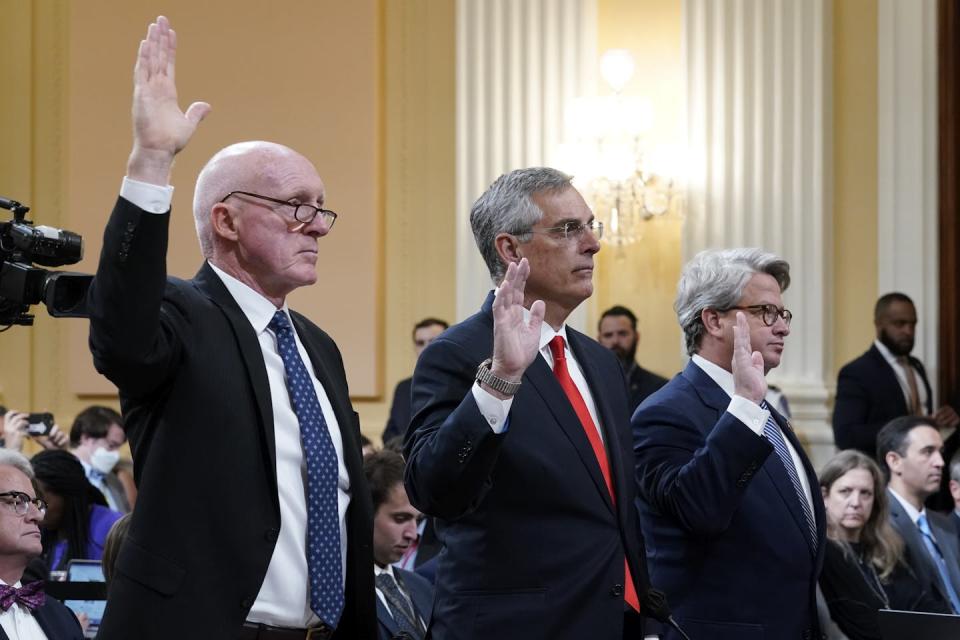 Arizona House Speaker Rusty Bowers, left, is sworn in before testimony at the Capitol on June 21, 2022, alongside Georgia Secretary of State Brad Raffensperger and Georgia Deputy Secretary of State Gabriel Sterling. AP Photo/J. Scott Applewhite
In June 2023, church leaders issued a statement against straight-ticket voting, saying “voting based on ‘tradition’ without careful study of candidates and their positions on important issues is a threat to democracy.”
Holy purpose
Ever since the Puritans, many people in what became the United States have believed God has a special plan for their society – part of the same current that drives Christian nationalism today.
Latter-day Saints, however, have a specific vision of that plan. According to the church’s teachings and scriptures, the country’s establishment was a necessary step toward restoring the “only true and living church” – their own. And that church is a global one, not just American. More than half of all Latter-day Saints today live outside the U.S.
Ultimately, Latter-day Saint teachings consider America’s story part of a greater goal: ushering in the second coming of Jesus Christ. As the church’s name suggests, Latter-day Saints believe that they are living in the last days, just before the millennial reign of Jesus – a kingdom where national and political distinctions melt away.
But as with all other churches, its members live in the current day, where political, cultural and social realities shape how they interact with the world around them – and how they vote.
This article is republished from The Conversation, a nonprofit, independent news organization bringing you facts and trustworthy analysis to help you make sense of our complex world. It was written by: Nicholas Shrum, University of Virginia
Read more:
Nicholas Shrum does not work for, consult, own shares in or receive funding from any company or organization that would benefit from this article, and has disclosed no relevant affiliations beyond their academic appointment.
Source link : http://www.bing.com/news/apiclick.aspx?ref=FexRss&aid=&tid=671a8a94b3c04a60a7191ddc93717b7e&url=https%3A%2F%2Fwww.yahoo.com%2Fnews%2Fmany-latter-day-saints-america-124012399.html&c=6095306210833328274&mkt=en-us
Author :
Publish date : 2024-10-24 03:08:00
Copyright for syndicated content belongs to the linked Source.