Meanwhile, Young tells stories of an election worker who had someone show up at their house at 3am, attempting to make a citizen’s arrest. Other employees have been doxxed online.
Young’s team recently won a court case, which challenged the office’s decision not to release employees’ personal details under the Freedom of Information Act in an effort to protect their physical safety – something they did until recently. They won.
“Although we can’t necessarily ensure that everyone is going to feel comfortable in every single position that they’re in, especially when they’re working in a presidential election that’s as contentious as this one is, we feel like we’ve done a good job at providing them with enough tools,” he says.
But despite the anxiety, Maricopa County currently has more people asking to help with the election than they have jobs for.
“I haven’t seen a more dedicated people. They don’t have to work here, they could probably find another job or position that’s way less stressful … but they are here for a purpose; they are here to protect democracy, and provider the Maricopa County voters with the most opportunity that they can to cast their ballot and vote for the candidate they support.”
Despite all of these efforts, not everyone is won over.
Maricopa continues to face unfounded allegations over election integrity. And some of those involved following the 2020 controversy have become collateral damage.
Richer backed his systems in the face of Trump’s brazen attempts to overthrow the 2020 election results, telling courts and the Senate his people administered the election with “integrity” to produce “accurate and reliable” results.
(A total of 14 claims of fraud, tampering or manipulation emerged and no instances have been proven; no court cases won.)
But Richer still lost the Republican primary to hold onto his role earlier this year.
Meanwhile, Maricopa County board of supervisors member Bill Gates has decided he will not run again this year, citing harassment and conspiracy theories related to election integrity.
Young told Newsroom the questioning of his staff and his systems can be “frustrating at times”.
“Especially as a technologist; as an IT guy, we hear people say things that are just patently not true about technology or about our IT system.”
The chief information officer refers to conspiracy theories from the 2020 election, including claims ballots had been printed on bamboo paper and an Italian satellite had hacked the systems.
But he also sees this as a challenge to educate people about the election process and the steps taken to protect democratic systems.
Six days out from election day, 2.6 million people in the county are registered to vote. Of those, 1.1m have already returned their mail-in ballot and 104,000 people have early voted in-person.
Mail-in voting has been in place in Arizona for more than 30 years, creating a culture of “voting from the couch”, as well as early voting.
However, Young says people still like to push it to the last minute, and he expects both a high turnout of in-person voters on November 5, as well as lines and lines of cars filled with people who didn’t get around to dropping off their mail-in ballot sooner.
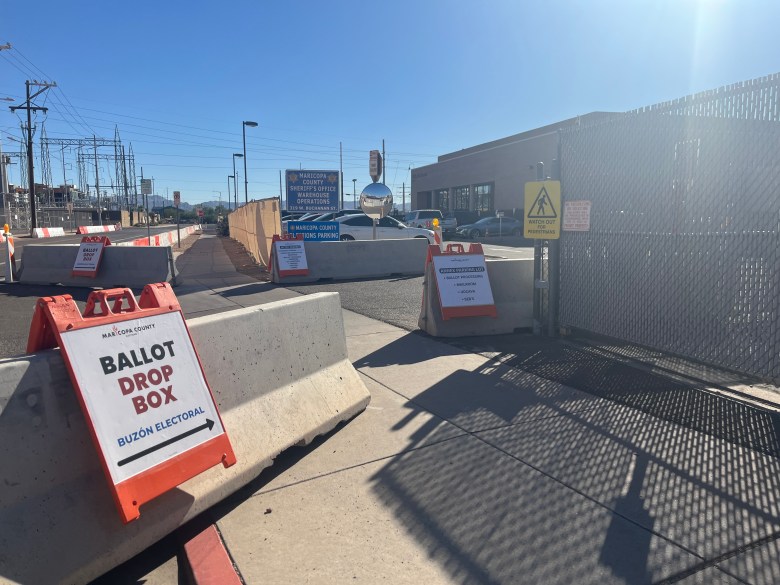 Heavy physical security measures have been put in place to keep the ballots, the processing system, and workers safe at the warehouse used to process votes in one of the most crucial counties in this year’s elections. Photo: Laura Walters
One person unlikely to be voting in this year’s crucial election is Maricopa County resident Stuart Mazzeo – not by design, but through misunderstanding.
Despite the county’s best efforts at mounting an unprecedented public information campaign, it’s impossible to reach everyone.
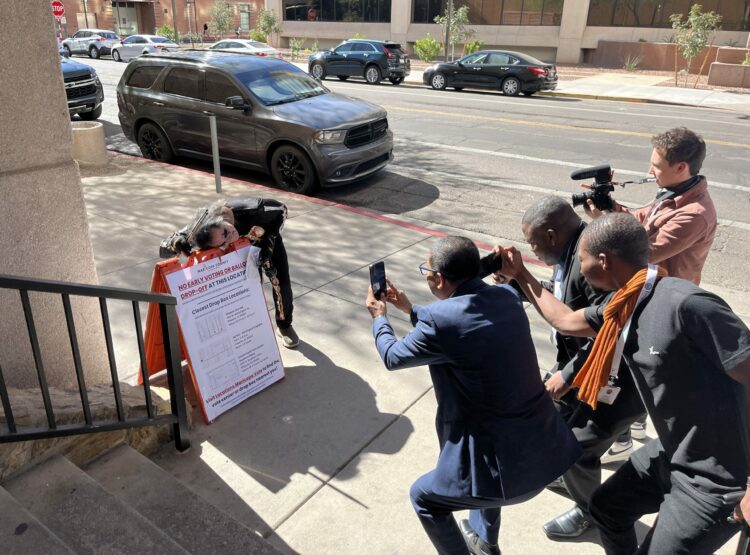
On October 31 – dressed as a skeleton and black eye make-up in an homage to Alice Cooper – Mazzeo walked into the Maricopa County courthouse in downtown Phoenix.
Mazzeo told Newsroom he’d walked eight miles (13 kilometres) to drop off his voter registration form. But he was turned away. He says he was turned away by an employee who said they didn’t like his attitude. He says he planned to walk a further couple of kilometres to try again.
In Arizona, voters have to be registered 29 days ahead of the election to vote. So, Mazzeo won’t get to vote for the candidate he refers to as “my guy” this election.
Mazzeo has passionate opinions about immigration and the rule of law that’s driven him to register. When asked point blank why he’s voting for “my guy”, he says: “Because I’m sick of being poor”.
Perhaps, Maricopa will follow the likes of Alaska, Rhode Island and Washington, D.C. to allow same-day registration next time around.
Laura Walters is in the United States covering the 2024 presidential election as part of a press programme hosted by the US State Department
Source link : http://www.bing.com/news/apiclick.aspx?ref=FexRss&aid=&tid=6724fb355ae84a81ad1996594e761823&url=https%3A%2F%2Fwww.newsroom.co.nz%2F2024%2F11%2F01%2Fus-election-the-world-could-wait-a-fortnight-thanks-to-one-arizona-county%2F&c=13628236763401596132&mkt=en-us
Author :
Publish date : 2024-11-01 04:08:00
Copyright for syndicated content belongs to the linked Source.