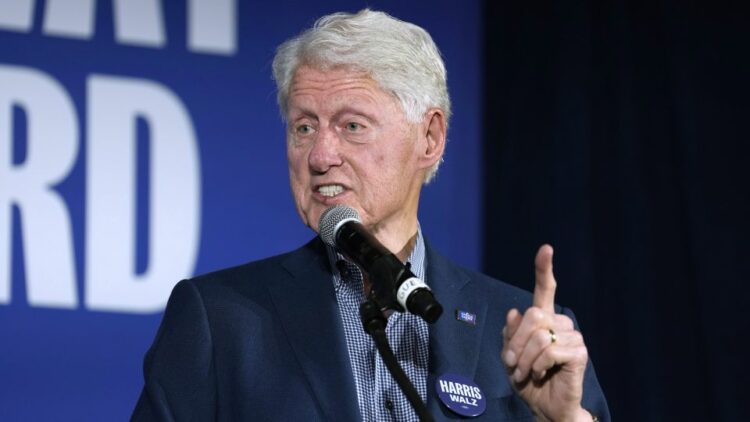
Clinton speaks at a campaign event in Fort Valley, Georgia, on October 13, 2024. – Julia Beverly/Getty Images
Trade is a sensitive subject for him, but one, he argued when asked – after a few minutes of initial defensiveness – that proves his point over what being president is actually about. Imagine if America hadn’t signed on, hadn’t bailed out Mexico when the peso was failing, he argued: Mexico might have collapsed, probably another million undocumented immigrants would have come over the border, the upheavals in imports and exports would have rocked the American economy.
Then again, Clinton said, he was “gobsmacked” that companies that said they’d pay to help with the transition never did. And he blamed the Republicans who rode an anti-Clinton, anti-NAFTA wave in 1994 for never getting the universal health care and job retraining programs he had envisioned as the other side of the agreement.
“The government should have seen that we had a public stake in minimizing the inevitable losses,” Clinton said. “The benefits, no matter how great, are dispersed. The burdens, no matter how light, are concentrated.”
He added, “The thing you have to give Trump credit for is he saw that was a parade he could get out in front of.”
Contrast that, Clinton said, to Trump’s isolationism and massive tariff proposals, which he said Americans should care about not just out of principle but because of what the reality of a global economy would mean for prices at home as other countries look to make up the costs: “He just could never get his head around it … I think he literally thought that you should be able to win all the time and rewrite the books of the world.”
“People hire a president,” he said, “to look down the road and around the corner.”
Advice for Democrats, and for Harris if she wins
No matter who the president is, Clinton predicted, the economy is about to take off. Either Harris will benefit from work she was involved in – or Trump will, by virtue of running against what Clinton says is just the hard interim years.
“We’re now going to be dealing with the genuine economic dilemma of, how can we keep growing things without inflation and the genuine political dilemma going back at least 20 years, maybe more: The imperative of partisanship is to trump the other side,” Clinton said.
The former president said he’s heartened to see Harris talking about making compromises to govern, especially if she gets elected and ends up with a Republican Senate.
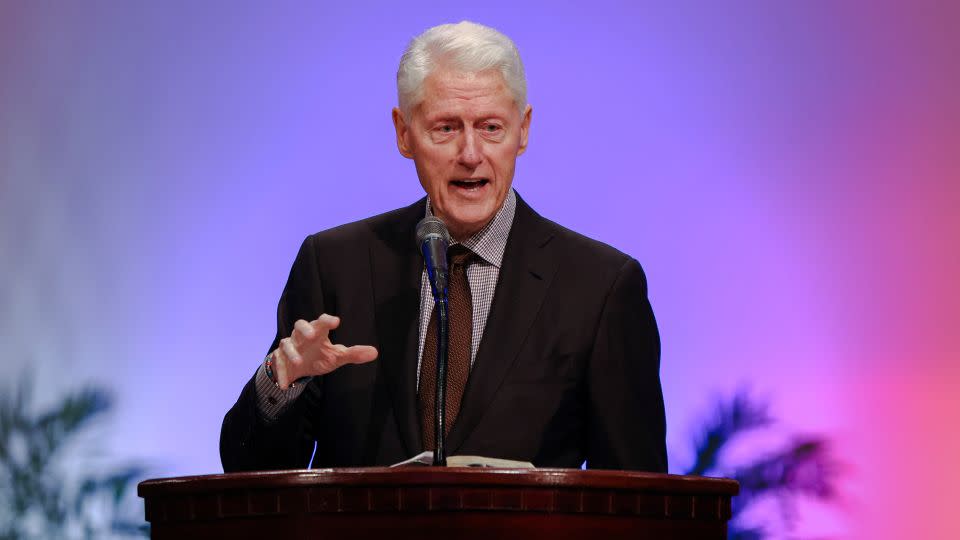
Clinton speaks during morning service at a church in Albany, Georgia, on October 13, 2024. – Logan Cyrus/AFP/Getty Images
“If you’re a Republican, you have to believe in your conservative philosophy enough to do some deals with Democrats that are good for everybody and that leave us better off,” Clinton said, arguing that the GOP could respond to “a lot of legitimate issues at play in people’s heads from all the things Trump’s advertising,” but “if you’re a Democrat, the problem is: Are you betraying your progressive principles every time you make a deal?”
Learn from his mistakes on trade and other deals with Republicans, Clinton urged Harris.
“You need a better strategy than we had to make it OK for us to make principled deals with the Republicans,” he said, shaking his head as he reflected on how he didn’t think to do that himself. “And we need to talk about it.”
As for Democrats, “we can’t go around saying, as I do all the time, that what we have in common is more important than our interesting differences – which I deeply believe as a matter of biology and I believe it as a matter of psychology and I’m certain it’s true as a matter of economics,” Clinton said, “and at the same time basically try to make mincemeat out of the electorate and only go after this little piece and leave that little piece alone.”
And while the economic, social and psychological differences are real, Clinton said, some of the voters backing Trump need to be more honest about what’s driving them.
“It’s also true that if you grew up like I did in a White working class family in the South and felt that the only people who were ‘below’ you, if you will, were Black, and you might have known that the only way to hold on here was not to have too much progress of Black folks and what they’re allowed to get,” he said.
Accepting George W. Bush’s silence
There’s only one living former president missing in this race: George W. Bush. Many people think they know where he stands on Trump, even though he has refused to say.
Clinton, who has his own long history with the Bush family, defended the 43rd president’s choice to stick to his rule of avoiding campaign politics in his post-presidency.
“First of all, he’s spoken up, I think, more than he’s gotten credit for, and he takes every opportunity that I’ve seen to talk about how important immigration is and how we can’t survive without it,” Clinton said, leaving hanging in the air the implication of that contrast to Trump’s nativism.
Bush really did want to get out of politics, Clinton said, before dropping in passing that “he likes Colin Allred,” who happens to be Bush’s local congressman in Texas and is trying for a potentially Democratic majority-preserving upset Tuesday against Republican Sen. Ted Cruz. Clinton said Bush told him that directly: “Oh, yeah. He’ll tell anybody that, that he’s a good guy.”
Bush left a congratulatory voicemail for Allred, when he first won election as the congressman from his home district in 2018, and they met in person once, but the former president has not gotten involved in the Senate race.
“He also knows, beginning with our relationship, it’s very different when you’re out of political life, when there is no competition, no consequence,” Clinton said. “And I think he believes that since he was a proud Republican all those years, it’s enough for him to make clear what he believes with all this, without giving up the party he’s been with all his life.”
When read Clinton’s comments, a person close to Bush told CNN, “President Bush has indeed moved on from presidential politics, but he has been working quietly and diligently to keep the Senate in GOP control.”
The person declined to comment on whether that work included efforts on behalf of Cruz.
Clinton’s biggest regret of 24 years ago refracted in today’s politics
Clinton’s case for Harris is looped through with his own experience: The reason he’s so sure Americans will soon start feeling better about the economy is because that’s what happened in between Democrats’ devastating 1994 midterms after he made huge cuts to the shrink the national debt, and how they felt about the surging economy years later. He said he feels for Biden, complaining at the White House about not getting credit for infrastructure projects like replacing lead pipes and other spending that he says helped save the economy, “but that happens to all of us.”
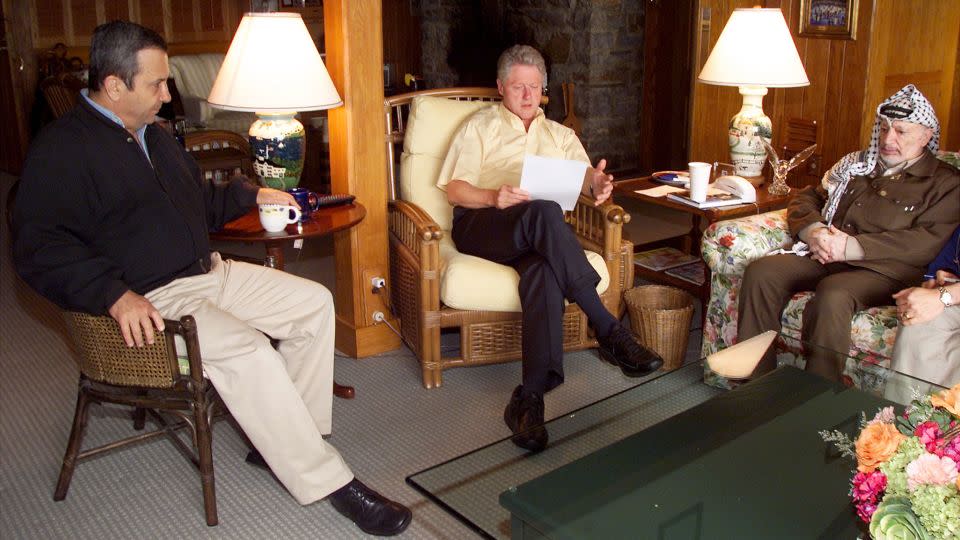
Clnton speaks during a morning meeting with Israeli Prime Minister Ehud Barak, left, and Palestinian Chairman Yasser Arafat at Camp David in Maryland on July 25, 2000. – Ralph Alswang/Newsmakers/Getty Images
The list goes on – but nothing is so aching for Clinton as what has always been the regret he couldn’t reconcile: His failure, up until almost the day he left the White House in 2001, to land a permanent peace deal between the Israelis and Palestinians.
Especially since October 7, 2023, people who have spoken with Clinton told CNN he has talked with anger and remorse in private about what could have been and what didn’t have to be. Standing in Michigan, reflecting on Arab American politics in the state sent him off on an extended riff through history and emotional understanding, building up to the missed crowning achievement that might have gotten him the Nobel Peace Prize and almost certainly would have saved many of the lives that have been lost without it.
“The only time Yasser Arafat didn’t tell me the truth is when he promised me he was going to accept the peace deal that we had worked out,” he said, starting to tick through the details of the would-be agreement and the history of its approval by the Israeli Cabinet.
“I can hardly talk about this,” Clinton said, audibly choking up for a moment.
“How about we stop funding it?” a woman called out.
He kept going. There’s one president at a time, he said, but he thinks America needs to restart the bigger peace process.
“I’m going to do everything I can to convince people that they cannot murder their way out of this. Neither side. They can’t kill their way out. They have to make a new beginning,” he said.
The answer, he pleaded, isn’t being so mad at Biden that they turn toward Trump or other candidates that might help the Republican win. Show up for Harris, he told anyone listening, and it’ll be up to the next president to restart the peace process and pick up where he’d been forced to leave off.
“We have to find a way to share the future,” he said.
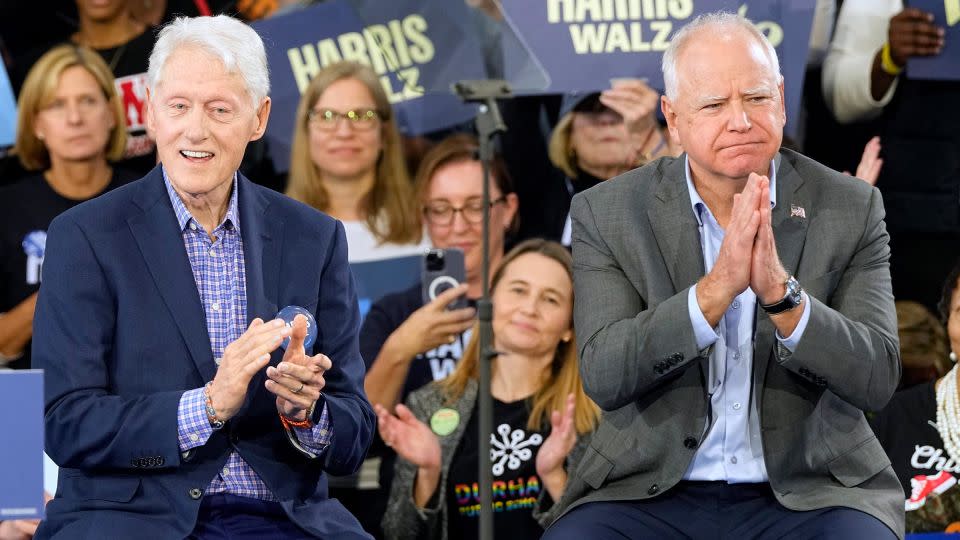
Minnesota Gov. Tim Walz appears with Clinton at the campaign rally in Durham, North Carolina, on October 17, 2024. – Steve Helber/AP
Around longer than he expected
Long before Clinton finished up his Democratic National Convention speech in August by saying, “I have no idea how many or more of these I’ll be able to come to,” he was so far off the prepared text that the teleprompter operator had given up trying to search for a thread and just paused it in the middle of an abandoned paragraph.
The reaction Clinton got in Chicago surprised him. But that reaction was in part about how shocked some people get to see the youthful president they remember now so wrinkled, his hair so white. When he slipped into a McDonald’s in Georgia last month for an old times’ sake stop, the woman behind the counter thought at first that he was Biden.
“I freaked some people out. I didn’t mean to. But I realize that I was comfortable living with my own mortality and not being morbid about it, more so than a lot of people,” he said.
Clinton’s father died before he was born. He’s the first man in four generations of his family to make it this far, and, he said, “I can honestly say when I was younger, I did not think I would live to be 78 – because I didn’t know about all the advances in heart health, all the things I could do with diet. Now I’d love to live to be 90 or 100.”
Asked if he is hoping to beat out the presidential record Jimmy Carter is setting, now a month into being 100 himself, Clinton flashed a grin: “If he heard that whispered in his ear, he’d live to be 150.”
The way he knows he’s getting older, Clinton said, is that he’s thinking more about strengthening his foundation and the places left on his bucket list he wants to get to.
Another way of measuring it: “I’ve reached the point where I’d rather work than play golf.”
Imagining Wednesday morning
As the bus neared Battle Creek, Clinton began a response to a question about how he’d feel when the election is called by talking about the potential impact on the Supreme Court.
If Trump wins, “I don’t know what I’m going to think, but I think that I will do my best to save my foundation for the work we do, and for my wife and daughter, go back to work,” he said. “Whether they’ll let me do it or not, I don’t know.”
He didn’t linger on the threat he feels behind that “let me.”
If it’s Harris, he said, he’s ready for more work.
“My belief is that you should always help if the president asks you to. I said, ‘I can help you on natural disasters, I can help you on some problems, but I will never call you,’” he said, proudly noting his 24-year, four-president run of never being the one to initiate a call, despite the many that have come in.
“She’ll call and say thanks to Hillary, me, and I’ll say, ‘We’re as close as your phone, but you’ve got a hard job, and the last thing you need is anybody like us working you.’”
For more CNN news and newsletters create an account at CNN.com
Source link : http://www.bing.com/news/apiclick.aspx?ref=FexRss&aid=&tid=672781ede3fd4d55b229f2488f3eb330&url=https%3A%2F%2Fwww.aol.com%2Fnews%2Fcnn-exclusive-bill-clinton-hopes-113023817.html&c=4632004235000567881&mkt=en-us
Author :
Publish date : 2024-11-03 01:30:00
Copyright for syndicated content belongs to the linked Source.