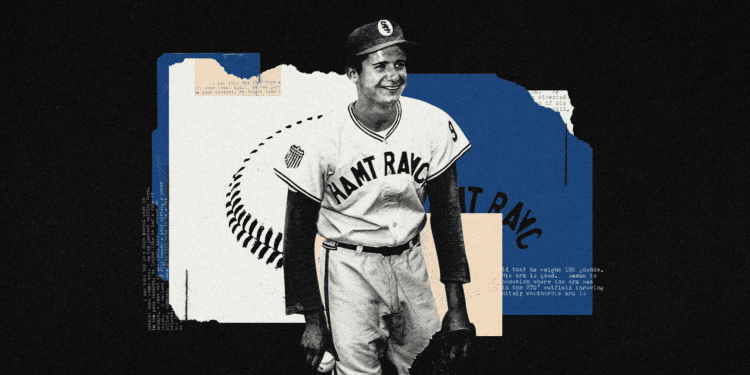
In Rickey’s papers, now housed at the Library of Congress, there are two scouting reports filed on Deras. The first, dated June 5, 1964, hints at his potential.
“I see nothing (sic) whatever wrong with his form,” Rickey wrote. “His head goes toward the pitch with every swing. He should be a good hitter, and his form supports his record for power.”
The second is dated July 14, 1964, soon after Deras began his pro career, and hints at what was to come.
“In the game tonight he looked like he had a case of cramps — came out of his shell late,” Rickey wrote. “Showed no power. I believe he will become a good hitter, a power hitter, someday. Surely he will come to be a bit (more) relaxed. I hope that management will not advise about his batting or change him in any respect until, per chance he gives up.”
By the numbers, Art Deras’ professional baseball career amounted to this: A .243 career batting average and 32 home runs over five seasons in the minor leagues. He spent all of 1966 and 1967 in Double-A Arkansas, before a demotion to Class A the following year.
“I couldn’t understand why he never made it in the major leagues,” Paciorek said. “I said that. ‘If Arty can’t play in the big leagues, there’s no way I can.’”
Done with baseball, Deras served in the National Guard for a few years, then headed home to the Detroit area. He applied for a job at the police force and settled into a quiet life. He got married and had two children. Kevin was the first. A few years later came a girl, Deb.
In the years after his baseball career ended, Deras had a fractured relationship with the sport. He battled depression and wanted nothing to do with the game.
“People come up to me even now and ask why I quit,” Deras said in 1983. “I just tell them it was because of personal reasons. … By the time I was 21, I had already had a full 14-year career — playing every day, two amateur championships, a room full of trophies. I should have been reaching my prime and I was exhausted. Looking back on it, I guess it was just a problem of getting too much too soon.”
Eventually, baseball’s idyllic rhythms drew him back. He played rec softball and began watching the Tigers every night. He even ventured to Tiger Stadium to see Pacoriek play when the Dodgers were in town.
Kevin has faint memories of going to a reunion for the Little League team one year in Hamtramck, but even then he didn’t quite ascertain how big of a deal it was. Kevin also played baseball growing up. His father didn’t push him into the sport, he says, but he didn’t hold him back from it, either. As for the subject of Art’s own Little League career? It just wasn’t a topic that came up very often.
Truth was, Art could be closed off to a fault. Kevin and Deb both speak highly of their father, but Kevin acknowledges a certain emotional distance. He pieced together more about his father’s career over the years, and one year before his birthday, he called the Little League Museum in Williamsport, Pa. He told them his father had played on a championship team, and he was hoping to acquire some film to give his dad a special gift.
“Did you say ‘Deras?’” a worker asked over the phone.
“Yeah, my dad was Art Deras,” Kevin replied.
“Like Art ‘Pinky’ Deras?”
“Yeah.”
“Hold please.”
Kevin split the costs to help the museum convert old 8mm reel tape to DVD. He presented the rediscovered film to his father, including the ninth inning of the championship game and the ensuing celebration, when eight kids mobbed their bigger teammate as he walked off the mound.
“It was really hard to judge his reaction,” Kevin said. “You could tell he appreciated it. He was intrigued watching it. But it may have brought back some bad memories.”
Jane Chupailo was a waitress at a Ram’s Horn restaurant off Dequindre Street, and occasionally the police officers who came in would point to Art Deras and ask her: Do you know who that is?
“No,” she might say. “I just knew he had nice biceps.”
Art was 12 years her senior, divorced with two children of his own. One day he swung by her house anyway, and soon they were dating. It wasn’t until sometime later her father pulled her aside.
“Jane,” he said. “Do you know who that is?”
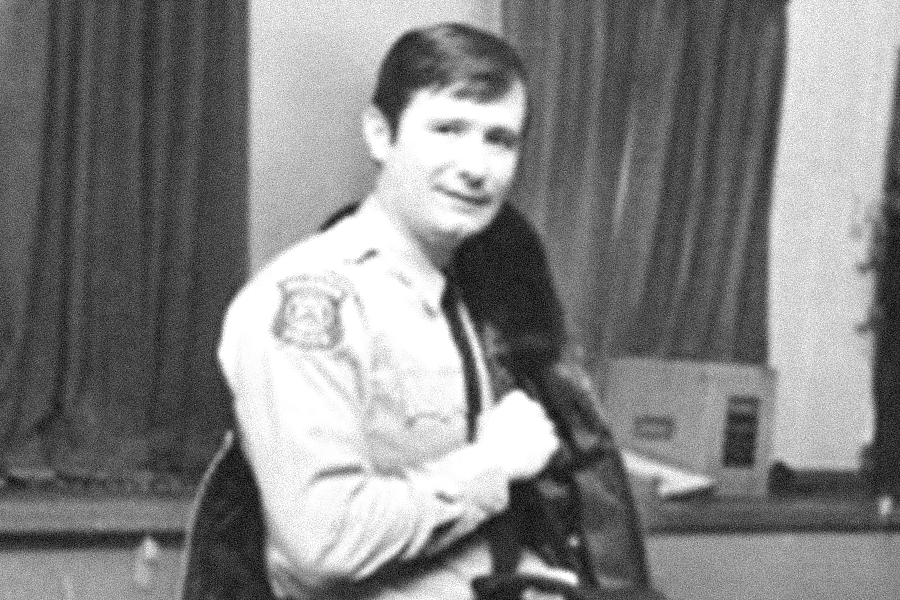
Deras during his career as a police officer.
Jane had a big family that loved sports, and from time to time, she would hear Art discuss his career with her father or brother. But it wasn’t until Kevin got another call from the Little League Museum that all the pieces started falling into place.
Two filmmakers, Brian Kruger and Buddy Moorehouse, had inquired about a project they were interested in. Museum director Lance Van Auken gave them another idea: Do something on Pinky Deras. The project turned into the 2010 documentary “The Legend of Pinky Deras.”
The Art who appears in the film is quiet and speaks in a matter-of-fact tone, but Jane says the project energized him. As for everyone else, including son Kevin, it wasn’t until the documentary that they finally realized the full extent of his legend. By then Kevin was approaching 40.
“It took that amount of time,” he said, “to realize how exceptional he was.”
Deb, the daughter from Art’s first marriage, married a man who enjoyed baseball, and they eventually moved out to Arizona. They had three boys who took an interest. Visits back to Michigan soon meant questions, and slowly Deb began learning more about all her father had accomplished. Her youngest son now plays baseball at Paradise Valley Community College in Arizona, and this summer, he ordered a custom glove with the words Pinky Deras inscribed on the glove’s smallest finger.
Adam was the youngest, 30 years younger than his half-brother. The dynamic was unusual. But Jane called Adam her miracle baby, finally conceived at age 40 after three surgeries and three attempts at in-vitro fertilization.
Though Art and Jane divorced when Adam was in fifth grade, they remained on good terms. Art spoiled his son and let him do anything. Perhaps the only thing that ever made him hesitant was baseball. Adam played the sport growing up and says his father was supportive, but Jane says it was her brother who first signed him up.
“I thought Art was gonna hit the roof,” Jane said. “He was so angry.”
Jane called Art’s baseball career “his Berlin Wall.” A line she simply wouldn’t cross.
“Some people … I don’t even know how to explain it,” she said. “You have things you’ll talk about, but there’s things you keep in your heart.”
The children each have slightly different theories on why he didn’t divulge more.
Maybe it was simply his personality, a quiet man who never sought to talk about himself.
“He was happy with the fame he got,” Deb said. “He didn’t care about moving on. It just wasn’t meant to be. … He never regretted it.”
Maybe it was deeper than that. The pain of not making it further as a professional, of not quite meeting all the expectations of greatness others had bestowed upon him.
“It’s a hard thing when people expect something out of you and you can’t produce,” Adam said. “He had some issues with that.”
Or perhaps it went even further, memories of a robbed youth he buried in hopes of forging a new identity.
“Why he decided not to talk about it, I think it was a little bit of the letdown,” Kevin said. “Didn’t want to relive it because of the could-woulda-shouldas. He probably had some regrets. Maybe after leaving, if he decided to go back, maybe he didn’t think people would take him back.”
By the time Adam grew up and moved out, he called his father every morning at 5 a.m.
Adam worked mornings, and Art was religious about his routines. He would rise and drink coffee in a dark house every day at 4 a.m. At night he would sit down with a bowl of vanilla ice cream and watch the Tigers.
By the end he was reclusive. The once-great athlete had stopped exercising after a back injury many years before. He grew inactive and health issues followed. If Art didn’t answer Adam’s early morning phone calls, something was wrong. He had battled heart problems for years. One day after an episode he checked into the hospital, and a couple of nights later, on June 5, 2022, the kids learned he died in his sleep at age 75.
In the days after, they all heard stories they never knew before. Old friends and teammates reached out. The best stories always involved Art’s days playing baseball. There was happiness in stories like that, but there could be a certain sadness, too.
“There were so many unanswered questions,” Kevin said. “So many questions not asked. And some of those questions I tried to ask and never really got a lot of response on. That’s part of it. I guess I missed out on some closure. … My regret is not getting into enough detail and trying to drill deep as far as his mindset and the pressure.”
Many of those answers will remain forever elusive. But if those closest to him looked hard enough, there were sometimes the smallest hints at the feelings Pinky Deras kept locked inside.
Every year around the time of the Little League World Series, he would take his usual seat on the couch and tune in. More than once, after a kid made an amazing play or after a new team got crowned as champions, Jane would look over. And if she timed it right, she would catch Art Deras, the greatest Little Leaguer to ever play, with tears welling in his eyes.
(Illustration: Dan Goldfarb / The Athletic. All images courtesy of Adam Deras)
Source link : http://www.bing.com/news/apiclick.aspx?ref=FexRss&aid=&tid=66bf32bf67574de7a1c6b463aff5d650&url=https%3A%2F%2Fwww.nytimes.com%2Fathletic%2F5703670%2F2024%2F08%2F16%2Flittle-league-world-series-pinky-deras%2F&c=4751735827324233414&mkt=en-us
Author :
Publish date : 2024-08-15 13:00:00
Copyright for syndicated content belongs to the linked Source.