Francine Kiefer/The Christian Science Monitor
A housing and social services navigation center for homeless people is under construction in Palm Springs, California, Aug. 1, 2024. The center includes 80 units of modular, transitional housing for individuals and families.
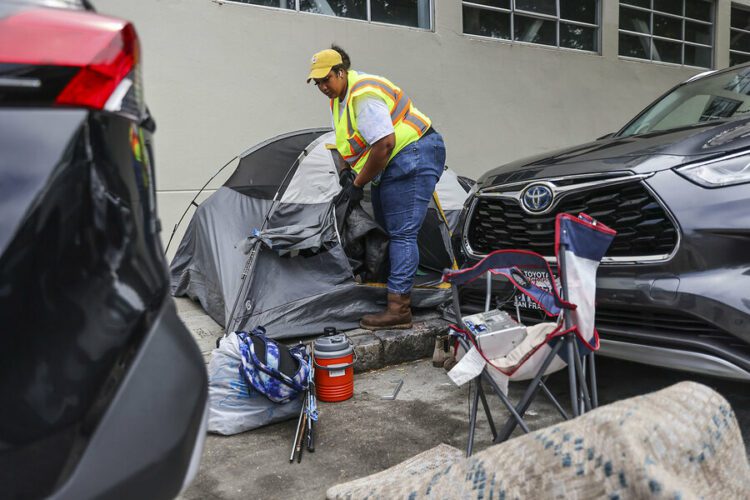
A recent study of three homeless hot spots in Los Angeles found that in places with encampment clearing, the homeless population declined – but only for two or three months.
“The people come back, [though] they might not have tents anymore,” says Sarah Hunter, director of the Rand Center on Housing and Homelessness, which conducted the study.
While Governor Newsom stressed the urgency behind encampment cleanup, he also said it needed to include “supporting and assisting the individuals.” The order calls for state agencies, such as parks, to adopt guidelines consistent with those of the state’s Department of Transportation, which has cleared more than 11,000 encampments from underpasses and other areas in the last three years. The guidelines must include advance notice of a cleanup, contact with homeless service providers, and storage of people’s belongings.
Coordinating moving and services
The state is providing billions of dollars for homeless services, housing, and encampment clearing. But Dr. Hunter says the governor is putting the cart before the horse, as not all of the resources have come online yet.
Meanwhile, politics play a “pretty substantial role,” she says, given the governor’s role on the national stage and Mayor Breed’s reelection bid. In addition, the Republican Party is using Democratic presidential nominee Kamala Harris of California as a punching bag for failed liberal policies.
In Palm Springs, which last month passed an ordinance to prevent encampments and sleeping in public places, police Chief Andy Mills is grateful for both the Supreme Court ruling and the governor’s executive order.

Francine Kiefer/The Christian Science Monitor
Police Chief Andy Mills stands at the site of a cleared encampment of tents along Gene Autry Trail in Palm Springs, California, Aug. 1, 2024. At one point, the area pictured behind him had about 70 tents in it.
“The state has finally come to the realization that just housing alone is not going to work,” he says. “There has to be some enforcement also.”
When Chief Mills came to Palm Springs three years ago, he found that the top concern was not burglaries, traffic, or shootings. It was, by far, homelessness. He and his team focused on it with the relentlessness of the desert sun – taking a detailed census of homeless people; connecting them with shelter, services, family, and other locations; and clearing encampments by using existing laws against trespassing and starting fires.
Of the roughly 350 homeless people living year-round in Palm Springs in 2022, only about 100 “recalcitrant” people remain, according to city police. Police now have legal authority to tell people, “You cannot lie in the middle of the sidewalk in the middle of the day,” says Chief Mills.
Like Mr. Webb of Redondo Beach, the police chief says the high court has given him “one more piece of leverage” to move homeless people who refuse housing and services.
A new $40 million homeless navigation center
The city’s new ordinance won’t go into effect until a new $40 million housing and social services navigation center is completed for homeless people, probably in September. It offers 80 units of modular, transitional housing for individuals and families, and includes supportive services, a play area, green space, and a dog park.
Police describe their approach as “compassion first.” But there are also consequences.
If people violate the new ordinance, they have three options, says Chief Mills: the new navigation center (if there is space), another location (preferably their hometown or with family), or jail – at the police officer’s discretion.
“We are not solving homelessness,” says the police chief. “But people have to understand they’re full-grown adults like you and I. They need to be held accountable for their impact on our community.”

Francine Kiefer/The Christian Science Monitor
Donna Jones, a self-described “trust fund baby” who is now homeless, sits behind the Palm Springs police station Aug. 1, 2024. “I’d rather sleep under the stars” than stay at the city’s new navigation center, she says.
Donna Jones, a homeless woman sitting on a sidewalk near a cooling shelter with access to services, has no interest in the new navigation center – neither its large room with 50 beds that opened this spring, nor the individual units coming online. She says that she feels unsafe in group shelters. Small individual units strike her as “a little jail.”
“I’d rather sleep under the stars,” with occasional rejuvenating visits to Motel 6, she says. A self-described “trust fund baby” whose downfall was gambling, Ms. Jones has heard nothing of the Supreme Court ruling, governor’s executive order, or new city ordinance.
“I don’t think that’s right,” she says, when told about the court’s decision and the possibility of arrest. She perks up at the news that Los Angeles, her hometown, is not going to penalize people for sleeping outside. She wonders, How can anyone tell her where to live?
Source link : http://www.bing.com/news/apiclick.aspx?ref=FexRss&aid=&tid=66bbcc2afc8a491783050ad3eb03a18e&url=https%3A%2F%2Fwww.csmonitor.com%2FUSA%2FSociety%2F2024%2F0813%2Flos-angeles-california-homeless-sleep-outside&c=13798115420734535176&mkt=en-us
Author :
Publish date : 2024-08-13 09:37:00
Copyright for syndicated content belongs to the linked Source.