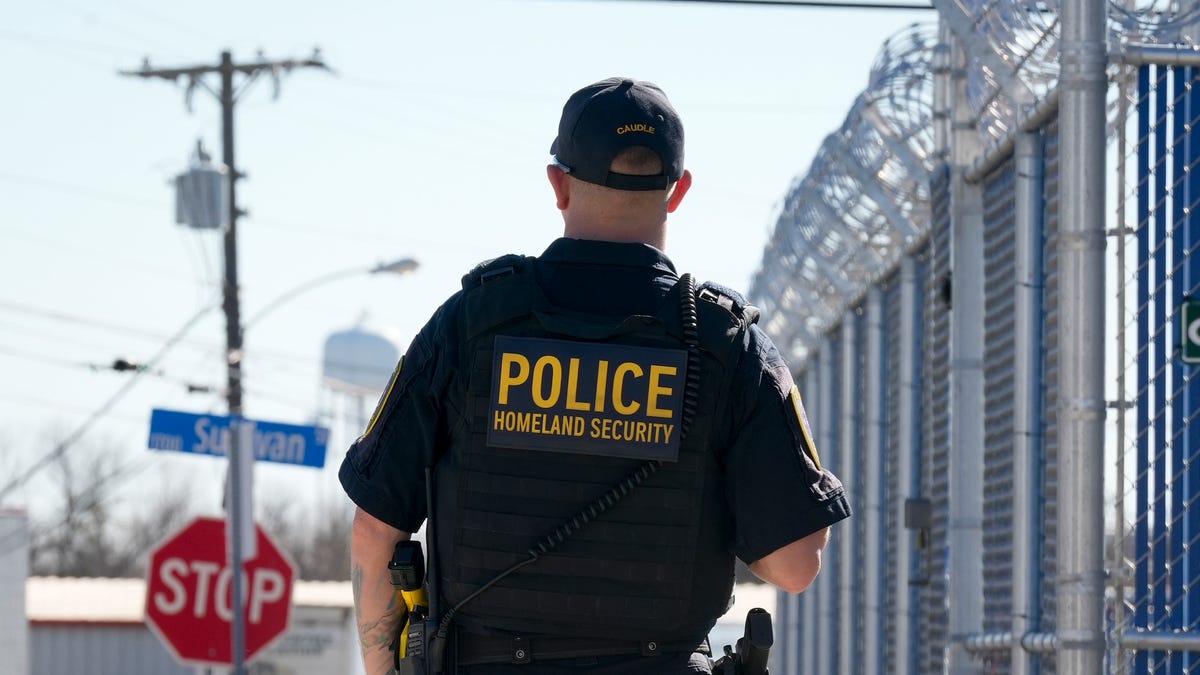
San Francisco leaders unite to support migrants after ICE raids
San Francisco Mayor Daniel Lurie and other community leaders gathered at City Hall to express support for migrants after ICE raids in the city.
People, regardless of their immigration status, have certain rights that may be especially relevant in encounters with ICE such as the right to remain silent.One organization serving the immigrant community in the Inland Empire recommends not to answer the door if ICE at your door.Rapid Response Networks in California, the ACLU and the Coalition for Humane Immigrant Rights are among the organizations with resources for immigrants in California.
Widespread arrests and deportations of immigrants lacking permanent legal status in the United States under President Donald Trump and his administration have hit home for Californians in recent weeks.
In January, a nearly weeklong sweep by U.S. Border Patrol agents in Kern County that led to 78 arrests is now at the center of a lawsuit from United Farm Workers and five Kern County residents, according to a complaint filed by American Civil Liberties Union affiliates on Wednesday. The lawsuit alleges that Border Patrol agents operated unlawfully in its stops and arrests during that January operation.
Other people in California have been arrested since by immigration enforcement agents, some of which were made public by the U.S. Immigration and Customs Enforcement on social media.
While the number of people deported during Trump’s first month in office is “far less” than the monthly average of removals and returns in the last full year of former President Joe Biden’s administration, the number is “poised to rise,” Reuters reported. It comes as the lack of transparency surrounding arrest and deportation data triggered questions about whether the narrative about immigration enforcement in America under Trump is trying to be controlled and why, USA TODAY reported.
Still, people nationwide, including Californians, are concerned about whether they’ll become the next target of ICE agents and where they might be approached at.
The Desert Sun interviewed two experts on what people should know about their rights, regardless of their immigration status.
What are my rights? Here are several to know
The Office of Homeland Security Statistics estimated that in 2022, 2.6 million people living in California were not legal residents. This includes people who entered the U.S. illegally and DACA recipients.
Among the rights people are entitled to under the U.S. Constitution and California’s constitution, regardless of their immigration status, are several that are especially relevant in encounters with law enforcement, including immigration enforcement.
The first is the right to be free of search and seizure without cause under the Fourth Amendment of the U.S. Constitution, Megan Beaman Jacinto said.
She’s an attorney who founded Beaman Jacinto Law P.C. based in Palm Desert. Their areas of practice include employment law, in which many of her clients are immigrant workers, immigration law, and civil rights law.
“So that is a right that every person has, that law enforcement cannot search through their belongings or their cars or their homes unless they have either consent or a warrant from a judge, and that applies to a lot of the immigration stops or immigration encounters as well,” Beaman Jacinto said.
The right to not self-incriminate, commonly known as the right to remain silent, is protected under the Fifth Amendment of the U.S. Constitution, Beaman Jacinto said.
“It’s not required or necessary for a person to answer questions from law enforcement agents, including immigration agents, really in any circumstance, but it’s important to exercise that right if the questions are asking to reveal information that could possibly lead to your immigration detention or law enforcement detention,” she said.
People can communicate that they do not want to answer questions in whatever way is comfortable to them, said Beaman Jacinto.
“The calmer you can be, the better,” said Benjamin Wood, the legal director for the Inland Coalition for Immigrant Justice, which serves the immigrant community in the Inland Empire. He’s not an attorney but an accredited representative under the Department of Justice, someone who can represent individuals in immigration legal matters, according to the Executive Office for Immigration Review.
Telling an officer that you’re not going to answer any questions until an attorney’s present or not going to provide any information until one is present are among the ways to communicate that you’re exercising your right to remain silent, Wood said.
“If they detain people anyways, people should feel empowered to stand firm on that they’re not going to provide any information,” Wood said. “Once they’re booked, then they have a right to a phone call. They can call their consulate, they can call a family member, they can call their attorney, they can call their local community organization or union and let people know that they’ve been detained and start the process of getting legal defense.”
One guidance Beaman Jacinto gives detained people is not to sign anything. That’s because people may be presented with a Voluntary Departure, which, if signed, essentially says you’ve agreed to be deported voluntarily.
Other rights people should know, perhaps especially relevant for bystanders to people who consider themselves allies, are protected by the U.S. Constitution’s First Amendment.
“It’s the First Amendment right to free speech, so law enforcement agents should not be arresting people because of their exercise of free speech in protest or in opposing,” Beaman Jacinto said. “There have been many people, for example, recording or advising people of their rights during law enforcement detentions or law enforcement actions.”
The authority of ICE at your home, in the workplace
Last year, a court order vacated any policies or practices that allowed officers in the Los Angeles Field Office of ICE or Enforcement and Removal Operations the ability to conduct what is known as “knock and talk” operations, as these operations were leading to arrests despite immigration enforcement agents lacking a judicial warrant, or the consent of a resident, to enter the “curtilage” of the person’s home — basically, the immediate area surrounding your home such as a porch or yard, according to the Los Angeles County Sheriff’s Department.
“While agents would have been permitted to enter these areas if their purpose was merely to ask questions of residents, with residents’ consent, according to the court, the Constitution prohibits them from encroaching upon these areas ‘with the intent to arrest,’” according to the ACLU of Southern California.
But what if an immigration enforcement agent is at your door?
Inland Coalition for Immigrant Justice advises people not to answer the door, Wood said. This guidance may contradict other information in this scenario, which may recommend asking immigration enforcement agents to slide their warrant under the door to check whether a judge signed it. That’s because there’s such a thing as administrative warrants, which do not come from a judge, and those warrants aren’t enough for an agent to force a search or entry into a home.
If an agent has a judicial warrant, they’ll enter, said Beaman Jacinto. But to try to ascertain what kind of warrant an agent at their door has is not in someone’s best interest to do so, Wood explained, especially someone who doesn’t speak the language of the agent or doesn’t have familiarity with legal language, or is just nervous about the interaction.
Should an immigration enforcement agent enter a workplace, there is one protection people should know. While these agents can enter the public area of a workplace without a warrant (say, a lobby), they can’t freely enter spaces reserved for employees. California law says employers can’t consent to agents to enter those areas without a warrant, Beaman Jacinto said.
“Historically, and what we’ve been seeing even recently is that the way they tend to operate is that they’re looking for specific individuals, and so because of that, if I’m not the person the ICE is looking for, then they really have no reason to stop me or ask me any questions, or I don’t really have much reason to be alarmed or change anything that I’m doing,” Wood said. “So generally, our advice to people in the workplace is to just go about your business.”
For decades, federal immigration agents generally avoided conducting enforcement sweeps or detentions at or near what the federal government deemed “sensitive” areas, including schools and churches, although there were exceptions in emergencies. After retaking office, Trump immediately rescinded that longstanding policy and instead told agents to use “common sense” in making arrests where necessary. It comes as a bill introduced in December in California that would prohibit agents or employees from ICE from entering school grounds without providing identification, a written statement of purpose, and a judicial warrant, The Californian reported.
“Immigration agents do have the ability to go into those spaces in most contexts, even in California at this point, but people’s rights never change,” Beaman Jacinto said, adding that there have not been many confirmed enforcement actions in these spaces.
People have the same rights, such as not answering or not providing consent to a search, whether approached by an immigration enforcement agent at a school bus stop or at a hospital, she said.
Wood said his advice for people getting stopped on the street is to comply.
“It’s better to fight it in court than to fight it on the street because you don’t also want any additional criminal charges,” he said.
Need more information to navigate your situation? Here are some resources
Across California are Rapid Response Networks, which operate hotlines people can call, including for legal assistance if ICE has detained someone. The California Collaborative for Immigrant Justice has more information on their website, including contact information.
Various organizations focused on civil rights and immigrants’ rights offer a variety of documents and infographics online and on social media titled “Know Your Rights,” often providing information such as constitutional rights and how to navigate encounters with immigration enforcement. These include the American Civil Liberties Union, the legal and civil rights organization Asian Law Caucus that began in Oakland, and the Coalition for Humane Immigrant Rights.
However, the Inland Coalition for Immigrant Justice has been moving toward individualized “Know Your Rights” information, as what to do during encounters with immigration enforcement agents is “really case dependent,” Wood said. The coalition is organizing free legal consultations for people as well.
USA TODAY reporter Trevor Hughes contributed to this article.
Paris Barraza is a trending reporter covering California news at The Desert Sun. Reach her at [email protected].
Source link : http://www.bing.com/news/apiclick.aspx?ref=FexRss&aid=&tid=67c62214092e41768b440cf9f63365cd&url=https%3A%2F%2Fwww.usatoday.com%2Fstory%2Fnews%2Fnation%2Fcalifornia%2F2025%2F02%2F28%2Fice-arrests-california-know-your-rights-immigration%2F79428605007%2F&c=12852580352212995545&mkt=en-us
Author :
Publish date : 2025-02-28 06:34:00
Copyright for syndicated content belongs to the linked Source.