How ‘La Niña’ is causing this year’s extreme weather events
La Niña, the cool phase of the El Niño-Southern Oscillation (ENSO) cycle, is set to trigger extreme weather events in 2024.
unbranded – Newsworthy
After one of its hottest and driest summers, Southern California could remain abnormally warm and dry this winter as La Niña conditions develop, a cycle that can trigger irregular weather patterns worldwide.
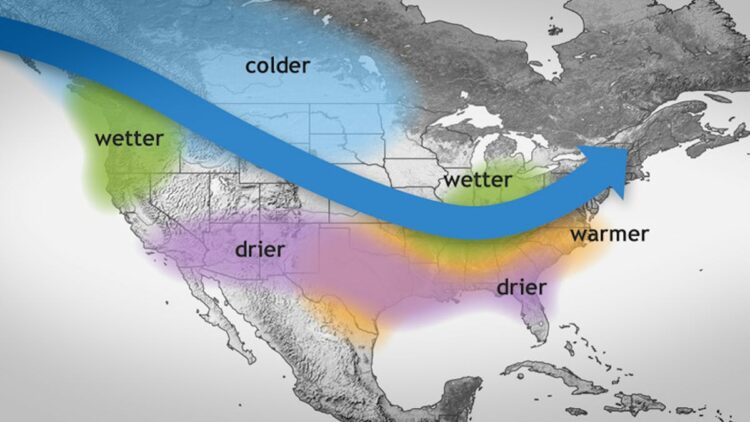
La Niña tends to produce drier weather in Southern California and the Southwest during the winter, a critical time to replenish water resources. Drier vegetation can also worsen the risk of wildfires.
Even if this La Niña is weaker, it could still have serious regional implications. Northern California may see a wetter-than-average weather this winter, according to the National Oceanic and Atmospheric Administration.
While seven of the 10 La Niña events this century resulted in dry years in California, research also suggests that even as the climate grows hotter and drier overall, the precipitation that California does receive will arrive in stronger storms, increasing the risk from flooding, according to the California Department of Water Resources.
“California experienced record heat and dry conditions this summer, drying out the landscape and putting our hydrology behind before the water year even starts,” said State Climatologist Dr. Michael Anderson. “While there is still a lot of uncertainty around how La Niña could impact the state this year, we know we can count on it to include extreme conditions.”
Here’s what to know about La Niña and how it could impact the weather and conditions in Southern California and the Southwest:
Will this be a La Niña year?
The National Weather Service has issued a La Niña watch, with a 71% chance La Niña conditions will develop in October or November. If it does emerge, climatologists predict La Niña would continue through January to March.
“We are favoring La Niña conditions to come in,” said Jon Gottschalck, chief of the operational prediction branch at the National Oceanic and Atmospheric Administration.
“Typically in the Southwest, with La Niña as you go into the fall or winter, temperatures generally are warmer than normal,” he said. “There’s a pretty strong signal during La Niña events of below normal precipitation in the Southwest and southern plains.”
La Niña triggers below-normal oceanic temperatures in the Pacific, which can cause irregular weather patterns across the U.S. and the world. A La Niña event could add more stress to the heat and drought-stricken Southwest.
What is La Niña?
La Niña, and its counterpart El Niño, are climatological events that are part of a natural cycle called the El Niño-Southern Oscillation, or ENSO. It represents the relationship between ocean temperatures and atmospheric conditions stemming from the Pacific Ocean.
During a La Niña event, trade winds that blow east to west near the equator intensify. Stronger winds push warm water from the eastern Pacific toward Asia, warming surface temperatures in the western Pacific. This shift summons deep, cold waters in the central and eastern Pacific.
Related: When will it start to cool down in California? Here’s what Old Farmer’s Almanac predicts
Cool water drawn up from the ocean depths due to the wind shift triggers a chain reaction of weather events. Once the atmosphere responds to the changes in oceanic temperature, there tends to be more tropical rainfall in areas like Indonesia, the Philippines and northern Australia.
“When that happens, those changes in tropical rainfall along the equator change the jet streams across the Pacific and North America,” Gottschalk said. “Those changes are what causes temperature and precipitation changes over a season.”
During La Niña, the Pacific Ocean tends to have a weaker hurricane season, with a busier season in the Atlantic.
El Niño is the opposite condition, as the trade winds weaken or sometimes reverse direction and ocean temperatures increase. Warmer water releases more moisture and energy into the atmosphere, creating wetter conditions in many areas and strengthening hurricane season in the Pacific.
Both patterns last nine to 12 months but can continue for years. They typically happen every two to seven years but do not have a regular, predictable schedule. Historically, El Niño happens more frequently than La Niña.
There is a third ENSO pattern, called a neutral phase. Trade winds and ocean temperatures tend to be closer to normal during neutral years without extremes triggered by El Niño or La Niña.
While climatologists are confident La Niña will emerge within the next month or two, they cannot be certain.
“We’re still a little bit a ways away from having those impacts,” Gottschalk said. “We’re still waiting for those conditions to officially develop in the ocean and then the atmosphere has to respond.”
How will La Niña affect the weather?
ENSO climate phases can affect weather across the U.S. and could influence conditions in the upcoming winter months.
The Southwest, the central Rockies, the Gulf Coast and the eastern seaboard typically have drier and warmer winters during La Niña years, according to Gottschalk. Northern California, the Pacific Northwest, New England and the Great Lakes regions could have wetter winters during the event.
But even if La Niña develops fully this year, climatologists say it’s difficult to predict how it could impact the weather.
“La Niña is forming quite slowly, and the slower it forms, the less time it has to actually peak,” said Crimmins. “It looks like it’s going to be a weak event.”
“Those events historically have kind of given us a mixed bag of conditions for the Southwest,” he added.
The last La Niña began in 2020 and lasted through 2023, a rare event with three consecutive years of La Niña conditions, known as a “triple-dip” phenomenon. This event triggered droughts, floods, heat waves and other weather extremes around the world.
The Southwest was hit with extreme drought conditions and active wildfire seasons during that period.
Although this winter’s La Niña likely won’t be as severe as the last one, the extent of its impact is still uncertain.
“That’s why you get this probabilistic forecast where it leans dry, but it leaves the door open for average to above-average conditions,” Crimmins said. “I know it’s maddening to people because they just want to know if it’s going to be dry or not.”
Hayleigh Evans writes about extreme weather and related topics for The Arizona Republic and azcentral.com. Email her with story tips at [email protected].
Source link : http://www.bing.com/news/apiclick.aspx?ref=FexRss&aid=&tid=6708ddf1ad6d48c1bd4dca7dea9c7a30&url=https%3A%2F%2Fwww.usatoday.com%2Fstory%2Fnews%2Fnation%2Fcalifornia%2F2024%2F10%2F08%2Fla-nia-conditions-could-produce-dry-winter-for-southern-california%2F75572142007%2F&c=12266052369148881981&mkt=en-us
Author :
Publish date : 2024-10-07 17:00:00
Copyright for syndicated content belongs to the linked Source.