
Trevor Reilly joined a group heading to Jordan that had established personal and professional relationships in the region, but he didn’t stop there. (Courtesy of Trevor Reilly)
On Dec. 25, Reilly flew to Riyadh. While waiting at the airport in Amman, Reilly emailed VisitSaudi.com and informed them of his intentions to get in touch with someone at the Saudi Tourism Authority. Emails and receipts reviewed by The Athletic confirmed Reilly’s travel timeline and his attempts to set up business meetings. Attempts to reach those Reilly spoke with in Saudi Arabia were unsuccessful.
Coles and his friends in Jordan let some contacts in Riyadh know that Reilly was arriving, too.
“We did our best to let Trevor have an at-bat, and he did swing for the fences,” Coles said.
Reilly did not disclose the identities of all those he met with, but said one 90-minute meeting in Riyadh featured two government employees educated in the United States. One attended the University of Miami and the other Indiana University, he said. They both knew who Deion Sanders was and understood the value of college football in America.
After they met, he stopped in Dubai for a few days and attempted to organize meetings with the country’s office of tourism, according to emails reviewed by The Athletic, but his attempts were unsuccessful.
No deals resulted from his travels.
“Me being over there, it doesn’t mean that they were willing to do business,” he said. “It just means that they understood that this was a possibility. Which, what’s wrong with that, man?”
The concept of an expedition to the Middle East to seek out millions of dollars to help a college football program may be jarring to some considering Saudi Arabia’s human rights record, but it is entirely predictable to others as the country’s Public Investment Fund has invested in sports worldwide.
“You want to talk about the wild, wild West? I’m surprised more people haven’t gone out to the Middle East,” Reilly said. “It’s oil money there, or it’s oil money here: T. Boone Pickens at Oklahoma State or T. Boone Muhammad in Riyadh.”
Which is exactly why Reilly says he went. To seize on his boss being one of the most marketable sports personalities in America.
Colorado was the most-watched team in college football last season until the penultimate week. An estimated $343 million was generated off the program’s exposure. The city of Boulder brought in an estimated $113 million in economic impact during Colorado’s six home games in 2023 alone. Sanders, 57, was named Sports Illustrated’s Sportsperson of the Year for 2023.
The athletic department saw a $14 million rise in season ticket revenue since Sanders arrived and the university recorded a record-breaking 68,000 student applicants for the fall of 2024, a 20 percent jump from the previous year. USA Today projected last fall that Sanders was worth an estimated $280 million to the university in ticket sales, donations and media exposure.
Sanders’ arrival provided a necessary jolt to an otherwise obsolete program. Colorado announced that in 2023 the Buff Club, its main fundraising arm, raised nearly $8 million more than in 2022.
So as figures and estimates climbed, why did a fairly low-level staffer feel compelled to take it upon himself to try and change the essence of Colorado’s NIL future in one very big leap?
Reilly said he did not tell Sanders of his plans to visit the Middle East after the conclusion of the 2023 season, but said he informed members of Sanders’ personal staff of his intentions. He also had made it clear to tourism officials in the Middle East that he could never himself strike a deal, but his goal was to serve as an introductory middleman between Colorado’s collective and potential partners.
Sanders was asked about Reilly on the “Outta Pocket with RGIII” podcast hosted by former ESPN analyst and NFL quarterback Robert Griffin III.
“It’s interesting, because I’m trying to take care of him because I love him. I love him as a man, I love him as a father,” Sanders said on Aug. 27. “My prayers for Trevor is just that it comes back together. We didn’t fire Trevor. And everybody knows Trevor’s my guy. And I have love for Trevor. I try to support him in every way imaginable.”
Since that interview aired, Reilly said he and Sanders spoke at length on the phone and have kept in touch via text message, adding, “he has about 70 percent of the details of the things I did for him at Jackson and Colorado, which is good.
“Not everyone has time to know 100 percent of everything, right?”
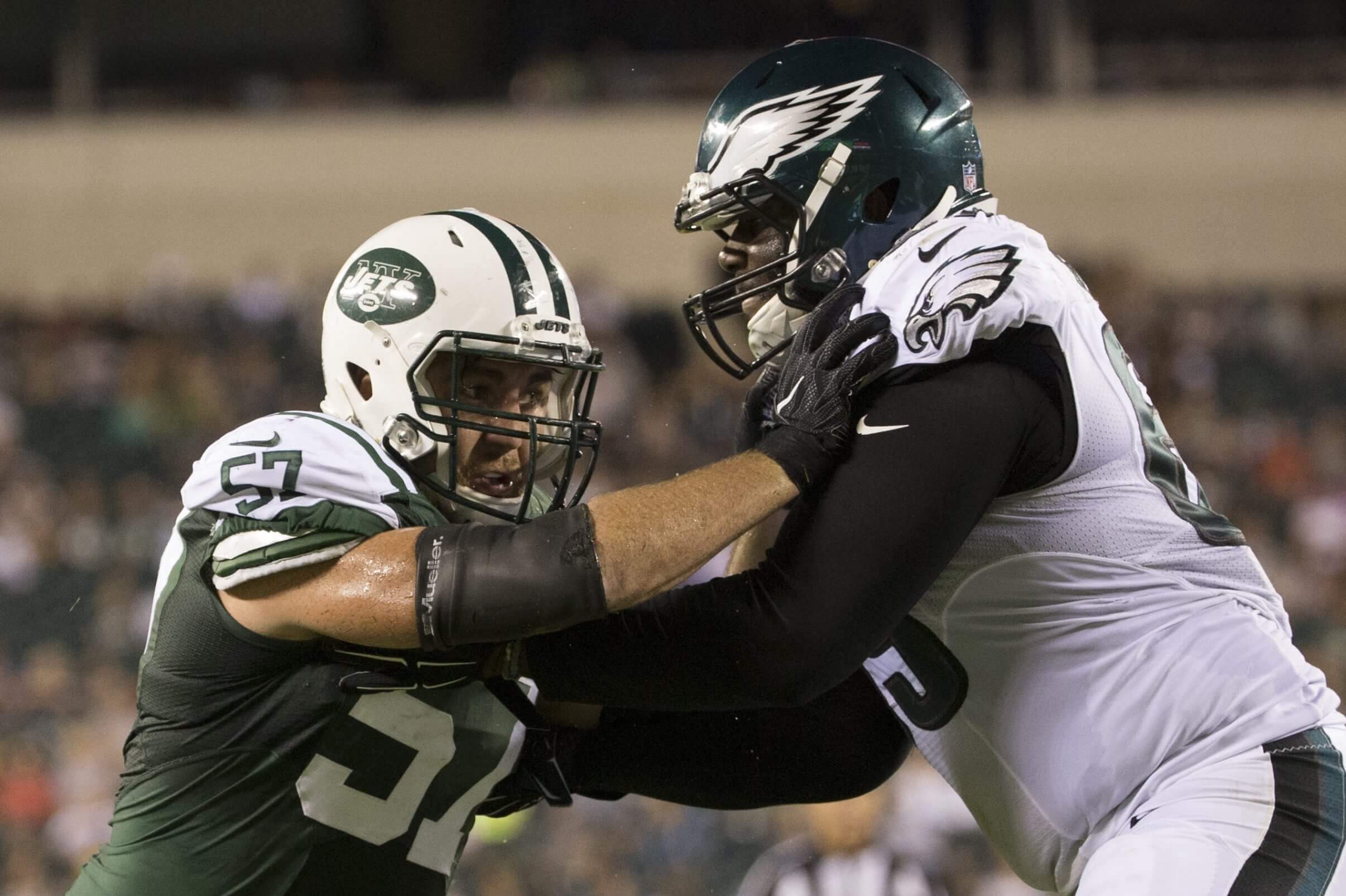
Trevor Reilly, left, was drafted by the New York Jets in the seventh round out of Utah in 2014. He played four seasons in the NFL. (Mitchell Leff / Getty Images)
Reilly was technically a quality control analyst who helped with special teams but never coached on the field due to previous NCAA regulations that limited staffs to 10 on-field assistants.
He couldn’t recruit off-campus either, so he spent time scouting players in states like Utah, Arizona and Nevada. Reilly said he negotiated his hybrid role with members of Sanders’ staff, including his salary and the role of seeking out potential NIL deals for players.
Reilly’s attempts go back to the week that Hunter, the top recruit in the 2022 class, stunned college football by flipping his commitment from Florida State to Jackson State. According to emails reviewed by The Athletic, Reilly was in talks with a Utah-based energy drink company to partner with Hunter soon after he signed to play for Sanders.
Reilly facilitated an NIL deal between Shedeur Sanders and safety Shilo Sanders with Utah-based dealership Truck Ranch, owner Jadon Wagner confirmed. Wagner, a former BYU football player who played with Reilly’s brother, Drew, said that without Reilly being on staff, a deal with the Sanders family would be nearly impossible. Reilly was the intermediary between the Sanders brothers, their representatives and Truck Ranch.
“Without Trevor, who am I? I’m one of a thousand car dealerships,” Wagner said in a recent phone interview. “The best way to do business is through mutual acquaintances and referrals.”
Such an approach helped Reilly land meetings in the Middle East.
According to Reilly, some Colorado staffers were stunned at his leap to jet across the globe and called the notion “a little crazy,” but also asked for more details.
Reilly said he left contacts he made in the Middle East with the leaders of the Colorado collective who said “no to the Saudis slowly, and we lost traction over there.”
Documents obtained by The Athletic revealed breakdowns of the money at the disposal of Colorado’s main NIL collective, the 5430 Alliance, named after Boulder’s elevation above sea level.
The 2023 summary from the alliance showed that $3.6 million was funneled to 25 Colorado football players a year ago. Its acquisition budget for 2024 ballooned to $5.1 million and was expected to be spread among 38 players on the roster.
Reilly said the staff was informed that funds could eventually reach as high as $8 million at some point in 2024. While specifics are sparse on how collective funds are allocated to individual players, Reilly said he believed both Shedeur Sanders and Hunter, who has emerged as a Heisman Trophy contender, were each making at least around $1 million through the collective. Realistically, Reilly said, splitting what would then be about $3 million among 30 or so players is not enough to field a conference-contending team on an annual basis.
A pitch deck said the average compensation for other players on the roster was $73,000 in 2023.
While collectives avoid sharing official numbers, it’s becoming clearer the cost of building a Playoff-caliber roster. This year, powerhouse Ohio State spent a reported $20 million in NIL on its roster through its various collectives, which few programs nationally would be able to match.
The Athletic reported Florida State invested $12 million in its 2024 roster, but the Seminoles have been one of the biggest disappointments in the sport this year, starting 1-5. While addressing fans at the Little Rock Touchdown Club in September, Arkansas athletic director Hunter Yurachek estimated it needs $12 million in NIL donations to field a competitive football team each year.
But more change is coming with the House settlement ushering in revenue sharing as early as next July with formal approval. The role of collectives would morph again, as the new financial model puts the mantle for paying players on the schools. Athletic departments will be hunting for new revenue streams in response.
Colorado hired Blueprint Sports in March to oversee its NIL operations. Reilly said the company has failed to capitalize on Sanders as a marketing phenomenon. Reilly claims he repeatedly told 5430 Alliance executive director Natalie Sharp, who was hired in April, and director of business operations Reggie Calhoun Jr. that if the collective couldn’t find alternative means of fundraising that the football program would fall further behind the status quo.
Sharp and the 5430 Alliance, through Blueprint Sports, declined The Athletic’s request for comment. Calhoun did not respond to messages seeking comment. The Athletic sent Blueprint a series of detailed questions regarding Reilly’s claims, but the organization said through a spokesperson it would not address questions individually but issued a statement:
“Our policy is to avoid addressing unsubstantiated, old claims made by former, dissatisfied coaches. We are dedicated to maintaining the highest standards of professional conduct and fully support the hardworking 5430 Alliance staff who are committed to the success of CU student-athletes.”
During a news conference this week when asked about the direction of NIL, athletic director Rick George said, “We might’ve been a little late to the party … the 5430 Foundation has really put us at a point where we can compete with other schools.” He noted the collective will shift in-house and work to create business partnerships for athletes after the House settlement.
Reilly’s claims raise a question about the man in charge: Should Sanders, who can sell himself to anyone, be committed to helping the NIL cause on a larger scale? He has been critical of the concept of NIL collectives in the past.
“I want the kid to get compensated,” Sanders said in an interview with Fox’s Joel Klatt in June 2023, “but you’ve got to balance the fine line. Is he still going to want it like that when you’ve just given him that (money) and he didn’t have to earn it?”
Asked about Sanders’ approach to NIL, Reilly said:
“Deion’s time is worth a lot of money. Deion doesn’t have time for this s—, man.”
At every stop on the Big Island, Reilly routinely circled back to this point: “It’s not Deion’s fault.”
He said it at an evening jam session of hippies playing Peter Frampton and Bob Marley in the mountains below the volcano. He said it again in a downpour at the Hilo Zoo. And again at a deep tidal pool near a black sand beach where turtles sometimes float. And once more at a local pub where he tells locals that he played with Tom Brady and, up until this summer, was coaching the team on the screen.
A year ago, Reilly was on the sidelines in Boulder for Colorado’s double-overtime victory over Colorado State. Now he’s well across the Pacific Ocean watching Hunter haul in yet another highlight-reel interception as the Buffaloes are topping the Rams again. Three weeks since The Athletic’s visit, Colorado is two games from being bowl eligible for the first time since 2020 and hosts No. 18 Kansas State on Saturday.
Reilly said he and Sanders “had a great relationship but were not great friends. We were great coworkers.” While at Jackson, Sanders came to a youth basketball game for Reilly’s oldest daughter. Sanders’ sister, Tracie, was an influence on Reilly’s children the past several years, too.
As tensions mounted between Reilly and those involved with Colorado’s collective, he said he felt like he was becoming a distraction for the team and the staff. He emailed a resignation letter to Sanders and George on Aug. 1, citing challenges working with Colorado’s NIL team. Days later, Reilly said he returned to the CU Champions Center to retrieve the last of his personal items, when he engaged in a fight with Colorado graduate assistant Josh Jynes. Reilly said Jynes was hindering him from gathering his items. The fight was captured on film and was reviewed by The Athletic.
Reilly said he knows his exit may seem chaotic and his views eccentric to some. But Reilly said he believes he put the players and program first. Even after he left, the program incorporated some of his ideas on behalf of the players.
Now, even living in the shadow of volcanoes, he can’t escape the pull of the sport. He volunteers as an assistant defensive football coach for nearby Keaau High School.
He bought an aging Ford Crown Victoria for $1,800, helps locals eradicate aggressive feral pigs and is teaching his puppy, Bullah, to be less of an introvert. He’s working part time at a Japanese restaurant washing dishes a few days a week.
It’s about as far away as you can get from worrying about a football program’s NIL budget and mulling whether a player may or may not be affordable.
His life in Hawaii is far different. Reilly showed up to a beach-side barbecue hosted by the school’s coaches, and the grill simmered with ribs, chicken and pineapple-filled sausage links. He was met with hugs and questions about schemes for upcoming opponents. A whiteboard was lifted from one picnic table and placed in front of him next to the sumptuous sliced meats.
Reilly grabbed the black marker and got to work.
(Top image: Dan Goldfarb / The Athletic; Photos: Chris Leduc / Icon Sportswire / Getty, iStock and courtesy of Trevor Reilly)
Source link : http://www.bing.com/news/apiclick.aspx?ref=FexRss&aid=&tid=6707a47f040d47a29f04dacc6a7ccb7c&url=https%3A%2F%2Fwww.nytimes.com%2Fathletic%2F5832177%2F2024%2F10%2F10%2Fnil-funding-trevor-reilly-colorado-deion-sanders%2F&c=15545324001763283819&mkt=en-us
Author :
Publish date : 2024-10-09 22:09:00
Copyright for syndicated content belongs to the linked Source.