Subscribe to Technology Networks’ daily newsletter, delivering breaking science news straight to your inbox every day.
Subscribe for FREECourtney-Davies added that the study will help scientists understand a critical phase in not just the planet’s geologic history but also the history of life on Earth. The first multicellular organisms may have emerged in oceans immediately after Snowball Earth thawed.
“You have the climate evolving, and you have life evolving with it. All of these things happened during Snowball Earth upheaval,” he said. “We have to better characterize this entire time period to understand how we and the planet evolved together.”
Searching for snow
The term “Snowball Earth” dates back to a paper published in 1992 by American geologist Joseph Kirschvink.
Despite decades of research, however, scientists are yet to agree whether the entire globe actually froze. Geologists, for example, have discovered the fingerprints of thick ice from this time period along ancient coastal areas, but not within the interior of continents close to the equator.
Which is where Colorado enters the picture. At the time, the region didn’t sit at the northern latitudes where it does today. Instead, Colorado rested over the equator as a landlocked part of the ancient supercontinent Laurentia.
If glaciers formed here, scientists believe, then they could have formed anywhere.
Going deep
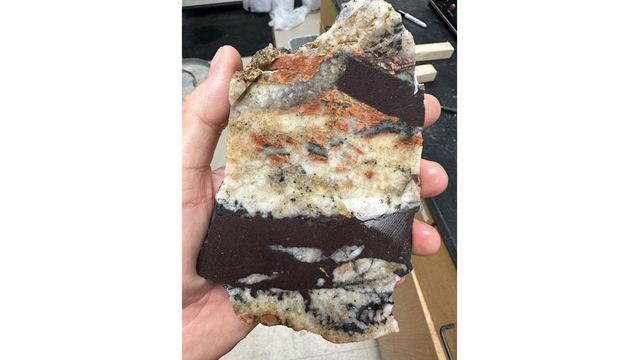
The search for that missing piece of the puzzle brought Courtney-Davies and his colleagues to the Tava sandstones. Today, these features poke up from the ground in a few locations along Colorado’s Front Range, most notably around Pikes Peak. To the untrained eye, they might seem like ordinary-looking yellow to brown rock running in vertical bands less than an inch to many feet wide.
But for geologists, these features have an unusual history. They likely began as sands at the surface of Colorado at some point in the past. But then forces pushed them underground—like claws digging into the Earth’s crust.
“These are classic geological features called injectites that often form below some ice sheets, including in modern-day Antarctica,” Courtney-Davies said.
He wanted to find out if the Tava sandstones were also connected to ice sheets. To do that, the researchers calculated the ages of mineral veins that sliced through those features. They collected tiny samples of the minerals, which are rich in iron oxide (essentially, rust), then hit them with a laser. In the process, the minerals released small quantities of lead and the radioactive element uranium. Because uranium atoms decay into lead at a constant rate, the team could use them as a sort of timekeeper for the planet’s rocks.
It was a Eureka moment: The group’s findings suggest that the Tava sandstone had been pushed underground during Snowball Earth. The group suspects that, at the time, thick ice sheets formed over Colorado, exposing the sands to intense pressures. Eventually, and with nowhere else to go, they pushed down into the bedrock below.
“We’re excited that we had the opportunity to unravel the story of the only Snowball Earth deposits that have so far been identified in Colorado,” Flowers said.
The researchers aren’t done yet: If such features formed in Colorado during Snowball Earth, they probably formed in other spots around North America, too.
“We want to get the word out so that others try and find these features and help us build a more complete picture of Snowball Earth,” Courtney-Davies said.
Reference: Courtney-Davies L, Flowers RM, Siddoway CS, Tasistro-Hart A, Macdonald FA. Hematite U-Pb dating of Snowball Earth meltwater events. PNAS. 2024;121(47):e2410759121. doi: 10.1073/pnas.2410759121
This article has been republished from the following materials. Note: material may have been edited for length and content. For further information, please contact the cited source. Our press release publishing policy can be accessed here.
Source link : http://www.bing.com/news/apiclick.aspx?ref=FexRss&aid=&tid=673353e1de794c0693a7b122d37a689f&url=https%3A%2F%2Fwww.technologynetworks.com%2Ftn%2Fnews%2Fcolorados-tava-sandstones-provide-new-evidence-for-snowball-earth-393134&c=14762012280962916546&mkt=en-us
Author :
Publish date : 2024-11-11 20:39:00
Copyright for syndicated content belongs to the linked Source.