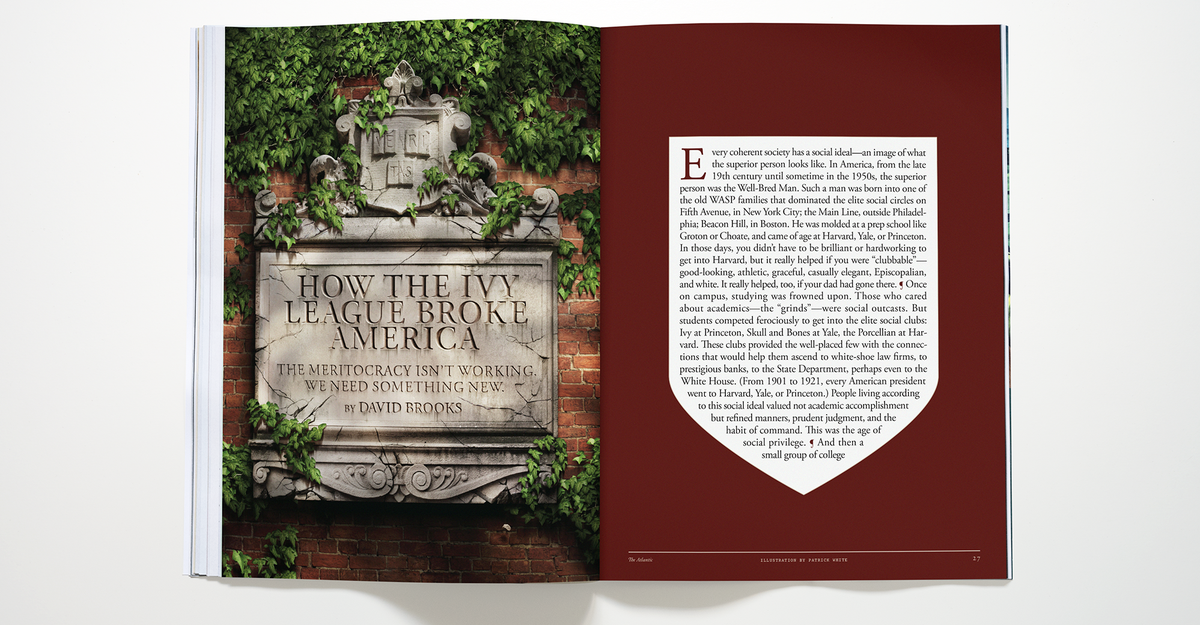
It is a very Ivy League thing to try to take credit for breaking America. I share David Brooks’s criticisms of a system that ranks and sorts based on test results. But standardized testing had taken hold in the United States long before James Conant’s presidency at Harvard. The danger of blaming the Ivy League for today’s overreliance on blunt ranking-and-sorting instruments is that we may be tempted to wait for the Ivy League to fix it. Instead, let’s agree that we also need leaders who flourished in local community colleges, regional universities, apprenticeships. The talent is out there—I saw it every day as a high-school teacher. But our current system sends the message that if you do not score well on standardized multiple-choice tests delivered in English, you are not capable.
Erin Crisp
Knoxville, Tenn.
Most of the elite schools David Brooks criticizes already evaluate “the whole person.” Cognitive metrics are only a small part of getting in. These institutions have invested heavily in evaluating applicants’ noncognitive skills, and arguably, the result is worse.
Families seeking to secure a spot at a top college must strategically position their child as a well-rounded applicant. They choose extracurricular activities and write admissions essays that demonstrate empathy, curiosity, the ability to overcome hardship—all things that Brooks wishes these institutions would evaluate. This approach has further advantaged families with the financial means to afford educational consultants, private coaching, and enrichment activities. We do need an alternative to the meritocratic system. Unfortunately, Brooks’s solution has already been swallowed by the meritocratic machine.
Pete Marshall
St. Louis Park, Minn.
Why is the central force controlling our economy and society today Ivy League admissions offices and not, say, the demands of global capitalism, the transition to a services-based economy, or the increasing value of symbolic thinking in those contexts? The world has changed in ways that reward a certain kind of intelligence. That may be good or bad, but it’s not primarily the fault of a small number of elite schools—it’s true in every developed economy.
Andrew Bartholomew
New York, N.Y.
It’s not utopian to imagine an American public-school system and society that recognize the skills and contributions of both the mechanic and the debater. They do it in Europe: Set into the bronze plaques on London’s Tower Bridge are the names of a plater, a rivet boy, a cook. In America, such a prestigious public placement on an iconic structure would honor only big corporate donors.
The people who pursue vocational education ought to be treated as a core constituency in arguments about the meritocracy, not as afterthoughts.
Sheela Clary
West Stockbridge, Mass.
David Brooks is right that America is broken, but he points his finger at the wrong culprit. Universities aren’t wrong to evaluate academic merit and select the students who will most benefit from the education they offer. The societal problem is an economic system that gives almost all of the benefits of growth to the already wealthy and not the working class. The economic elites are the real predators savaging the American dream—not the cultural elites.
Stuart J. Kaufman
Bear, Del.
Much of what David Brooks described resonated with me. I attended community college on a full Pell Grant; both of my parents were blue-collar workers. I loved school and I loved learning, but my parents could never afford to pay for extracurricular activities, Advanced Placement exams—I never even took the SAT. I always felt that there was an elite class of learning that I would never access.
And in many ways, I was right. I was rejected from hundreds of jobs, only to find out later that the successful candidate was from an elite school. This instilled in me what Brooks calls the sixth “deadly sin” of the meritocracy—“contempt for the entire system.” I now teach as an adjunct, and my students are generally much more well-off than I ever was. I fear my anger has made me less inclined to understand the very real stresses they face.
I voted for Donald Trump in 2016 and for Kamala Harris in 2024. It was during this span of eight years that I attended college and then graduate school—I am a living example of the way education influences opinions and beliefs. Yet I empathize with the working-class voters of Texas, my home state, far more than I empathize with the elite voters of New York City.
Katherine A. Chase
Brooklyn, N.Y.
I am 92 years old. I attended a public high school in Cincinnati. When I told my principal I wanted to go to one of the best liberal-arts colleges, he recommended Harvard—he told me that Harvard would take up to seven students from my class. Looking through my records, he noticed that I was Jewish and qualified his statement, saying that Harvard would never take more than three Jews. Harvard accepted seven students from my class, including me, and six of us were Jewish. When I arrived in the fall of 1950, it was obvious that the quota system was gone—Jews made up a significant portion of my class. At a meeting with incoming students, the dean of freshmen proudly told us that our class had the highest average SAT score of any incoming college class in the country. I frequently saw James Conant walking in Harvard Yard, not knowing that he had made it possible for me to be there.
John J. Frank Jr.
Cincinnati, Ohio
David Brooks replies:
I’m grateful for the thoughtful responses. I’d like to highlight one area of disagreement and one area for further exploration. Pete Marshall says that “cognitive metrics are only a small part of getting” accepted to an elite school. I’d say they are the foundational part—the average Harvard freshman has an SAT score of about 1520. You have to meet those metrics before any other qualities are considered. Andrew Bartholomew suggests that the real problem is global capitalism in the Information Age. There’s a lot of truth to that. I do think universities churn out “knowledge workers” because intellectual life has been commodified. Students and workers are caught in the same system that wants us to live lives of total work. But my argument is that our system doesn’t even turn out ideal capitalists: Large numbers of new employees have to leave their firms because companies don’t know what to look for in applicants. They select for the qualities that the meritocracy can quantify—but those aren’t the qualities that matter. Intelligence is overrated, and temperament and desire are underrated.
A Note from the Editor in Chief
More than two decades ago, The Atlantic decided to reduce the number of print issues published each year, dropping from 12 to 10, thus ending the run of what had been previously called The Atlantic Monthly. The rise of the internet made this seem at the time, I’m sure, like an obvious and unavoidable choice. But the history of our magazine is filled with improbabilities, and today, more people subscribe to our print magazine than at any time since its birth, in 1857. Which is why we’ve decided to restore The Atlantic to monthly print publication, beginning with the issue you are currently reading.
The broader trends in the magazine business, and across journalism generally, are not promising. But The Atlantic continues to grow, because (I believe) our editorial team produces the highest-quality journalism, and because readers like you continue to find what we do useful, and even illuminating.
Last year was a very good year for The Atlantic. We crossed the million-subscription threshold; we became profitable again after running in the red for several years; and we won our third consecutive National Magazine Award for General Excellence, something no other magazine has done in this century. But mainly what we’ve tried to do is make important journalism. I hope, by your lights, that we are succeeding, and that you join me in finding the return of a monthly Atlantic a very happy thing.
— Jeffrey Goldberg
Behind the Cover
In this month’s cover story, “The Anti-Social Century,” Derek Thompson explores how Americans came to spend so much time alone, and what that solitude means for our personalities, our politics, and even our relationship to reality. For the cover, the illustrator Max Guther created a series of figures engaged in solitary activities. Arrayed across an otherwise blank field, Guther’s figures evoke a nation in which people have come to prefer their own company to that of others.
— Liz Hart, Art Director
The Atlantic
This article appears in the February 2025 print edition with the headline “The Commons.”
Source link : http://www.bing.com/news/apiclick.aspx?ref=FexRss&aid=&tid=6786557bf40f4b47b4b7cfbbc5b9e18c&url=https%3A%2F%2Fwww.theatlantic.com%2Fmagazine%2Farchive%2F2025%2F02%2Fthe-commons%2F681087%2F&c=1372368687250321831&mkt=en-us
Author :
Publish date : 2025-01-13 23:00:00
Copyright for syndicated content belongs to the linked Source.