
Bill Gates at the groundbreaking for TerraPower’s nuclear power plant near Kemmerer, Wyoming, in June. – Benjamin Rasmussen/The New York Times/Redux
Bottom line, the amount of HALEU the US can get from its nuclear weapon stockpile is relatively small. It’s going to need a bigger production line.
“The long-term solution is we have to have enrichment,” said Jeff Chamberlin, the acting principal assistant deputy administrator for defense nuclear nonproliferation. “Even if we down-blended all that material tomorrow, we couldn’t supply the demonstration needs of all the advanced reactor companies the US has stated right now.”
Why the US needs special nuclear fuel
The United States currently gets about 20% of its power from nuclear. Inside the US Energy Department, there’s high interest to increase that percentage in the coming years because nuclear energy is reliable and doesn’t produce climate pollution.
“We need some firm, clean baseload electricity — nuclear provides that,” said Goff. “In order to meet our energy security needs and our climate goals, we do need significantly more nuclear energy deployed.”
The nuclear power industry is increasingly looking to smaller reactors, which run on HALEU. These reactors can last longer than conventional ones and fit into smaller spaces — making them more versatile and easier to set up.
The uranium for conventional reactors is enriched up to 5% and HALEU is uranium enriched between 5-20%. Highly enriched uranium is anything more than 20% and is used in weapons or naval submarines.
In other words, if conventional reactor uranium is Miller Lite, and highly enriched uranium is Everclear grain alcohol, HALEU is the nice cool glass of Belgian beer that strikes the balance between two extremes, said Dan Leistikow, vice president of corporate communications at US-based uranium enrichment company Centrus Energy.
“You can get more energy in smaller spaces,” said Josh Jarrell, director of the Idaho National Laboratories fuel cycle science and technology division. “You can be more energy dense, you can make more effective fuel, theoretically, we could generate electricity more economically.”
Centrus is one of two enrichment companies in the US working to break America of its dependence on Russia, which supplies the vast amount of the world’s enriched uranium. Congress recently passed an import ban on Russian uranium, leading to a supply squeeze both for HALEU and fuel for conventional reactors.
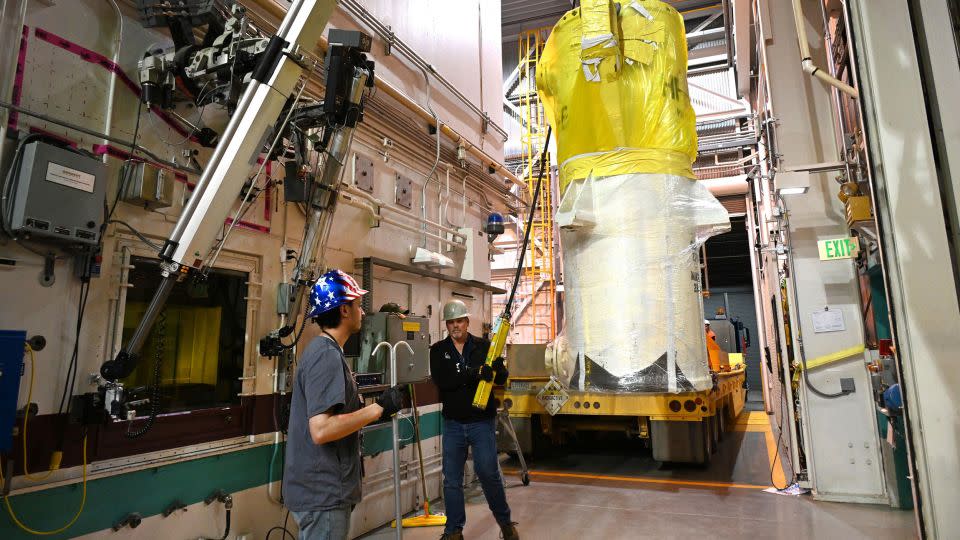
Idaho National Labs is also working to convert warhead uranium into reactor fuel. – Idaho National Labs
After a “lack of investment over decades,” Centrus is aiming to “restore a domestic enrichment capability with US technology” to meet the demand for the country’s electricity and for its national security, Leistikow told CNN.
It will take years to get there.
The Energy Department estimates the advanced nuclear industry will need 40 tons of HALEU by 2030. Centrus is seeking funding from DOE to expand its operations, but it can currently enrich a little less than 1 ton per year.
What will the country’s leftover nuclear arsenal contribute? Six tons by 2027.
TerraPower’s Navin said six tons is a “great start,” but far from enough for his company’s first core load, let alone other advanced nuclear projects in the US.
Exactly how much highly enriched uranium the US has is a classified secret, and there are a lot of interests competing for it, from national security to research nuclear reactors.
But Congress recently directed the NNSA and Energy Department to prioritize converting America’s old nuclear arsenal for advanced reactor fuel.
“Within their possession, they have more than enough (highly enriched uranium) to make many, many, many tons of HALEU,” Navin said.
This story has been updated with additional information.
For more CNN news and newsletters create an account at CNN.com
Source link : http://www.bing.com/news/apiclick.aspx?ref=FexRss&aid=&tid=66dfb7bf066d4355bcbf1c9cf8a5e926&url=https%3A%2F%2Fwww.aol.com%2Fus-dismantling-nuclear-warheads-power-080019879.html&c=13022866392589257726&mkt=en-us
Author :
Publish date : 2024-09-09 09:41:00
Copyright for syndicated content belongs to the linked Source.