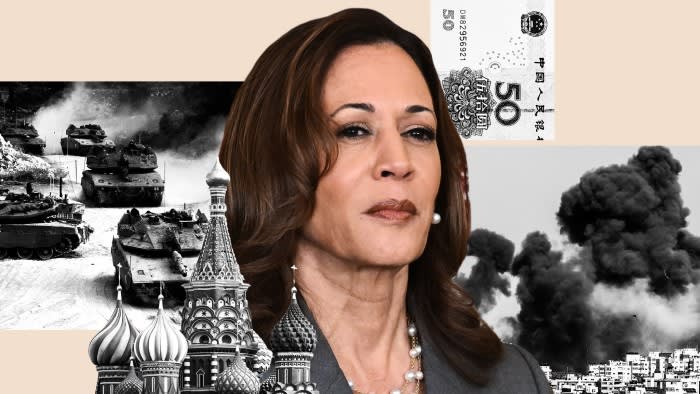
“Joe Biden would say I remember talking to Golda Meir. In the Biden narrative, Israel and the Arab states were David and Goliath,” says Rothkopf. “But from the era of Obama onwards, Israel has been acknowledged as the strongest actor in the region and is often seen, as we know, as a bully or worse.”
Harris’s advisers make clear she would defend Israel — and its right to exist — to the hilt. After Iran’s ballistic missile barrage against Israel in early October she delivered a forthright statement condemning it.
As to whether she would ever follow in the footsteps of President George HW Bush who played one of America’s trump cards and withheld loan guarantees to Israel, this is seen as unlikely, not least given the attack by Iran. But one supportive lawmaker suggests that depending on how the situation develops she would probably turn up the pressure on Prime Minister Benjamin Netanyahu and might consider imposing sanctions on far-right cabinet members.
Advisers also suggest she might — after a potential long-awaited ceasefire in Gaza — push to resume the quest for a two-state solution. The Biden administration had in effect given up on this before last October’s devastating attack on Israel by Hamas, although since then their position has been all about the need for it for a durable peace.
As a philosophy of life she has always stood up for those who don’t have a seat at the table
“The vice-president has seen how costly this conflict has been . . . . first and foremost for the people of Gaza, for Israel and the region, but even in our own society,” says an aide, referring to the tensions on American campuses and more broadly. “On Israel and the Palestinians, she has said before that she doesn’t see it as a binary choice, to be pro-Israel or pro-Palestinian.”
Lawmakers who have worked with her say she would see the Israeli-Palestinian conflict as part of a broader puzzle, involving Arab states, in particular Saudi Arabia — as the Biden administration has. “It’s not a two-state solution, it’s a 23-state solution,” says Chris Coons, a Democratic senator who is one of the party’s leading voices on foreign affairs.
“I don’t think there’s any president that implements the prior president’s foreign policy wholesale,” says fellow Democratic senator Murphy carefully. “It’s likely she has departures from Biden’s foreign policy in the Middle East.”
When Harris suddenly went in July from being loyal vice-president to the Democrats’ champion, two conflicting arguments did the rounds in Europe as to what she might mean for the continent.
The first was that Biden would prove the last of the cold war era transatlanticists and that Harris, as a Californian who grew up looking west across the Pacific, could echo Barack Obama in consciously pivoting to Asia. The second was that because her national security adviser, Phil Gordon, is a noted Atlanticist she would remain wedded to Europe.
 Ukrainian President Volodymyr Zelenskyy meets the US vice-president at the Munich Security Conference in February. She has consistently spoken out in support of Kyiv © Tobias Schwarz/POOL/AFP/Getty Images
Both were misconstrued, people familiar with her thinking say. She would, they say, stay committed to the defence of Europe. But that would not be because of Gordon, who has an overarching “realist” worldview, in which Europe is just one part. Rather it would be because she believes in strengthening alliances, a core part of the Biden administration’s strategy.
On trade and geoeconomics though, transatlantic relations might be testier. EU officials are all too aware that while they are hoping for a Harris administration, it would, like a Trump presidency, pose difficult questions over their economic ties with China.
As for Ukraine, Harris has delivered robust speeches in support of Kyiv. She would continue to provide what it needs to be in a good position at a negotiating table, say people privy to her thinking, although officials in Kyiv believe she would follow the Biden policy in not allowing them to use American missiles to hit targets deep in Russia.
Barring a sudden reversal of Russian forces, she would not push for a swift settlement as Trump says he would do. “The vice-president believes that rewarding Russian aggression would send a message round the world that you can invade a country without paying the price,” says one aide.
But the mood in Washington has shifted in recent months as Russia has made advances on the battlefield. There is a widespread sense that a Harris administration would ultimately be in favour of negotiations and winding down the war, however difficult it might be to provide the requisite security guarantees to ensure Ukraine’s survival.
 Ukrainian police help a woman escape a building hit by a Russian strike in the Donetsk region. Harris is wary of any peace deal that risks ‘rewarding Russian aggression’, according to one adviser © Genya Savilov/AFP/Getty Images
The failure of America and its allies to persuade much of the world to join them in backing Ukraine’s cause has underlined a recent phenomenon: the rise of so-called middle powers such as Brazil, South Africa and Indonesia who see an opportunity to play off America against China.
The Biden administration has been increasingly aware of the need to do more to win such countries over. But this has been undermined by what many in the global south see as America’s hypocrisy in condemning Russia while standing by Israel as it bombards Gaza.
Harris would intensify the courtship of non-aligned states, her allies say. This chimes with the thinking of David Lammy, Britain’s new foreign secretary, for whom improving ties with the global south is a priority. “We tend to focus on the conflicts in Gaza and the Ukraine,” he told the Financial Times. “But we could be talking about the conflict in Sudan or about Yemen.”
“As a philosophy of life she has always stood up for those who don’t have a seat at the table,” says a person familiar with Harris’s thinking. “Geopolitically, these are big and important countries with big populations that don’t always get adequately represented.”
Harris rejects the idea of seeing the world through the prism of a Manichean contest between democracies and autocracies, advisers suggest, and rather sees it like a lawyer: divided between rule-followers and rulebreakers. “She very much views the world in the prism of those who uphold international rules and norms and those who undermine them,” says an aide.
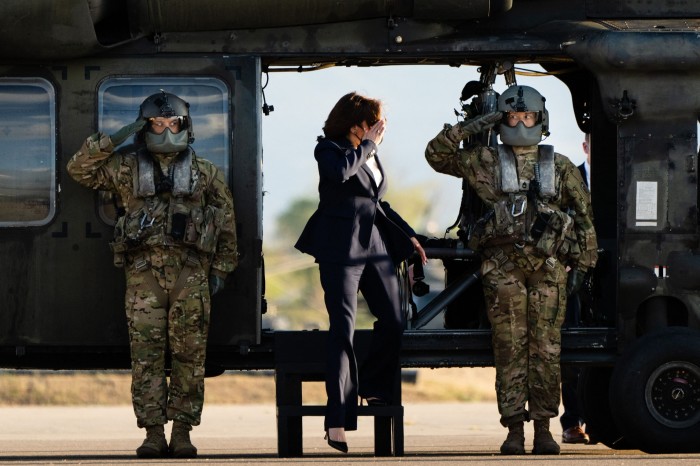 Harris begins her journey back from Honduras to Washington in 2022. Her role leading negotiations with ‘Northern Triangle’ countries was seen by some as a poisoned chalice © Erin Schaff/AFP/Getty Images
Senator Mark Warner, who worked with Harris on the Senate intelligence committee, says Harris has a “more nuanced understanding of the changing nature of the world”, which could help America’s quest to win over middle powers from China’s orbit.
“When we talk of America and the west we leave out the two-thirds of the world that I think would rather be with us because they see how draconian China and Russia are, and they know our technology is better,” he says. “I think she could bring a fresh voice in our approach to them.”
Of all the neuralgic issues a President Harris might be tempted to skirt, number one would surely be the southern border. Biden was seen to have handed her a poisoned chalice when he asked her to lead negotiations with the three “Northern Triangle” countries, Guatemala, Honduras and El Salvador, the source in recent decades of many of the migrants crossing the frontier. It has become a regular trope at Trump rallies to dismiss her as a failed “border tsar”.
And yet Venezuela, the oil-rich autocracy, which is home to many of the latest surge of migrants heading to America, would be a priority for Harris, allies say. The disputed election in July that returned President Nicolás Maduro to power threatens a fresh flood of refugees. “Venezuela will continue to require enormous attention,” says a person close to Harris’s thinking.
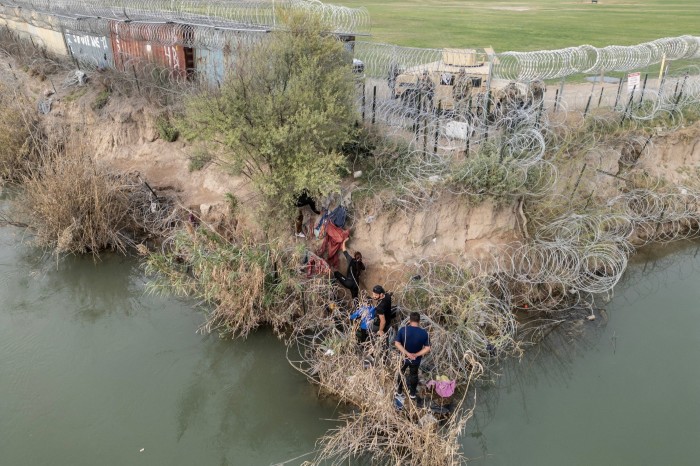 A group of migrants try to go through a wire fence on the banks of the Rio Grande river near US National Guard members. Trump has repeatedly called Harris the White House’s ‘border tsar’ © Go Nakamura/Reuters
The Biden administration’s carrot-and-stick policy of lifting some sanctions on Maduro in return for his holding credible elections has failed. As a putative case study, Murphy highlights how Harris channelled public and private capital into shoring up the Northern Triangle economies, while tightening sanctions on their elites — although local business leaders suggest many of the deals Washington touts were already in train.
There are ways to apply pressure on Venezuela, not least by scrapping remaining exemptions to oil companies from sanctions, and lobbying the EU and UK to increase their sanctions on the elite. But effecting change will be immensely hard. “It is not easy to find a meaningful resolution to the situation in Venezuela,” says Warner. “But it is doable with focus and attention.”
If Harris wins she would preside at a time of wrenching change and have to navigate America’s way into the third post-second world war age. After the cold war, and then almost three decades of American primacy, an increasingly multipolar world is emerging.
Her senior appointments would be vital. National security experts suggest she might bring in seasoned figures who would see themselves as her peers, in contrast with Biden many of whose senior aides had long been in his circle. There have been few disagreements over policy, but some insiders argue he has not been challenged enough by his staff.
She represents a new generation coming into power at the White House
Ultimately, the key to her foreign policy as with all administrations would be “events”. Just about every president has taken office with a presumed set of assumptions and then been buffeted into a different course.
Remember Obama, says one national security veteran. In his first term he approved the “surge” of troops to Afghanistan. He ended up so wary of using American power in his second that he used the slogan “don’t do stupid shit” to sum up his approach.
Harris’s allies say she would harness the exciting opportunities of technology. She could expand spending on defence industries, they hint, looking at the potential of artificial intelligence and space for modern forms of defence. “She represents a new generation coming into power at the White House with perhaps a longer-term view,” says Murphy.
But whatever her vision, with wars in Ukraine and the Middle East, and other crises lying in wait, her challenge as ever in the Oval Office would be seeing beyond the daily brief.
Source link : http://www.bing.com/news/apiclick.aspx?ref=FexRss&aid=&tid=6704bfe44e5a400195f65ebfb27ae303&url=https%3A%2F%2Fwww.ft.com%2Fcontent%2Fa169daf0-5bc2-449e-9081-9764e3689a22&c=2167215694233318439&mkt=en-us
Author :
Publish date : 2024-10-07 17:00:00
Copyright for syndicated content belongs to the linked Source.