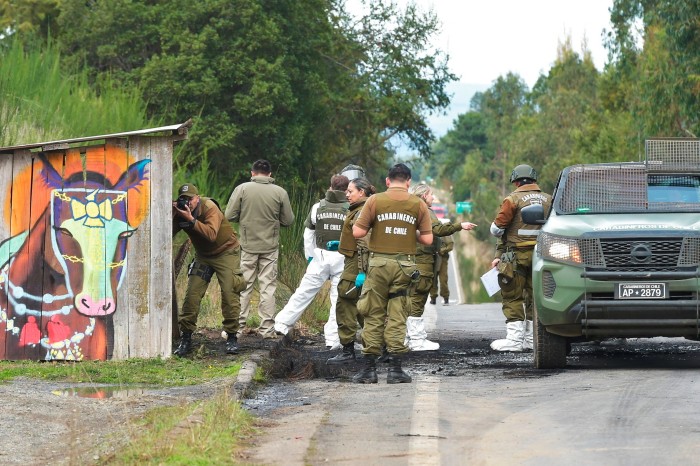
 Chilean society was stunned when three policemen were killed in April © Guillermo Salgado/AFP/Getty Images
Kidnappings, extortion and sex trafficking have also increased in Chile, Castillo said.
Fears over the gangs have transformed the country’s politics. Seven in 10 Chileans rank crime as their top concern, according to a March Ipsos poll. That has pulled attention away from economic inequalities that sparked mass protests in 2019, and helped to sap the popularity of leftist president Gabriel Boric even as his government works to beef up security policy.
“Crime and organised crime are the greatest threats we face today,” Boric said in his State of the Union address in June. “Without security, there is no freedom, and without freedom there is no democracy.”
On a recent afternoon in Maipú, a suburb of Santiago, salsa music played loudly from one of hundreds of homes improvised from MDF and corrugated iron beneath an underpass, which house mainly Haitian and Venezuelan migrants.
In March, a body was found here, stuffed in a suitcase and buried under cement: the corpse of Ronald Ojeda, a former Venezuelan soldier and critic of Venezuelan president Nicolás Maduro’s authoritarian regime.
Chile’s public prosecutor said the Tren de Aragua had carried out Ojeda’s high-profile assassination. He later added that the killing had been “organised” from Venezuela and was probably politically motivated.
Maduro’s foreign minister responded by claiming the gang “does not exist”, triggering a diplomatic dispute.
Similar migrant settlements to the one in Maipú have sprung up across Chile as the state failed to absorb millions of new arrivals: the country’s foreign-born population grew from just 1.8 per cent in 2013 to 13 per cent in 2023.
“The state loses control in these areas, and there is a generation of young people who aren’t getting access to education, healthcare and employment,” said Claudio González, director of the University of Chile’s Citizen Security Studies Centre. “It’s a perfect hunting ground for crime groups.”
Fears over organised crime have fomented anti-migrant sentiment among Chileans, polls show, but González said the gangs’ victims themselves were mostly migrants. Cases of violent gang crime targeting Chileans were “very exceptional”, he said.
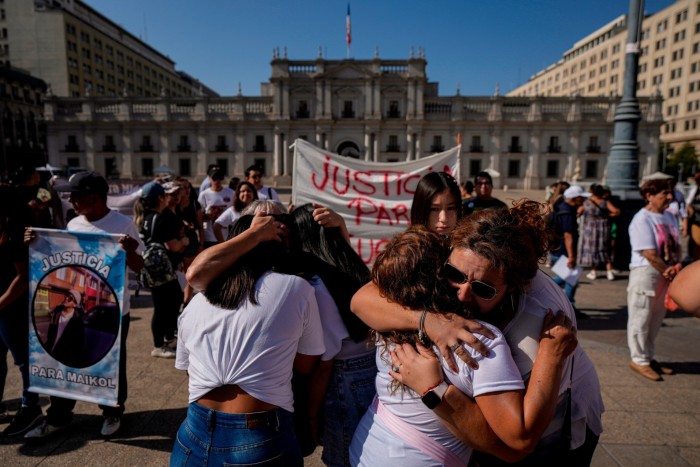 Relatives and friends of 13-year-old Mayra Castillo who was killed in gun violence hold a protest outside the president’s office © Esteban Felix/AP
A volunteer working with children on a community art project in the settlement, who declined to give his name because he also works for the government, said authorities had only carried out “isolated interventions” such as pop-up health clinics, and failed to reach undocumented migrants.
“Mostly they treat these communities as a security problem — they don’t prioritise their quality of life, so they won’t solve the problem,” the volunteer said.
The Tren de Aragua differs sharply from more famous groups like Mexico’s cartels, said Ronna Rísquez, a Venezuelan journalist who published a book on the gang last year.
“Those groups are militarised, and [tend to stay in] fixed territories, while the Tren de Aragua is more fluid, with loosely connected cells,” she said, adding that the group numbered 3,000 people at most.
The gang picks up contract jobs, such as assassinations or transporting drugs for other gangs, González said.
“These are basically predators who look for niches to exploit — they do a lot of harm, but they’re not very sophisticated,” he added.
The arrival of organised crime in Chile, combined with a conflict with separatist indigenous groups in the south, has pushed security to the top of the political agenda ahead of elections next year.
Chile’s rightwing has seized on Boric’s history as a critic of the country’s police. Its approval ratings have surged to an all-time high of 84 per cent amid the crime wave, according to pollster Cadem.
The situation has become a major headache for Boric, who had hoped to expand Chile’s social safety net and human rights protections, but has instead been forced to focus on security.
Recommended

Since 2022, the government has created organised crime units within the public prosecutor’s office and police, launched the first national organised crime policy, and passed dozens of crime-related reforms.
Having imprisoned some 100 members of Tren de Aragua, according to authorities, Chile is preparing to launch the region’s first mass trial of the group, with 38 people — 34 Venezuelans and four Chileans — facing charges including murder, kidnapping, and human and drug trafficking.
However, the country is not immune from the institutional corruption that enables organised crime to expand. In April, Chilean media reported two members of Chile’s investigative police had shared information with the Tren de Aragua.
“Our institutions have reacted very efficiently in an exemplary way,” Castillo said. “But when it comes to this type of crime, you have to be permanently vigilant.”
Additional reporting by Martín Neut and Benjamín Martínez in Santiago
Source link : https://www.ft.com/content/720cb0bb-63d1-4145-9de8-7ef382c6fe59
Author :
Publish date : 2024-06-09 00:01:24
Copyright for syndicated content belongs to the linked Source.