During this process, Lula has adopted an increasingly impatient and menacing tone, declaring last week that Maduro “must bear the consequences of his actions, and I will bear the consequences of my actions. Now I have the political awareness that I tried to help a lot, but a lot and a lot.” It is worth recalling that last December, Lula deployed troops to the Venezuelan border amid threats by Maduro to take control of territories disputed with neighboring Guyana.
At the same time, Washington has sought to make an example of the government of Honduran President Xiomara Castro, one of the few that still backs Maduro. Last week, the US ambassador denounced a meeting between Honduran Defense officials with Venezuelan Defense Minister Vladimir Padrino López. This was followed by the leaking of a video given by the head of a local drug cartel to US authorities that shows Castro’s brother-in-law accepting money from the cartel during her election campaign.
This has led to a wave of resignations in Honduras and a media and political campaign calling for the overthrow of Castro herself similar to that preceding the US-backed military coup in 2009 that ousted Castro’s husband, Manuel Zelaya.
Meanwhile, the Maduro administration has tried to use the elections and the aftermath to convince US imperialism that it can serve its interests better than the opposition by continuing to suppress the class struggle. It has combined threats against the far-right opposition with an olive branch to US imperialism.
At the same time, a recent reshuffling of cabinet positions, including the naming of Diosdado Cabello—the second most powerful leader of the Chavistas—as Interior Minister points to insecurity over allegiances. The elections have also shown that the government has lost a significant base of support in the working class.
In recent days, arrests of suspected opposition supporters have stopped, and a bill to outlaw foreign NGOs and another to wipe out organizations accused of “fascism” have been temporarily shelved.
Maduro has also extended the repression against organizations to the left of the government.
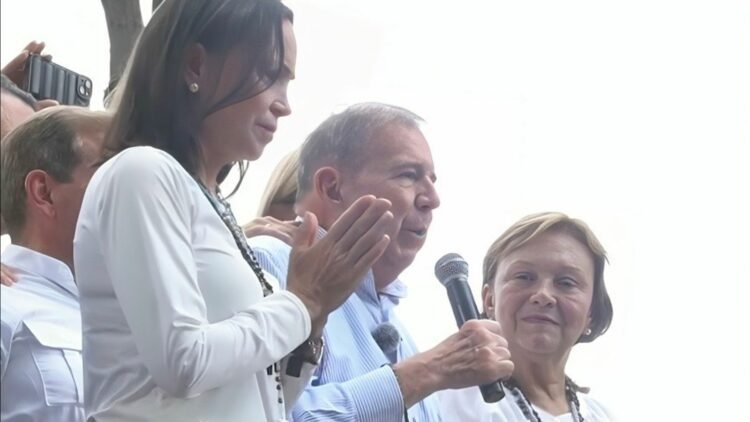
While an arrest warrant was issued against opposition candidate González Urrutia, efforts to detain him and Machado have been limited. On Wednesday, general prosecutor Tarek William Saab, a top Chavista leader, summoned González Urrutia’s lawyer, José Vicente Haro, for a private three-hour meeting.
While Williams Saab reaffirmed the arrest warrant against González Urrutia and rebuffed requests for an inquiry into the elections, Haro himself represents a bridge between factions of the ruling class and US imperialism. He helped draft the 1999 Constitution approved under Hugo Chávez and several other laws, while advising top Chavista officials before becoming a Stanford fellow and deepening ties with US foreign policy circles.
The dangers for the working class cannot be overstated. If Machado-Gonzalez have their way, they would install a fascistic, military dictatorship that would seek to privatize oil and other sectors and impose brutal social austerity at the behest of Wall Street, while aligning the country behind the US-NATO war against China and Russia.
However, every established political organization in Venezuela has been implicated in backing Chavismo or the far right. The most important aspect of the Venezuelan crisis is that it has exposed all bourgeois nationalist governments of the Latin American pink tide and their pseudo-left apologists as instruments of US imperialism as it drags the region and the world toward world war, fascist reaction and barbarism.
Sign up for the WSWS email newsletter
Source link : http://www.bing.com/news/apiclick.aspx?ref=FexRss&aid=&tid=66dbdab0336d4102805f75702f1e0d99&url=https%3A%2F%2Fwww.wsws.org%2Fen%2Farticles%2F2024%2F09%2F07%2Fewym-s07.html&c=4540381133946055973&mkt=en-us
Author :
Publish date : 2024-09-06 15:49:00
Copyright for syndicated content belongs to the linked Source.