
The countries in which residents are least likely to say they feel safe walking alone at night are exclusively a mix of countries in sub-Saharan Africa and Latin America and the Caribbean—which tends to be the case each year. Only Namibia and Malawi were not on the list in 2022.
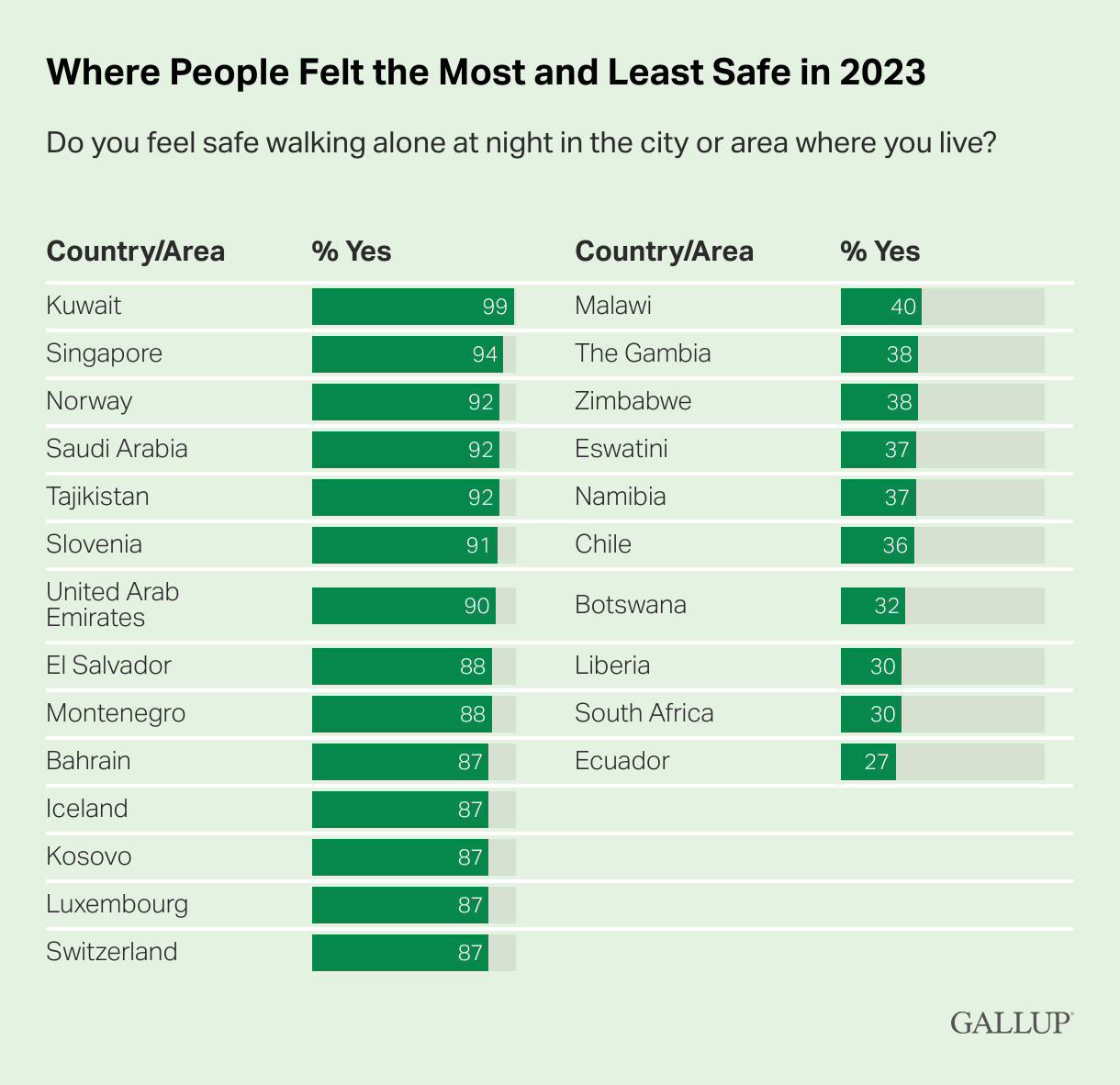
In most economically developed countries and territories with strong rule of law, high majorities of residents said they feel safe walking alone in their areas at night. The same is true in countries where populations are under tighter state control. For example, these feelings were nearly universal in 2023 in countries such as Kuwait (99%), Singapore (94%), Tajikistan (92%), Saudi Arabia (92%), and the United Arab Emirates (90%).
El Salvador Ranks Among ‘Most Safe’ for First Time
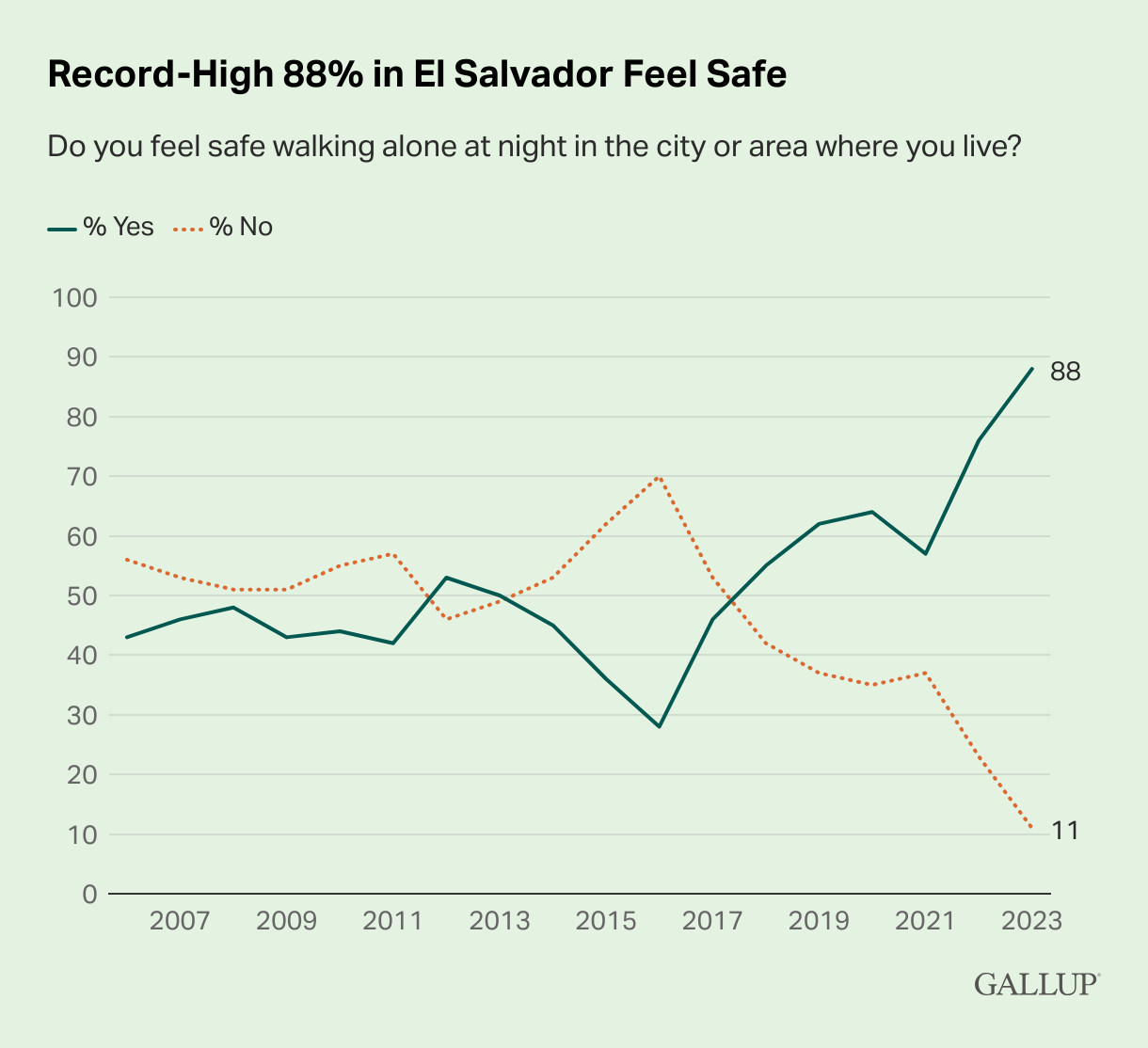
El Salvador, once known as the murder capital of the world, made the top of the “most safe” list for the first time in 2023, with a record high 88% of residents saying they feel safe.
Although the country has drifted toward becoming a police state, the government’s crackdown on gangs—which have incarcerated approximately 2% of the country’s population—has made the country safer. El Salvador currently boasts one of the lowest homicide rates in the Western Hemisphere.
 Fewer Israelis Feel Safe in Wake of Oct. 7 Attacks
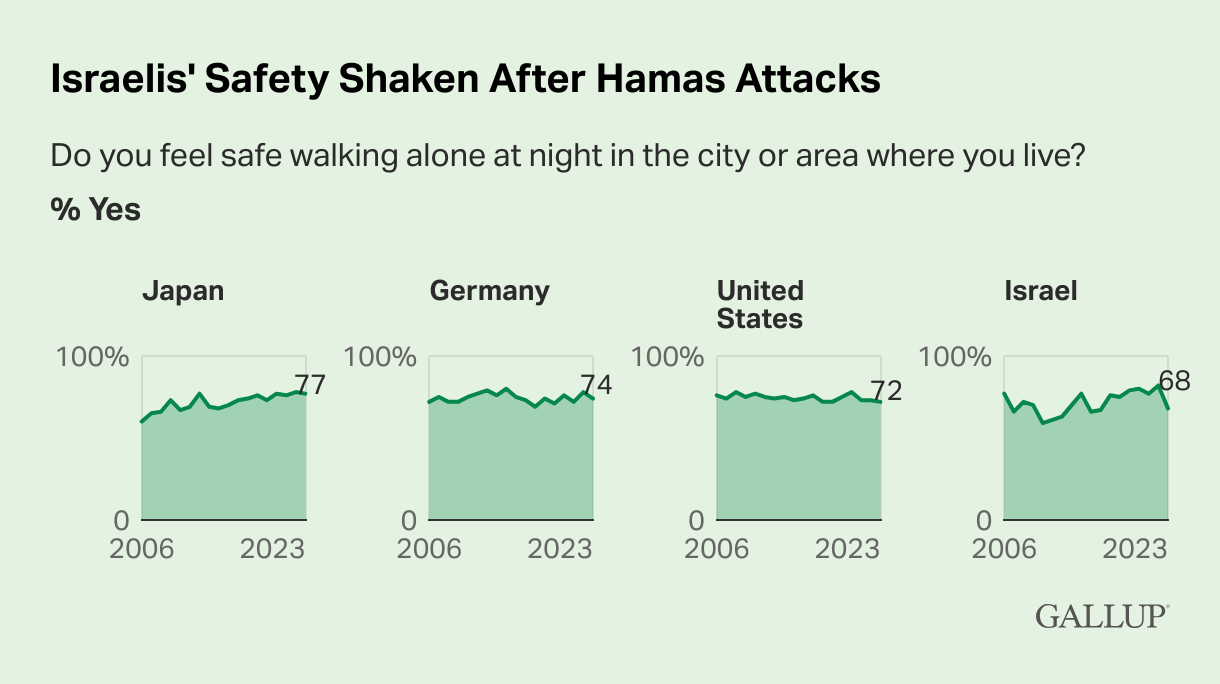
At 82% in 2022, Israelis’ perceived safety was higher than levels in other OECD member states, such as Japan (78%), Germany (78%), and the U.S. (73%).
In the immediate aftermath of the Hamas attacks on Israel in October 2023, this was no longer the case. A much lower 68% of Israelis said they felt safe walking alone at night where they live.
 Helping People Feel Safe Takes a Community, Rather Than a National, Approach
A Gallup analysis of people’s feelings of safety by country–income group suggests that strategies to help people feel safer may find more success if they start at the local level.
In addition to asking people about their safety, Gallup also asks about their confidence in institutions, trust in police, and satisfaction with different aspects of their communities.
Confidence in these national institutions, such as national government, the military, judiciary, and the honesty of elections, is only weakly related to perceived safety, but the odds that people feel safe increase if they are confident in more of these institutions.
However, across all countries, regardless of country–income group, two things matter most to people’s perceptions of safety:
people’s trust in their local policepeople’s satisfaction with their communities as places to liveBottom Line
In our uncertain world, it’s not enough to make sure that people are safe. They also need to feel safe. When people feel safe, they devote time and energy to learning opportunities and to their relationships with their families, communities and workplaces.
Feeling safe fosters trust in these relationships. This trust forms a foundation for collaboration, cooperation and social development, which makes communities more resilient to challenges such as natural disasters, economic downturns, political conflicts or health crises like the recent pandemic.
Zacc Ritter contributed to Gallup’s analysis of people’s feelings of safety by country–income group.
For complete methodology and specific survey dates, please review Gallup’s Country Data Set details.
Learn more about how the Gallup World Poll works.
Source link : http://www.bing.com/news/apiclick.aspx?ref=FexRss&aid=&tid=66fbecb0626249daa19f1bee6543d089&url=https%3A%2F%2Fwww.diplomaticourier.com%2Fposts%2Fglobal-safety-starts-to-slip&c=11449732673818387913&mkt=en-us
Author :
Publish date : 2024-10-01 01:05:00
Copyright for syndicated content belongs to the linked Source.