A.L. Barnett—Library of Congress/Corbis/VCG/ Getty Image
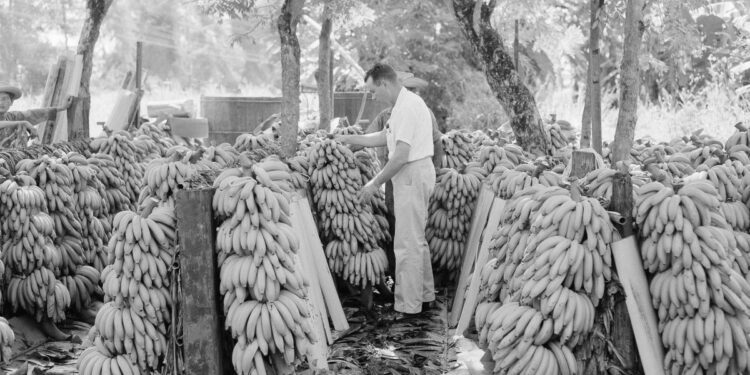
The Cuyamel Fruit Co. began the banana boom. Mr. Zemurray’s organization operated at Omoa, halfway between Cortés and the Guatemalan border. East of Cortés, at Tela and 100 miles down the coast at Truxillo, he got concessions for his friend Minor C. Keith, vice president of United Fruit. The concessions were in the names of the Tela Railway Co. and the Truxillo Railroad Co. The concessions called for construction of so many miles each year—enough to reach to Tegucigalpa—but instead of going straight inland the roads have spread laterally, to tap the banana lands. Minor Keith thought in terms of railroads, but United Fruit thought bananas. The North Coast soon began to fill up. Engineers came up from Costa Rica and Ecuador, boasting into their whisky of the fever on the Guayaquil-Quito job and cursing the gauge of Mr. Trautwine’s railway for exactly what it was.* From Louisiana and Texas came woodsmen and cattlemen and farmers and hard young men who would do anything. From Jamaica and other West Indian islands came black, strong Negroes immune to fever. Down from the foothills came the Hondureños who would risk malaria for the high wages the gringos paid. And with them, swinging their machetes, came the thieves and cutthroats of Honduras.
Beside the little village of Tela a new, bigger town sprang up. Out from the beach ran a new wooden pier. Back into the country a railroad cut through the jungle, and behind the railroad were the woodsmen and the farmers flattening out the jungle in a mad rush to get more banana land. Before the Tela Division was finished United Fruit was building Puerto Castilla on a sand spit out from Truxillo and turning 30,000 more acres of jungle into bananas. Mr. Zemurray moved in behind Cortés, across the Ulua from United Fruit’s Tela. His fellow townsmen, the Vaccaro Brothers (now the Standard Fruit & Steamship Co.) were already established at La Ceiba between United’s Tela and Truxillo holdings. Before 1920 the entire North Coast of Honduras was controlled by U. S. corporations. When, in 1930, United Fruit and Cuyamel became one, the banana lowlands of Honduras became for practical purposes the property of the corporation they formed.
Lee Christmas died in 1924, but the revolutions went on. Last November Guy Molony, older and fatter, captured a machine gun and chased a band of rebels out of San Pedro. On the beach at Tela seven revolutionists lay dead and buzzards feasted. One of his own men shot Willie Coleman in the back of the head and they laid him out in the disintegrating rain at the entrance to the graveyard where everyone could see. Nobody but his native wife was sorry Willie died. He was a bad hombre and had never approved of corporations.
*Rails are usually laid fifty-six and one-half inches apart (standard gauge) or thirty-six inches apart (narrow gauge). Mr. Trautwine built his railroad on a third, less common gauge of forty-two inches. This is appropriately known as bastard gauge.
Source link : http://www.bing.com/news/apiclick.aspx?ref=FexRss&aid=&tid=66b09141a79a42ee889f431721a0c034&url=https%3A%2F%2Ffortune.com%2Farticle%2Funited-fruit-conquest-honduras-swords-buzzards%2F&c=6322901420589480467&mkt=en-us
Author :
Publish date : 2024-08-04 00:08:00
Copyright for syndicated content belongs to the linked Source.