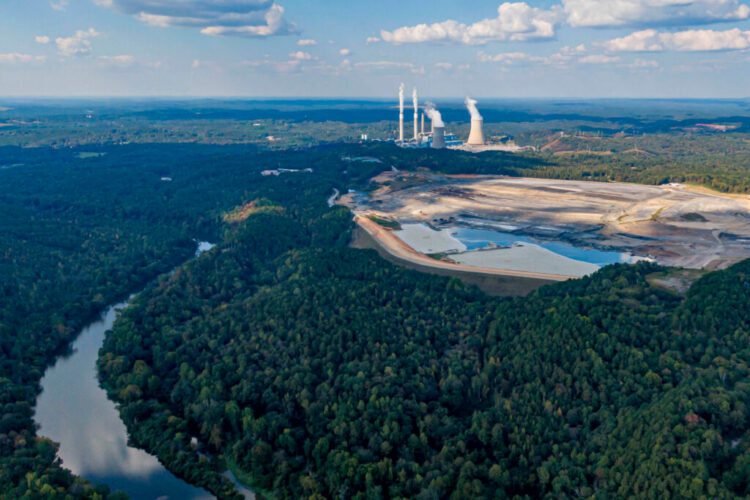
Mobile Baykeeper has long argued that a dam breach akin to the 2008 Kingston, Tennessee, disaster, or the 2014 Dan River coal ash spill in North Carolina would be catastrophic. They also say Barry is at greater risk of flooding from inland or from coastal storm systems, being located on a massive river delta near the coast.
“Honestly, with what we just saw with Hurricane Helene, I think those folks in the Carolinas are thankful they don’t have another thing to worry about because they’re already dealing with so much,” Kistler said.
Kistler said the recent settlement agreement was a start but didn’t address the “core problem” of whether the coal ash must be excavated.
“[The settlement] doesn’t mean the EPA is done,” Kistler said. “They can still take action. They’re not precluded from taking any action to deal with that most important piece of making Alabama Power clean up the coal ash pond, with a plan to actually get it out of groundwater.”
In total, Alabama Power is in the process of closing in place, or has already completed closing, an estimated 76.7 million cubic yards of coal ash at six sites around the state.
Under the cover in place option, Alabama Power drains the lagoons and compacts the remaining ash waste into a smaller area. The pile is then covered with a landfill-style impermeable liner. There is no bottom liner on the closed pond, leaving the potential for contaminants from the ash to move into groundwater.
Alabama Power says the process moves the ash material farther away from the river, and the company installs redundant dike systems meant to prevent flooding.
Frank Holleman, a senior attorney with the Southern Environmental Law Center who deals extensively with coal ash, said that Alabama remains an outlier even from neighboring states in how it handles coal ash.
“The state of Alabama has stuck out like a sore thumb in the Southeast in how poorly they have handled coal ash and what a poor job they’ve done on protecting the public and communities from coal ash pollution,” Holleman said. “Other states in the Southeast have taken a totally different approach.
“Every site like this in South Carolina either has already been or is being cleaned up and fully excavated,” he said. “Every site in the state of North Carolina, which has a lot more coal ash than Alabama: all being excavated. Every one Duke Energy has in North Carolina either has already been finished and cleaned up or is in the process. Every site Dominion has in Virginia, two thirds of Georgia Power’s coal ash [is being moved to lined landfills]. Whereas in Alabama, not one bit has been cleaned up.”
Tucker, the Alabama Power representative, said the company stands behind its proposal to cover the coal ash in place at Barry.
“We firmly believe that our operations at the Plant Barry [coal combustion residuals] surface impoundment are legal, safe and environmentally responsible,” Tucker said. “We respectfully disagree with any claims that we’ve violated CCR regulations.”
Holleman and the Southern Environmental Law Center are representing Mobile Baykeeper in a federal lawsuit against Alabama Power related to discharges from Plant Barry. The case was dismissed by a federal judge in Mobile last year, but Baykeeper is appealing that ruling. Holleman said nothing in this settlement impacts their case or prohibits EPA from taking more enforcement action against Alabama Power.
“What we can only hope is Alabama Power’s experience of having to pay a penalty, having the EPA bring enforcement activities against them, of getting sued, of ADEM getting its application denied because it’s done such a poor job in handling coal ash, that the succession of events will finally convince Alabama Power and ADEM and the other utilities in Alabama to clean up their act, and do what’s been done in South Carolina and North Carolina.”
About This Story
Perhaps you noticed: This story, like all the news we publish, is free to read. That’s because Inside Climate News is a 501c3 nonprofit organization. We do not charge a subscription fee, lock our news behind a paywall, or clutter our website with ads. We make our news on climate and the environment freely available to you and anyone who wants it.
That’s not all. We also share our news for free with scores of other media organizations around the country. Many of them can’t afford to do environmental journalism of their own. We’ve built bureaus from coast to coast to report local stories, collaborate with local newsrooms and co-publish articles so that this vital work is shared as widely as possible.
Two of us launched ICN in 2007. Six years later we earned a Pulitzer Prize for National Reporting, and now we run the oldest and largest dedicated climate newsroom in the nation. We tell the story in all its complexity. We hold polluters accountable. We expose environmental injustice. We debunk misinformation. We scrutinize solutions and inspire action.
Donations from readers like you fund every aspect of what we do. If you don’t already, will you support our ongoing work, our reporting on the biggest crisis facing our planet, and help us reach even more readers in more places?
Please take a moment to make a tax-deductible donation. Every one of them makes a difference.
Thank you,

Dennis Pillion
Reporter, Alabama
Dennis Pillion is a reporter for Inside Climate News based in Alabama. He joined ICN in 2024 after 17 years working for Alabama Media Group, including nine as the statewide natural resources reporter. His work for AL.com and The Birmingham News, won numerous Green Eyeshade and Alabama Press Association awards for his coverage of environmental issues in Alabama. He was born and lives in Birmingham, Ala.
Source link : http://www.bing.com/news/apiclick.aspx?ref=FexRss&aid=&tid=67092248287c4fa0bf5bc89160e6f5bb&url=https%3A%2F%2Finsideclimatenews.org%2Fnews%2F11102024%2Fepa-alabama-coal-ash-violations-settlement%2F&c=17635388752289907841&mkt=en-us
Author :
Publish date : 2024-10-10 22:04:00
Copyright for syndicated content belongs to the linked Source.